






Paper towels have become an essential disposable hygiene and cleaning product across residential, commercial, and institutional settings due to their high absorbency, convenience, and single-use functionality. Their widespread adoption is supported by increasing hygiene awareness, growing demand for disposable cleaning products, and expanding applications in households, healthcare facilities, foodservice establishments, and workplaces.
The superior absorbency of paper towels is attributed to their loosely bonded cellulose fiber structure, which creates microscopic capillary channels that rapidly draw in and retain liquids through capillary action and molecular adhesion. Continuous advancements in fiber technology, product durability, and sustainable manufacturing practices are further enhancing product performance while addressing growing consumer demand for environmentally responsible paper-based hygiene solutions.
Editor’s Choice
- The average American consumes approximately 40 pounds of paper towels annually, reflecting the product’s widespread use in everyday cleaning and hygiene applications.
- An average U.S. consumer uses approximately 145 rolls of paper towels each year, highlighting the country’s high per capita consumption.
- The United States accounts for nearly half of global paper towel consumption, making it the world’s largest paper towel market.
- The U.S. consumes approximately 13 billion pounds of paper towels annually, with production requiring an estimated 110 million trees and 130 billion gallons of water.
- Household spending on paper towels represents a recurring consumer expense, with purchases of standard and bulk packs collectively amounting to hundreds of dollars per year.
- Paper towel users spend approximately US$200 annually on disposable paper towels, while many households incur annual expenditures of US$400 or more.
- Lifetime spending on paper towels averages approximately US$10,500 per adult, reflecting the long-term financial impact of routine disposable paper product purchases.
- Japan consumes up to 470,000 tons of paper towels annually, with the average consumer using up to 17 boxes of paper towels per year.
- Approximately 45.3 million Americans use eight or more rolls of paper towels each month, demonstrating high consumption among heavy users.
- The average American spends 50%–60% more on paper towels than the average European and nearly 500% more than consumers in Latin America, highlighting significant regional differences in consumption patterns.
- 26% of consumers in the United Kingdom reduced their kitchen roll usage during the previous six months, primarily due to environmental concerns.
- 60% of Americans believe automated paper towel dispensers improve the perceived cleanliness of public facilities, underscoring the importance of hygiene-focused dispensing solutions in commercial and institutional environments.
General Statistics
- Americans discard approximately 3,000 tons of paper towels every day, highlighting the substantial volume of disposable paper waste generated across the country.
- Globally, paper towel disposal generates approximately 254 million tons of waste annually, equivalent to 695,000 tons of waste per day.
- An estimated 51,000 trees are required each day to replace the volume of paper towels discarded worldwide, underscoring the environmental impact of paper towel consumption.
- According to the U.S. Environmental Protection Agency (EPA), tissue paper and paper towels account for 3.8 million tons of municipal solid waste, representing 1.3% of total municipal solid waste generation.
- The production of one ton of paper towels requires approximately 17 trees and results in the pollution of 20,000 gallons of water, reflecting the resource-intensive nature of paper towel manufacturing.
- Reducing paper towel consumption by one 70-sheet roll per U.S. household each year would save approximately 544,000 trees annually.
- If every U.S. household used three fewer paper towel rolls annually, it would eliminate approximately 120,000 tons of waste and reduce landfill disposal costs by US$4.1 million.
- The global pulp and paper industry accounts for approximately 4% of total worldwide energy consumption, making it the fifth-largest industrial energy consumer.
- More than 60% of the approximately 17 billion cubic feet of timber harvested globally each year is utilized for paper and pulp production.
- The pulp and paper industry ranks as the third-largest industrial source of air, water, and land pollution in both the United States and Canada, releasing more than 100 million kilograms of toxic pollutants annually.
- An average paper towel generates approximately 7.5 grams of CO₂ emissions, while drying hands with three paper towels results in approximately 22.5 grams of CO₂ emissions.
- Each paper towel roll emits approximately 0.06 pounds of CO₂ throughout its lifecycle.
- Demand for kitchen paper towels increased by 200% during the COVID-19 pandemic, driven by heightened hygiene practices and increased household cleaning activities.
- 57% of Americans believe paper towel dispensers in public restrooms dispense more paper than necessary, reflecting growing concerns regarding product waste and dispenser efficiency.
Global Paper Towel Market Overview
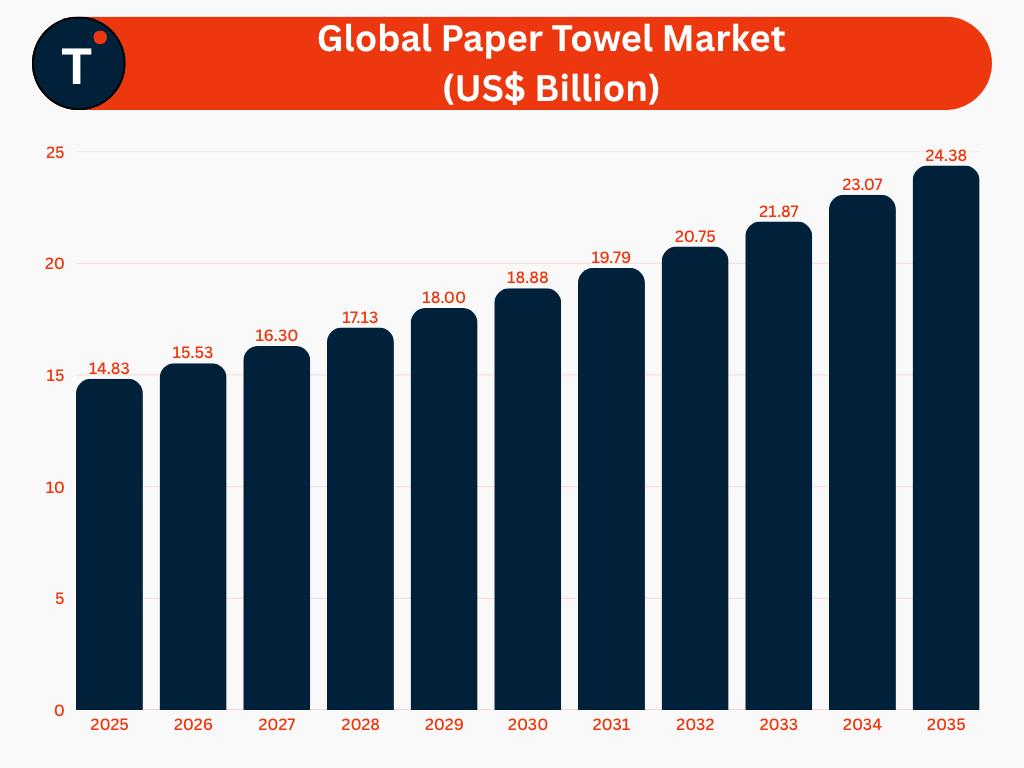
- The global paper towel market was valued at US$14.83 billion in 2025.
- The global paper towel market is projected to reach US$15.53 billion in 2026, reflecting continued growth in demand across residential and commercial applications.
- The market is expected to expand at a CAGR of 5.1% during the 2026–2035 forecast period.
- The global paper towel market is forecast to attain a value of US$24.38 billion by 2035.
Global Paper Towel Sales by Geography
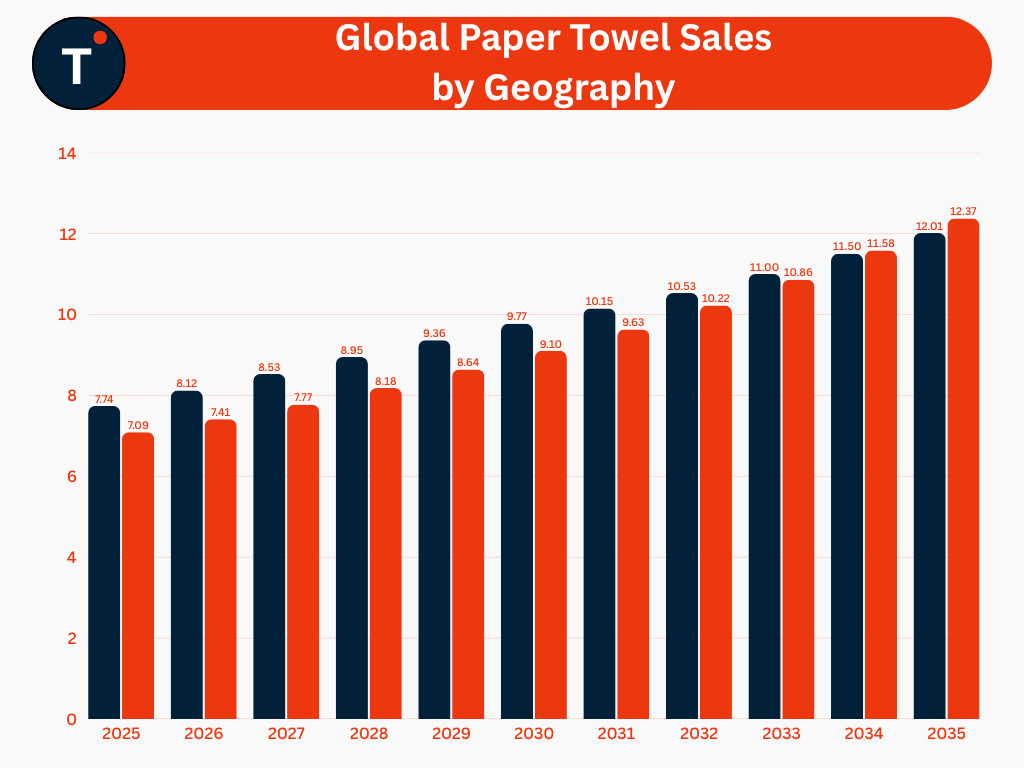
- The United States dominated the global paper towel market, accounting for 52.2% of total revenue in 2025.
- The U.S. paper towel market was valued at US$7.74 billion in 2025.
- The U.S. paper towel market is projected to reach US$8.12 billion in 2026, reflecting continued demand across household, commercial, and institutional applications.
- The U.S. paper towel market is expected to expand at a CAGR of 4.5% during the 2026–2035 forecast period.
- The U.S. paper towel market is forecast to attain a value of US$12.01 billion by 2035.
- The Rest of the World is projected to account for 50.7% of the global paper towel market by 2035, reflecting stronger growth outside the U.S. market.
- The Rest of the World paper towel market is expected to increase from US$7.09 billion in 2025 to US$12.37 billion by 2035, registering a CAGR of 5.9%.
Global Paper Towel Market by End-user
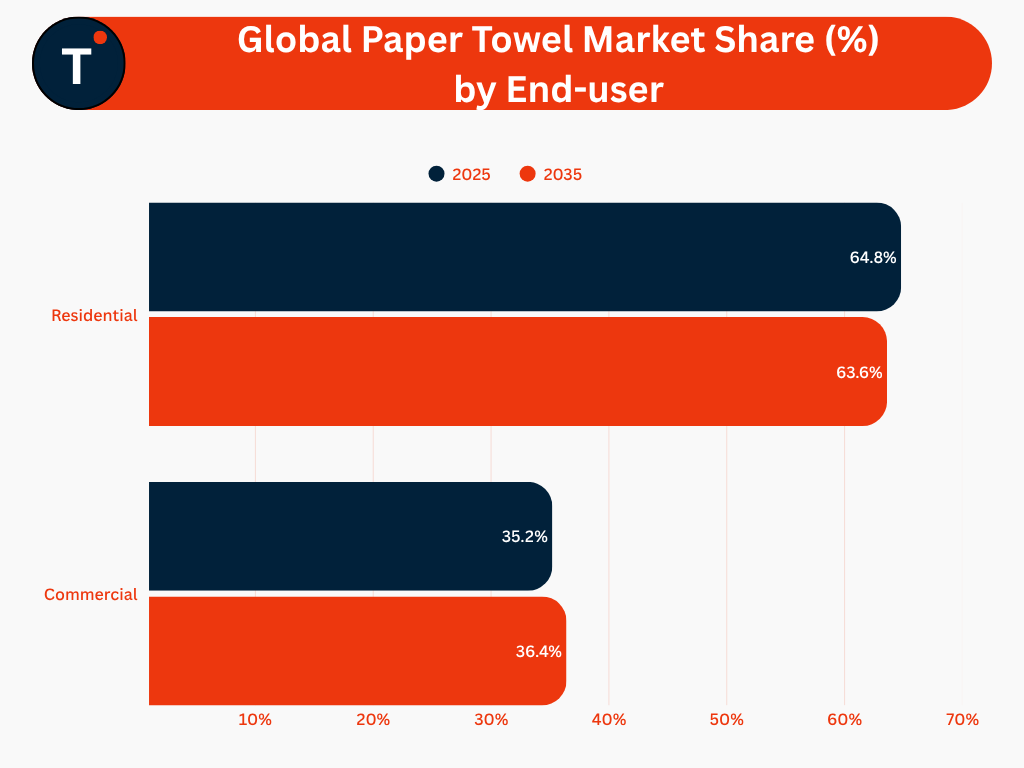
- The residential sector dominated the global paper towel market, accounting for 64.8% of total revenue in 2025.
- The residential paper towel market was valued at US$9.61 billion in 2025 and is projected to reach US$15.52 billion by 2035, expanding at a CAGR of 4.9%.
- The commercial sector accounted for 35.2% of the global paper towel market in 2025.
- The commercial paper towel segment is projected to register the fastest growth, expanding at a CAGR of 5.5% during the 2026–2035 forecast period.
- Revenue generated from commercial paper towel sales is expected to increase from US$5.21 billion in 2025 to US$8.87 billion by 2035.
Global Paper Towel Market by Distribution Channel
| Distribution Channel | 2025 (US$ Billion) | 2030 (US$ Billion) | 2035 (US$ Billion) |
| Offline | 11.30 | 14.28 | 18.05 |
| Online | 3.53 | 4.60 | 6.33 |
- The offline distribution channel dominated the global paper towel market, accounting for 76.2% of total revenue in 2025.
- Revenue generated through offline paper towel sales reached US$11.30 billion in 2025 and is projected to increase to US$18.05 billion by 2035, expanding at a CAGR of 4.8%.
- The online distribution channel is projected to register the fastest growth, with a CAGR of 6.2% during the forecast period.
- Revenue generated through online paper towel sales is expected to increase from US$3.53 billion in 2025 to US$6.33 billion by 2035.
Top Kitchen Roll-Producing Countries
- The United States is one of the leading producers of kitchen rolls, supported by its extensive pulp and paper industry, with paper and paper production reaching 72.397 million metric tons.
- China plays a significant role in the global kitchen roll market, leveraging its large-scale paper manufacturing industry. The country produces more than 128.37 million metric tons of paper and paperboard annually, making it the world’s largest paper producer.
- Germany ranks among the leading kitchen roll-producing countries, supported by its strong pulp and paper industry and position as one of Europe’s largest paper exporters, with annual paper production of 22.66 million metric tons.
- Japan maintains a prominent position in global paper production, manufacturing 26.06 million metric tons of paper annually, including approximately 0.9 million metric tons of kitchen rolls, supported by its advanced manufacturing capabilities.
Paper Towel vs. Cotton Towel
- A single cotton towel roll can replace up to 22,000 paper towels over its operational lifecycle, significantly reducing disposable paper consumption.
- Approximately 90% of used cotton towel rolls are recycled into cleaning rags and mops, supporting circular material utilization and waste reduction.
- Cotton towel rolls generate 95% less waste than paper towels produced from virgin fibers and 95.4% less waste than recycled paper towels, resulting in approximately 20 times less waste per usage cycle.
- Cotton towel rolls consume 48% less energy than virgin fiber paper towels and 40% less energy than recycled paper towels, demonstrating higher resource efficiency.
- The global warming potential of cotton towel rolls is 29% lower than paper towels manufactured from virgin fibers and 43% lower than recycled paper towels, highlighting their lower environmental impact across the product lifecycle.
Jet Air Dryers vs. Paper Towels
| Category | Jet Air Dryers | Paper Towels |
| Germ Dispersion | Jet air dryers disperse 1,300 times more germ particles than paper towels during hand drying. | Paper towels minimize germ dispersion during the drying process. |
| Bacterial Contamination | The inner surfaces of jet air dryers can harbor up to 48 times more bacteria than a toilet seat. | Drying hands with paper towels can reduce bacteria on hands by up to 77%. |
| Surface Hygiene | Coliform bacteria were detected on 52% of tested jet air dryers. | The friction created while using paper towels physically removes bacteria along with moisture. |
| Effect on Hand Bacteria | Jet air dryers can increase bacteria on fingers by up to 42% after use. | Paper towels help reduce bacterial presence through mechanical removal during drying. |
| Airborne Contamination | Water droplets containing bacteria can be dispersed up to 6.5 feet and remain suspended in the air for up to 15 minutes. | Paper towels do not generate airborne droplets, reducing the potential for cross-contamination. |
| User Preference | Lower user preference compared with paper towels in public washrooms. | 90% of users prefer paper towels over jet air dryers when given a choice of hand-drying methods. |
| Healthcare Recommendation | Not identified as the preferred method for healthcare settings. | The World Health Organization (WHO) recommends paper towels as the preferred hand-drying method in its Guidelines on Hand Hygiene in Health Care. |
| Impact on Hand Hygiene Compliance | Concerns regarding hygiene may discourage usage in sensitive environments. | Research published in the Mayo Clinic Proceedings suggests that the absence of paper towels in washrooms may reduce overall hand hygiene compliance due to strong user preference. |
Top Paper Towel Brands by Absorbency
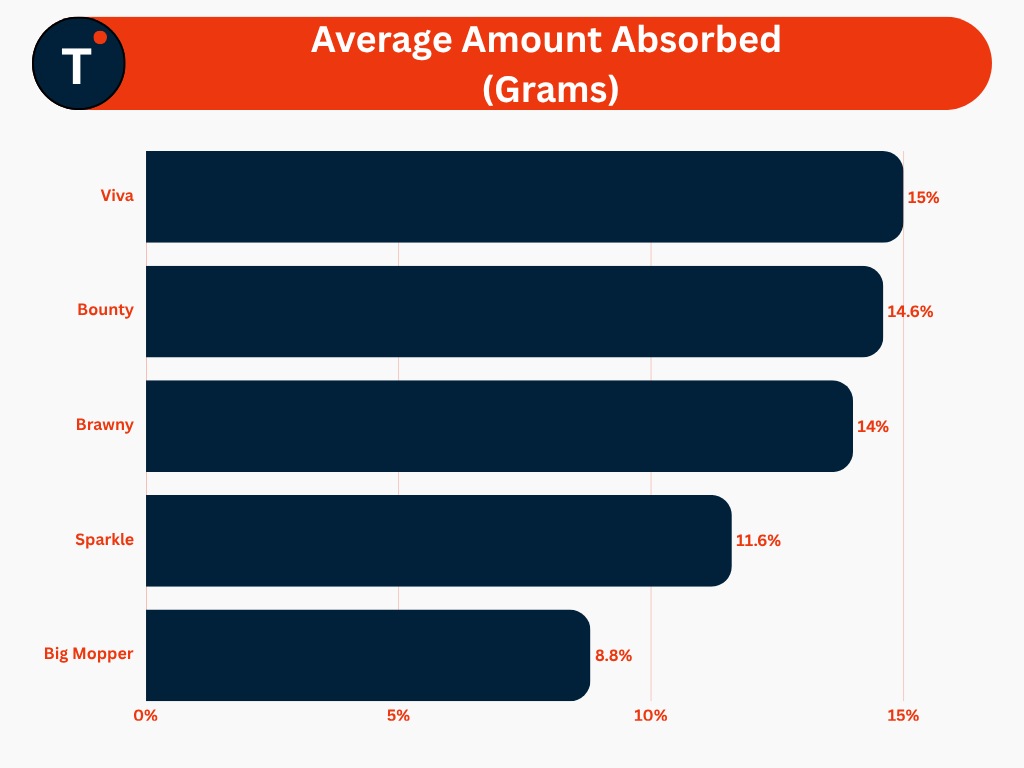
- Viva demonstrated the highest absorbency, with an average absorption capacity of 15.0 grams.
- Bounty ranked second, absorbing an average of 14.6 grams, highlighting its strong liquid retention performance.
- Brawny recorded an average absorbency of 14.0 grams, placing it among the top-performing paper towel brands.
- Sparkle achieved an average absorption capacity of 11.6 grams, providing moderate absorbency compared to the leading brands.
- Big Mopper exhibited the lowest absorbency in the comparison, with an average liquid absorption of 8.8 grams.
Perception of Paper Towels and Their Environmental Impact by Generations
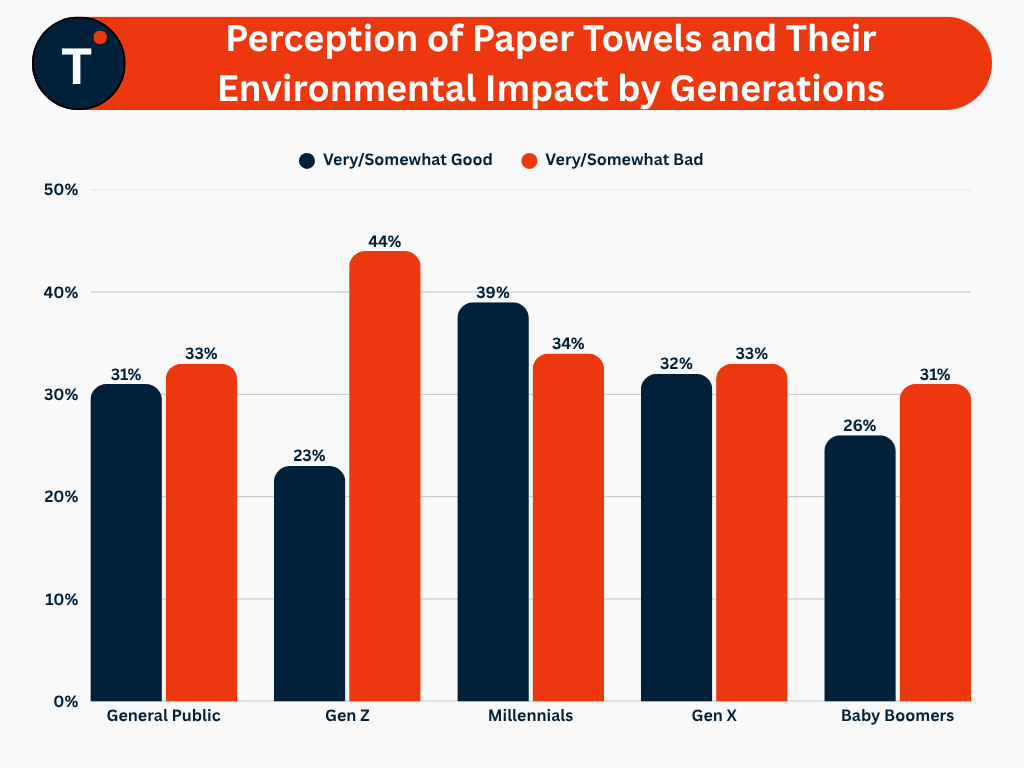
- Among the general public, 31% perceive paper towels as very or somewhat good for the environment, while 33% view them as very or somewhat bad, indicating a slightly more negative overall perception.
- Generation Z holds the most negative environmental perception of paper towels, with 44% considering them very or somewhat bad, compared with 23% viewing them positively.
- Millennials are the only generation where positive perceptions outweigh negative views, with 39% considering paper towels environmentally favorable, compared with 34% expressing a negative perception.
- Generation X exhibits a nearly balanced perception, with 32% viewing paper towels positively and 33% holding a negative opinion regarding their environmental impact.
- Baby Boomers also demonstrate a relatively negative outlook, with 31% perceiving paper towels as environmentally harmful, compared with 26% viewing them favorably.
Recent Industry Developments
- In June 2026, Essity expanded its Tork PaperCircle closed-loop recycling service in the United Kingdom, driven by increasing demand for circular economy solutions. During 2025, the service’s customer base grew by 33%, while the volume of recycled paper hand towels increased by 67%, surpassing 100 million hand towels annually.
- In May 2026, Yuhan-Kimberly introduced the world’s first biodegradable and reusable nonwoven paper towel made with amorphous PHA, representing a significant advancement in sustainable paper towel technology.
- In March 2026, Kimberly-Clark Professional partnered with the Columbus Blue Jackets, resulting in the installation of new paper towel, toilet paper, soap, and hand sanitizer dispensing systems throughout Nationwide Arena to enhance hygiene standards.
- In October 2025, Tork expanded its portfolio of high-capacity paper hand towel dispensers by launching an automatic dispenser capable of dispensing at least 500,000 paper towels per battery set, improving operational efficiency in high-traffic facilities.
- In September 2025, The Navigator Company expanded its paper towel portfolio with the launch of Amoos Max, a compact roll designed to deliver enhanced performance, convenience, and sustainability.
- In June 2025, Sellars invested US$15 million to establish a new production facility in Milwaukee, strengthening its manufacturing capacity for paper towels, shop towels, wipers, and absorbent products.
- In May 2025, Brawny introduced its new 3-Ply Paper Towels, positioned as the only premium 3-ply paper towel in the market and designed to deliver superior strength, absorbency, and durability.
- In April 2025, Sellars launched its Bravo paper towel product while advancing a broader manufacturing expansion strategy, reinforcing its commitment to product innovation and production capacity growth within the paper towel market.
Conclusion
- The paper towel market is expected to maintain steady growth, supported by increasing demand across residential, commercial, healthcare, hospitality, and foodservice sectors, along with continued emphasis on hygiene and convenience.
- The United States remains the largest paper towel market globally, accounting for more than half of global revenue, driven by high per capita consumption, widespread household adoption, and strong demand from institutional and commercial end users.
- Sustainability has become a key industry focus, encouraging manufacturers to invest in recyclable materials, biodegradable products, circular economy initiatives, and resource-efficient production technologies to reduce environmental impact.
- Product innovation continues to strengthen market competitiveness, with leading manufacturers introducing higher-performance, more absorbent, and environmentally friendly paper towel products while expanding manufacturing capacity and strategic partnerships.
- Growing awareness of hygiene, particularly in public and healthcare environments, continues to reinforce paper towels as the preferred hand-drying solution, supporting long-term demand despite increasing environmental considerations.