








What Is Soda Ash?
Soda ash, commonly known as sodium carbonate (Na₂CO₃), is a water-soluble inorganic compound and a weak base that dissociates into sodium (Na) and carbonate (CO₃) ions in solution. It is an essential industrial chemical with applications across glass manufacturing, cleaning agents, water treatment, steel production, textiles, pulp and paper, food additives, renewable energy, and battery production.
While lithium carbonate currently represents a relatively small end-use for soda ash, demand from this application is growing rapidly, supported by the expansion of electric vehicles (EVs) and energy storage technologies.
The growing solar industry is also reshaping soda ash consumption patterns. Solar glass used in photovoltaic (PV) panels has emerged as the fastest-growing application, driven by increasing solar installations worldwide.
Glass manufacturing remains the largest area of soda ash consumption, with flat glass accounting for the largest glass category globally. Flat glass is widely used in residential and commercial construction and automotive glazing, followed by container glass for food and beverage packaging. Other applications include tableware, lighting, display screens, mirrors, fiber optics, and insulation fiberglass.
Editor’s Picks
- Global soda ash demand reached 67.63 million tons in 2025 and is projected to rise to 84.84 million tons by 2035, reflecting a volume CAGR of 2.3%.
- The global soda ash market was valued at US$18.65 billion in 2025 and is expected to grow to US$25.87 billion by 2035, at a value CAGR of 3.4%.
- US consumption of soda ash totaled 5.36 million tons in 2025 and is forecast to reach 6.49 million tons by 2035, registering a volume CAGR of 1.9%.
- The US soda ash market generated US$1.48 billion in 2025, with its value anticipated to increase to US$1.98 billion by 2035 at a CAGR of 3.0%.
- Glass manufacturing remains the largest end-use application for soda ash, accounting for approximately 60.9% of worldwide consumption.
- Domestic soda ash production in the United States reached an estimated 12 million tons in 2025, up 3% from 2024, with the total value of output estimated at US$1.8 billion.
- The US soda ash industry comprised four companies operating five plants in Wyoming and one company operating a single plant in California, with the five producers together having a nameplate capacity of 13.9 million tons per year.
- Exports accounted for more than 50% of total U.S. soda ash production in 2025.
- China retained its position as the world’s largest soda ash producer in 2025, with output estimated at 38 million tons, the majority of which was produced synthetically.
- China, the United States, and Turkey collectively represented approximately 80% of global soda ash production.
- Soda ash prices in the United States climbed from around US$263.61 per metric ton in April to US$295.75 per metric ton in May, marking an increase of approximately 12.2%.
General Statistics
- The first natural soda ash operation in the United States began in 1868 near Fallon, Nevada.
- Synthetic processes, primarily the Solvay-Ammonia and Hou processes, account for most global soda ash production. However, natural soda ash production is expanding through new projects in mainland China, Turkey, and the United States.
- Soda ash is a crystalline substance with a melting point of 851°C and a boiling point of 1,600°C, providing the thermal stability required for a wide range of industrial applications.
- Global soda ash production capacity is expected to increase by around 16 MMTPA between 2023 and 2030, rising from 71.5 MMTPA to approximately 88 MMTPA.
- Mainland China recorded domestic soda ash demand growth of 18% in 2024, following 10% growth in 2023, primarily driven by rising solar glass production. The 2024 growth added approximately 5.6 million metric tons to the country’s soda ash consumption.
- Mainland China’s solar glass production capacity is expected to increase from 52 million metric tons in 2024 to approximately 56 million metric tons in 2025.
- The Inner Mongolia Berun natural soda ash project completed its ramp-up and reached a production capacity of 5 million metric tons. During the same period, mainland China added more than 5.5 million metric tons of Hou-based synthetic soda ash capacity.
- Lithium carbonate currently accounts for 3.2% of global soda ash demand but represents 20% of demand in South America, where it is projected to become the largest end-use application in 2025. Soda ash imports into South America also increased by 11% year on year during the first four to six months of the year.
- Natural soda ash is derived from trona and sodium carbonate-rich brines, with the world’s largest trona deposit located in Wyoming’s Green River Basin. Of the region’s estimated 56 billion tons of bedded trona and 47 billion tons of interbedded or intermixed trona and halite in beds exceeding 1.2 meters in thickness, approximately 47 billion tons of soda ash resources have been identified as recoverable.
How Much Soda Ash Does the United States Produce?
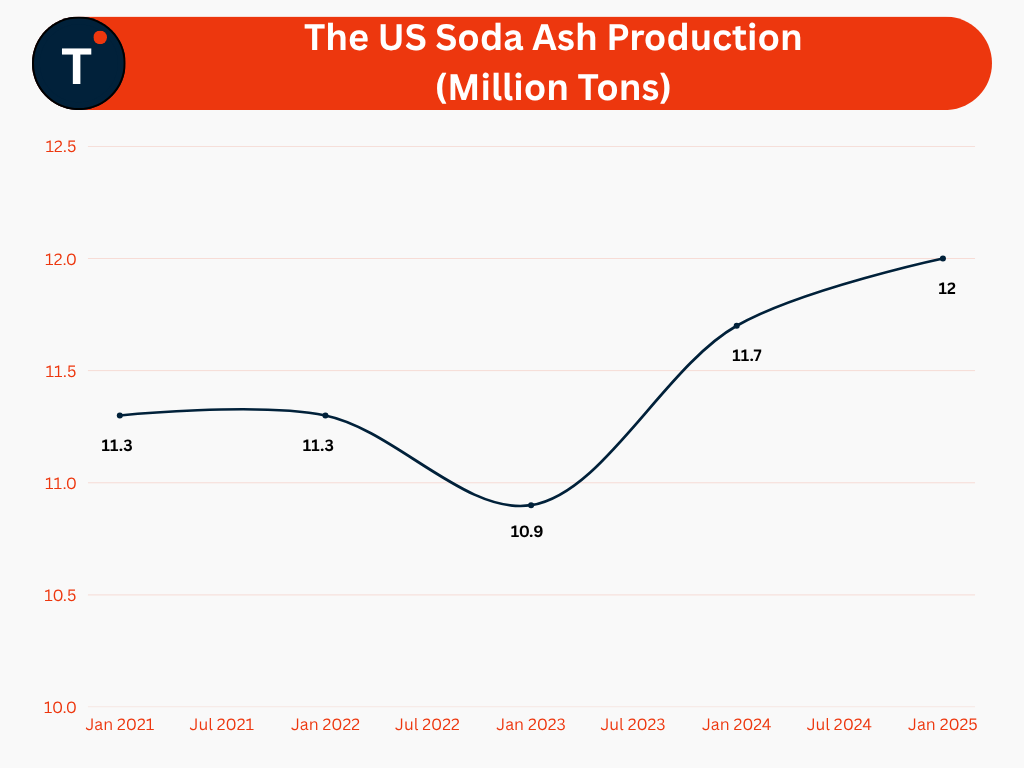
- US soda ash production remained stable at 11.3 million tons in both 2021 and 2022.
- Production declined to 10.9 million tons in 2023 before recovering to 11.7 million tons in 2024.
- US soda ash production reached 12.0 million tons in 2025, representing the highest level recorded during the 2021–2025 period.
How Much Soda Ash Is Consumed in the United States?
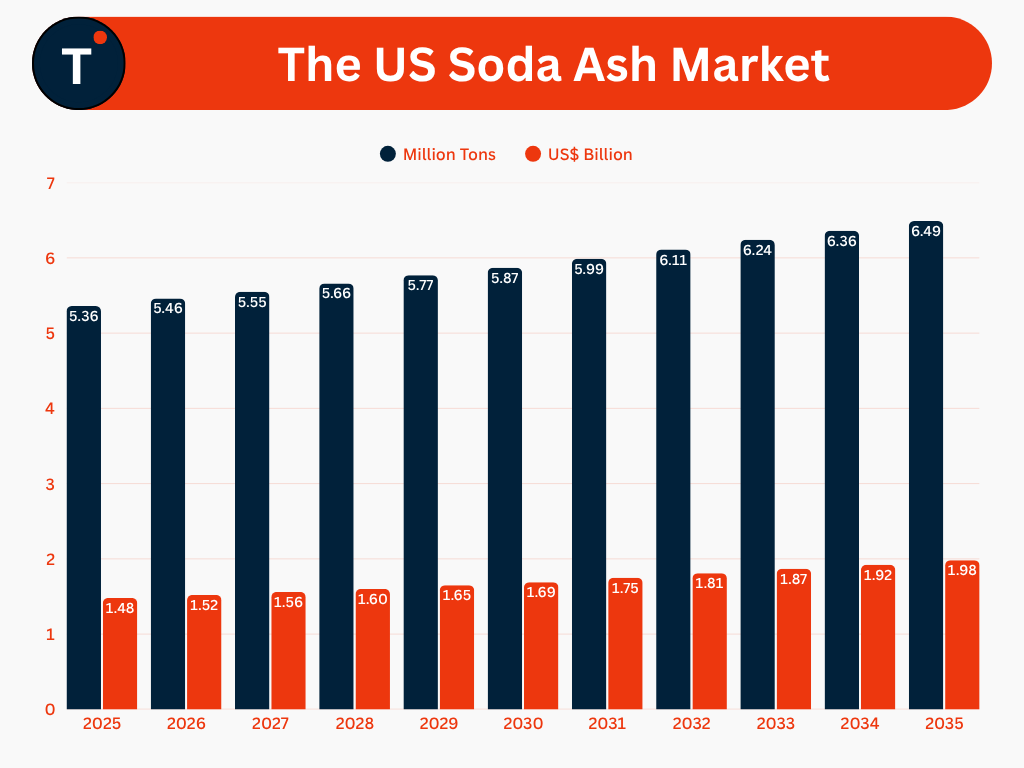
- The United States consumed 5.36 million tons of soda ash in 2025, with the market valued at US$1.48 billion.
- US soda ash demand is expected to reach 5.46 million tons in 2026, with a corresponding market value of US$1.52 billion.
- By 2035, the US soda ash market is projected to reach 6.49 million tons, valued at US$1.98 billion.
Soda Ash Supply Statistics
- China has witnessed some of the most significant near-term expansions in soda ash capacity, including 5.0 million metric tons of new low-cost natural soda ash production that began ramping up in mid-2023.
- In the United States, Genesis accounted for the largest recent capacity additions, with approximately 1.2 million metric tons of capacity becoming operational by the end of 2023.
- By 2028, global soda ash capacity is scheduled to expand by 18.0 million metric tons, with China accounting for 61% of the planned additions and the United States contributing 34%.
- US soda ash exports increased by 11% year-on-year in 2024, supported by a 72% surge in shipments to mainland China. The trend reversed through May 2025, when US exports declined by 3% and no shipments were recorded to mainland China.
- According to Longzhong Information, China exported a cumulative 1.9612 million tons of soda ash between January and November 2025, representing year-on-year growth of 88.82%. Imports during the same eleven-month period totaled only 21,700 tons, declining by 97.76% year-on-year.
- As of January 12, 2026, China’s domestic soda ash inventories held by manufacturers totaled 1.5647 million tons, declining by 0.80 thousand tons, or 0.51%, compared with the preceding week. Light soda ash inventories increased by 0.75 thousand tons to 844.00 thousand tons, while heavy soda ash inventories declined by 15,500 tons to 720,700 tons, indicating a slow overall destocking process.
- The soda ash production-to-sales ratio weakened significantly during the same period, with the shipment rate falling to 78.18%, down 26.15 percentage points from the preceding week, reflecting persistently weak terminal demand.
- The global soda ash capacity mix is gradually shifting toward natural production, with natural soda ash projected to account for 22% of total worldwide capacity by 2028.
How Much Soda Ash Is Consumed Worldwide?
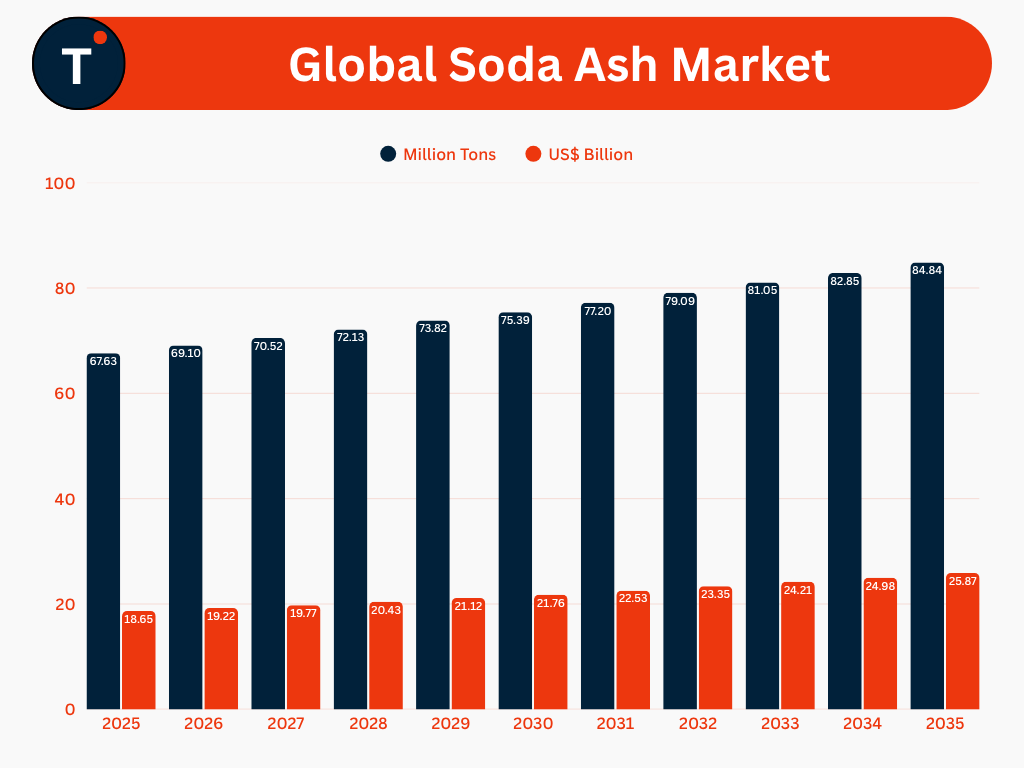
- Global soda ash consumption totaled 67.63 million tons in 2025, valued at US$18.65 billion.
- Worldwide demand for soda ash is projected to reach 69.10 million tons in 2026, with a market value of US$19.22 billion.
- By 2035, the global soda ash market is expected to reach 84.84 million tons, valued at US$25.87 billion.
Which Types of Soda Ash Are Available in the Market?
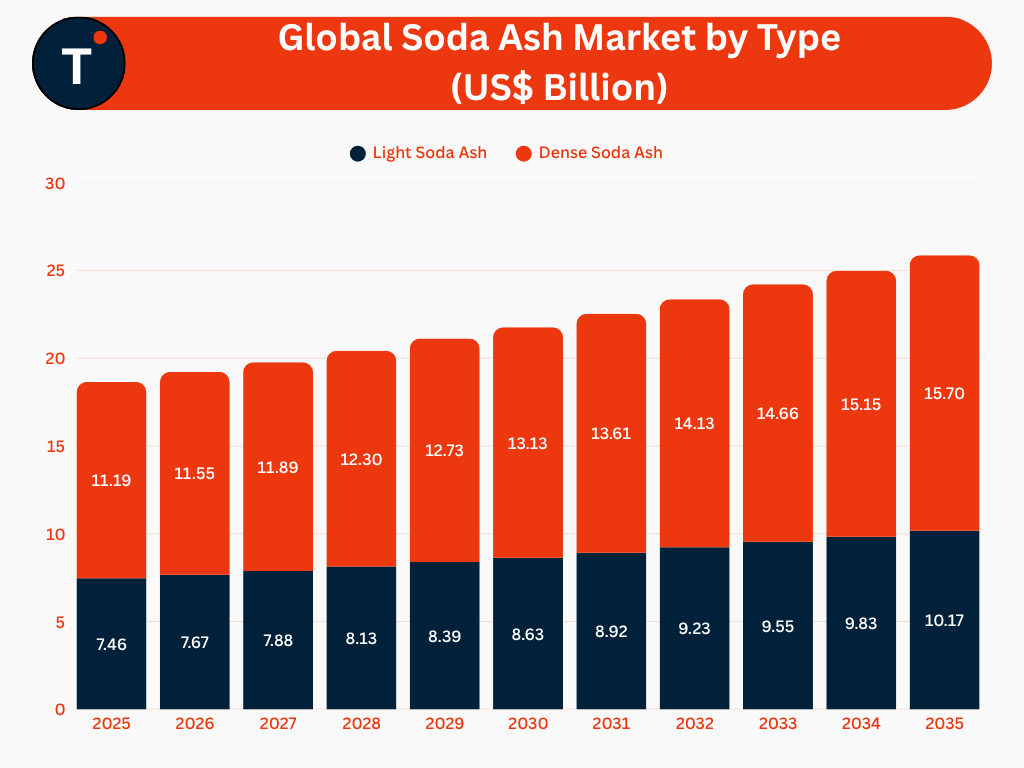
- Dense soda ash accounted for 60% of the global soda ash market in 2025, making it the dominant product type.
- The dense soda ash market was valued at US$11.19 billion in 2025 and is projected to reach US$15.70 billion by 2035, expanding at a CAGR of 3.5%.
- Light soda ash represented 40% of total soda ash consumption in 2025.
- The light soda ash market stood at US$7.46 billion in 2025 and is expected to reach US$10.17 billion by 2035, growing at a CAGR of 3.2%.
What Are the Major Applications of Soda Ash?
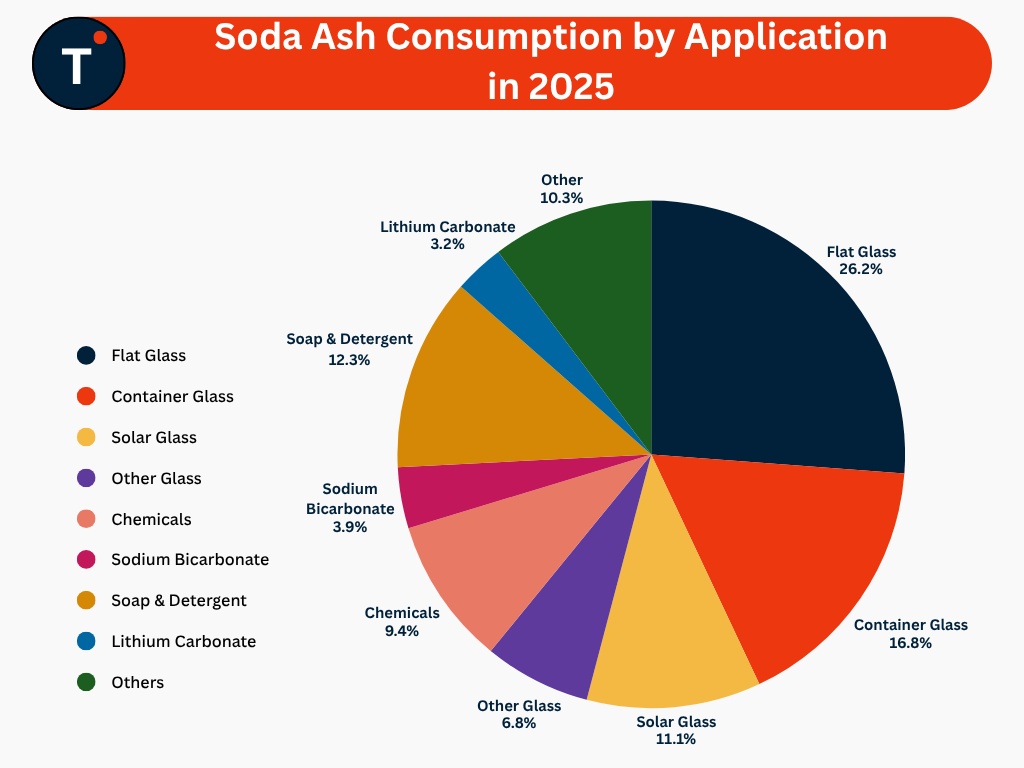
- Flat glass was the largest application of soda ash in 2025, accounting for 26.2% of the market. Soda ash demand for flat glass applications was valued at US$4.89 billion in 2025 and is projected to reach US$6.77 billion by 2035, expanding at a CAGR of 3.3%.
- Container glass accounted for 16.8% of the global soda ash market in 2025. Soda ash demand from container glass production was valued at US$3.13 billion in 2025 and is expected to reach US$4.26 billion by 2035, growing at a CAGR of 3.1%.
- Solar glass represented 11.1% of the soda ash market in 2025. The soda ash market for solar glass applications was valued at US$2.07 billion in 2025 and is projected to reach US$3.28 billion by 2035, registering a CAGR of 4.9%.
- Other glass applications held a 6.8% share of the global soda ash market in 2025. Soda ash consumption across other glass applications was valued at US$1.27 billion in 2025 and is expected to reach US$1.66 billion by 2035, expanding at a CAGR of 2.7%.
- Chemical applications accounted for 9.4% of the global soda ash market in 2025. Soda ash demand from chemical applications was valued at US$1.75 billion in 2025 and is anticipated to reach US$2.36 billion by 2035, growing at a CAGR of 3.0%.
- Sodium bicarbonate accounted for 3.9% of the soda ash market in 2025. Soda ash used for sodium bicarbonate production was valued at US$0.73 billion in 2025 and is projected to reach US$0.97 billion by 2035, at a CAGR of 2.9%.
- Soap and detergent applications captured a 12.3% share of the market in 2025. The soda ash market for soap and detergent applications was valued at US$2.29 billion in 2025 and is expected to reach US$3.15 billion by 2035, expanding at a CAGR of 3.2%.
- Lithium carbonate accounted for 3.2% of global soda ash demand in 2025 and is expected to record the fastest growth among the listed applications, at a CAGR of 5.3%. Soda ash demand for lithium carbonate production was valued at US$0.60 billion in 2025 and is projected to reach US$0.98 billion by 2035.
- Other applications collectively represented 10.3% of the soda ash market in 2025. Soda ash demand across these applications was valued at US$1.92 billion in 2025 and is expected to reach US$2.44 billion by 2035, growing at a CAGR of 2.4%.
Which Regions Are Driving Growth in the Soda Ash Market?
| Region | 2025 (US$ Bn) | 2030 (US$ Bn) | 2035 (US$ Bn) |
| North America | 1.92 | 2.19 | 2.54 |
| Europe | 2.83 | 3.20 | 3.68 |
| Asia Pacific | 11.78 | 13.97 | 16.88 |
| Middle East & Africa | 0.95 | 1.11 | 1.31 |
| Latin America | 1.16 | 1.29 | 1.46 |
- Asia Pacific dominated the global soda ash market in 2025, accounting for a 63.2% market share.
- The Asia Pacific soda ash market was valued at US$11.78 billion in 2025 and is projected to reach US$16.88 billion by 2035, expanding at a CAGR of 3.7%.
- Europe emerged as the second-largest regional market, holding a 15.2% share in 2025.
- Europe’s soda ash market stood at US$2.83 billion in 2025 and is estimated to reach US$3.68 billion by 2035, growing at a CAGR of 2.7%.
- The North America soda ash market is anticipated to grow from US$1.92 billion in 2025 to US$2.54 billion by 2035, registering a CAGR of 2.9%.
- Latin America’s soda ash market was valued at US$1.16 billion in 2025 and is projected to reach US$1.46 billion by 2035, at a CAGR of 2.4%.
- The Middle East & Africa soda ash market is expected to increase from US$0.95 billion in 2025 to US$1.31 billion by 2035, expanding at a CAGR of 3.3%.
How Much Does Soda Ash Cost per Ton?
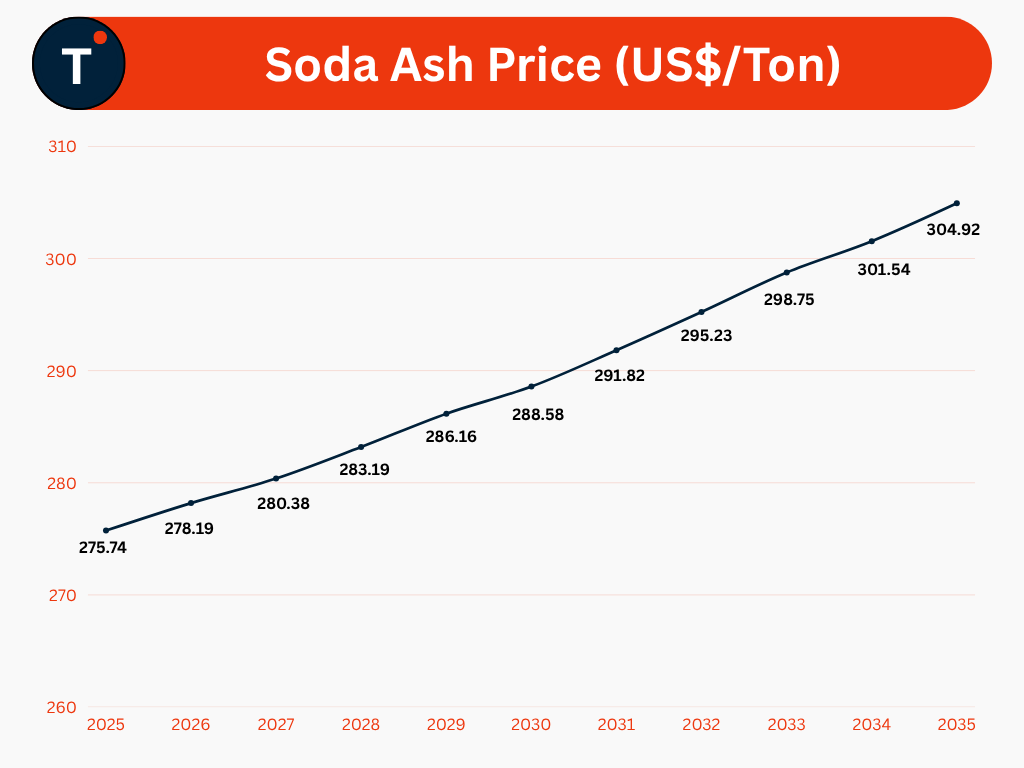
- The average FOB price of soda ash stood at US$275.74 per ton in 2025.
- The average soda ash price is expected to reach US$278.19 per ton in 2026.
- By 2035, the average price of soda ash is projected to increase to US$304.92 per ton.
Recent Developments
- In August 2026, Tata Chemicals North America (TCNA) took over soda ash customer contracts from Searles Valley Minerals (SVM) USA, covering supply commitments of more than 500,000 metric tonnes between September 2026 and December 2028. The transaction was valued at US$21.16 million and is expected to generate more than US$110 million in revenue, expanding TCNA’s customer network in the North American soda ash industry.
- In June 2026, the European Patent Office (EPO) confirmed the validity of Solvay’s European patent EP 3 971 138 B1 (“EP ’138”) after reviewing an opposition filed by WE Soda Ltd on February 13, 2025. Following oral hearings on May 19, 2026, the patent was maintained with limited amendments, while the ruling remains open to appeal.
- In February 2026, Solvay announced plans to reduce the soda ash production capacity of its Torrelavega facility in Spain from 600 kilotons to 420 kilotons, with implementation planned for the third quarter of 2026 following the required consultation process. The move is aimed at improving the competitiveness of the company’s global production assets.
- In February 2026, RSPL Group secured environmental approval to expand production capacity at its SOKA soda ash manufacturing facility in Gujarat. The expansion will allow the plant to increase its annual production capacity from 500,000 tons to one million tons.
- In February 2025, WE Soda Ltd finalized the purchase of Genesis Alkali, the largest producer of natural soda ash in the United States, from Genesis Energy LP. The acquisition was completed as a cash transaction with an implied enterprise value of US$1.425 billion, including working capital at the time of closing.
Conclusion
- The global soda ash market is set to maintain steady growth through 2035, supported by established demand from glass manufacturing and other major industrial applications.
- Asia Pacific continues to lead the market, while solar glass and lithium carbonate are emerging as important growth areas alongside traditional applications.
- Global supply dynamics are evolving through capacity expansions, particularly in China and the United States, with natural soda ash accounting for an increasing share of future production capacity.
- International trade patterns remain an important factor in the industry, as changing export flows between major producing and consuming countries continue to influence the global supply balance.
- Recent investments, acquisitions, capacity expansions, and operational adjustments by companies such as Tata Chemicals North America, Solvay, RSPL Group, and WE Soda highlight the industry’s ongoing efforts to strengthen production capabilities, market positions, and long-term competitiveness.