








Job satisfaction reflects the degree to which employees feel fulfilled, engaged, and satisfied with their roles and overall work experience. Key determinants of job satisfaction include compensation, benefits, workplace relationships, career growth opportunities, and the overall work environment. Employees with higher levels of job satisfaction are more likely to align with organizational values, demonstrate stronger engagement, maintain greater attention to detail, and contribute positively to overall business performance.
Editor’s Picks
- Overall job satisfaction in the United States reached 68.9% in 2026, increasing from 68.3% in 2025 and reflecting continued improvement in workforce sentiment.
- Job satisfaction has increased for 16 consecutive years, rising from a low of 42.6% in 2010 following the Great Recession.
- Satisfaction across individual job attributes averaged 59%, indicating that positive overall sentiment may coexist with concerns related to compensation, career advancement, and employee benefits.
- The most significant gender-based differences in job satisfaction were observed in wages (+7.2 percentage points), health plans (+7.0 percentage points), pension and retirement benefits (+6.3 percentage points), and promotion policies (+6.2 percentage points).
- 39.3% of employees reported that the use of advanced artificial intelligence (AI) tools enhanced their overall job satisfaction.
- 6.7% of employees indicated that AI adoption negatively impacted job satisfaction, highlighting the importance of effective implementation, workforce support, and employee training.
- Job satisfaction levels varied considerably by income, ranging from 45.3% among workers in households earning less than US$25,000 annually to 76.0% among those earning US$150,000 or more.
- Employees in households earning less than US$50,000 annually reported the lowest levels of engagement, workplace belonging, and intention to remain with their employer.
- The Western United States recorded the highest concentration of quality jobs, with 44% of workers employed in quality positions, followed by the Northeast (39%), South (38%), and Midwest (36%).
General Statistics
- 43% of individuals identify having meaningful employment as their greatest source of happiness, underscoring the importance of purpose-driven work.
- The global average job satisfaction score stands at 7.1, reflecting moderate to high levels of employee satisfaction worldwide.
- More than 50% of full-time employees are actively seeking new employment opportunities that offer higher compensation.
- Employees with high levels of job satisfaction remain with their employers 7 times longer than dissatisfied employees, highlighting the strong relationship between satisfaction and retention.
- More than 50% of Millennials have left a job due to a misalignment between personal values and organizational values.
- 40% of individuals globally consider meaningful work to be their primary source of happiness, surpassing the importance placed on job security.
- 77% of employees believe that positive relationships with coworkers contribute significantly to overall job satisfaction.
- 59% of employees express satisfaction with their direct managers, indicating the critical role of leadership in shaping workplace experiences.
- 46% of employees are satisfied with their relationships and interactions with colleagues.
- Only 34% of employees report satisfaction with their compensation, making pay one of the lowest-rated aspects of the employee experience.
- 33% of employees express satisfaction with promotion and career advancement opportunities.
- 62% of job seekers prioritize salary and benefits when evaluating employment opportunities.
- 70% of employees believe they are underpaid relative to their responsibilities and contributions.
- 61% of Americans perceive corporate executives as disconnected from the challenges faced by employees.
- 55% of employees believe chief executive officers receive excessive compensation relative to the broader workforce.
- Wages and salaries increased by 3.9% during the 12-month period ending June 2025, reflecting continued growth in employee compensation.
- The Consumer Price Index (CPI) increased by 2.9% during the 12-month period ending August 2025, indicating ongoing inflationary pressures.
- 46% of employees would consider leaving their employer if required to return to the office on a full-time basis, highlighting the growing importance of workplace flexibility.
Shift Worker Job Satisfaction Statistics
- 78.9% of shift workers reported feeling positive at the end of their shifts, representing an increase of nearly 0.5 percentage points compared to the previous year.
- The share of workers reporting negative experiences declined to 5.9%, down from 6.6%, indicating improving sentiment among shift-based employees.
- Among generational cohorts, Generation Alpha recorded the highest positive sentiment at 88.88%, followed by Generation Z at 78.42%.
- The hospitality sector achieved the highest positive rating among major industries at 82.98%, with retail closely following at 82.62%.
- Healthcare recorded the lowest positive rating among the major sectors analyzed, with 72.89% of workers reporting positive experiences.
- The gambling industry achieved a 100% positive rating, making it the highest-rated subsector for shift worker satisfaction.
- Other top-performing subsectors included firearms stores (89.53%), cafes and coffee shops (89.50%), and accommodation services (84.09%).
- Employees in cafes and coffee shops recorded the highest share of “amazing” workplace experiences, with 72.64% reporting exceptionally positive shifts.
- The highest levels of negative sentiment were observed among workers in tobacco, e-cigarette, and marijuana stores (13.34%), followed by animal health services (13.07%) and care facilities (11.55%).
- At the state level, Rhode Island recorded the highest positive shift-worker rating, while Alaska (95.35%) ranked second and Hawaii (92.89%) ranked third.
- The highest levels of negative sentiment were reported in Arkansas (12.68%), New Hampshire (12.31%), and the District of Columbia (11.11%).
Gender Disparities in Job Satisfaction
- Male employees reported higher satisfaction levels across 26 of 27 job satisfaction factors, indicating a consistent gender gap in workplace perceptions.
- Female employees reported lower satisfaction than male employees across nearly all measured job satisfaction dimensions.
- Work-life balance was the only category in which female employees reported higher satisfaction levels than their male counterparts.
- Female employees trailed male employees in 21 of 27 job satisfaction metrics, with the largest gaps observed in compensation, bonus structures, and retirement benefits.
- Only 33% of female employees indicated that their current salary adequately supports their desired lifestyle, compared with 50% of male employees.
- Average salary increases were lower for female employees, with annual pay raises of 2.7%, compared with 4.8% for male employees.
- 47% of female employees reported experiencing stress related to their typical workday, compared with 41% of male employees.
- Personal and family-related stress was reported by 45% of female employees, significantly higher than the 32% reported by male employees.
- Burnout-related turnover intentions were more prevalent among female employees, with 39% considering leaving their employer due to burnout, compared with 30% of male employees.
Job Satisfaction by Generation
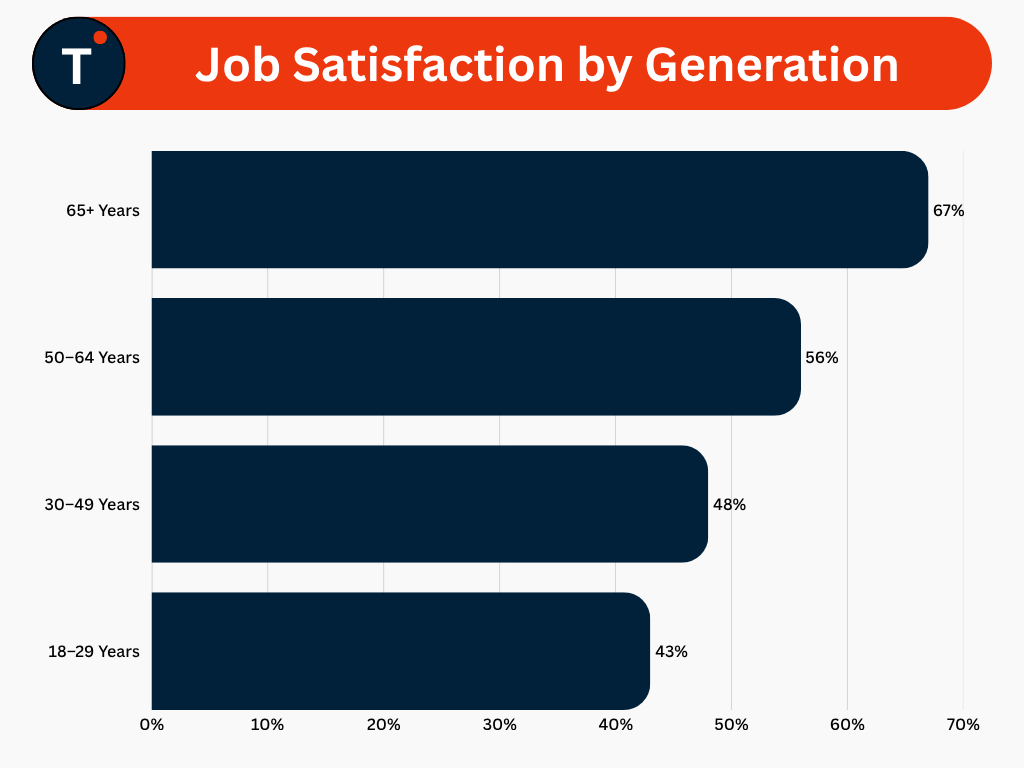
- Employees aged 65 years and above report the highest level of job satisfaction, with 67% expressing satisfaction with their jobs.
- Workers in the 50–64 age group record a job satisfaction rate of 56%, ranking second among the generations analyzed.
- Employees aged 30–49 years report a job satisfaction level of 48%, indicating a moderate degree of workplace satisfaction.
- The 18–29 age group records the lowest job satisfaction rate at 43%, highlighting comparatively lower levels of workplace contentment among younger workers.
Global Employee Engagement
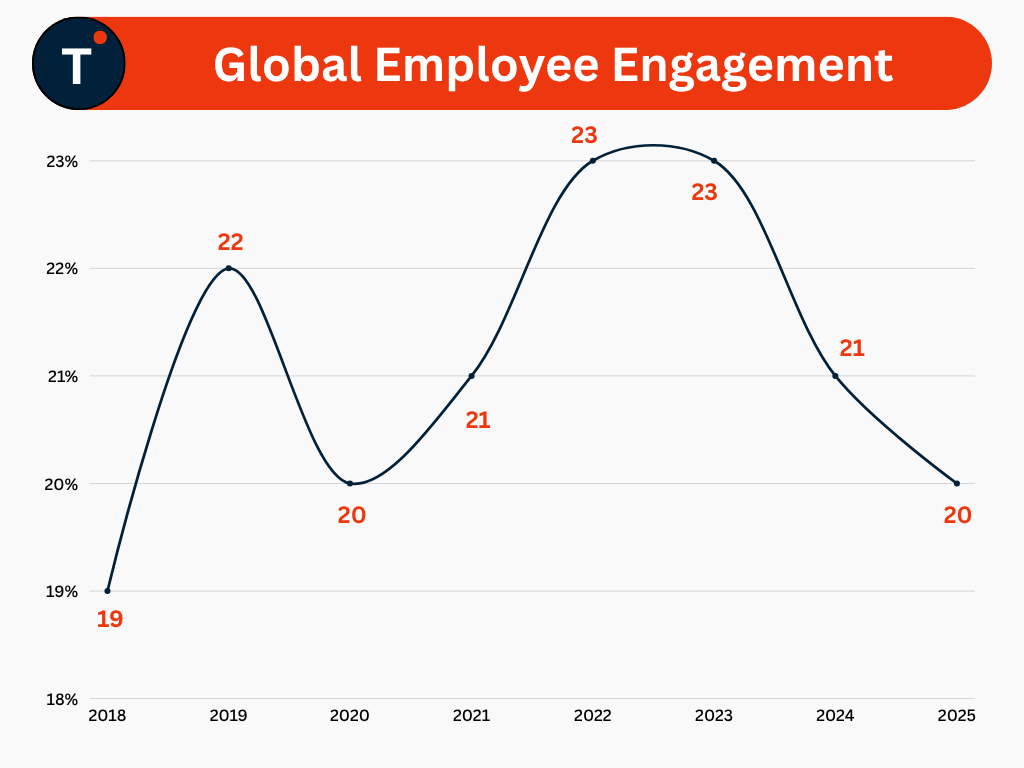
- Global employee engagement declined to 20%, down from a peak of 23% in 2022, indicating a weakening level of workforce engagement worldwide.
- Low employee engagement is estimated to cost the global economy US$10 trillion in lost productivity, equivalent to 9% of global GDP.
- Improvements in job market optimism during 2025 were driven entirely by non-remote-capable, fully on-site employees, whose optimism increased by 2 percentage points.
- Job market optimism declined significantly in Australia and New Zealand (-12 percentage points) and the United States and Canada (-10 percentage points) during 2025.
- Only 34% of U.S. employees are actively engaged in their work, highlighting substantial opportunities for organizations to strengthen workforce engagement.
- 91% of highly engaged employees report satisfaction with professional development opportunities, underscoring the strong relationship between career growth and employee engagement.
- 70% of organizations have implemented values-based employee recognition programs as part of their engagement and retention strategies.
- Organizations with high and sustainable employee engagement levels achieve operating margins that are up to 3 times higher than those with low or unsustainable engagement levels.
- An Ohio-based manufacturing company reported a 24% increase in profits following the implementation and measurement of employee engagement initiatives.
Digital Marketer Job Satisfaction Statistics
- 94.8% of digital marketing professionals report overall satisfaction with their careers, reflecting strong positive sentiment toward the profession.
- Despite high career satisfaction levels, 45.8% of professionals lack sufficient financial reserves to cover 1 month of living expenses without regular employment income.
- Nevada ranks as the leading U.S. state for marketing professionals, achieving a composite score of 73.0. Advertising and public relations firms account for 0.601% of all businesses in the state, supported by strong demand from the hospitality, gaming, and entertainment sectors.
- 35.2% of professionals identify inadequate compensation as the primary contributor to burnout, anxiety, and workplace stress.
- 32.5% cite frequent platform and algorithm changes as a major source of professional pressure.
- 31.0% experience stress associated with the continuous need to learn and adapt to new tools and technologies.
- 29.6% express concerns regarding the potential impact of artificial intelligence on role stability and long-term career prospects.
- 28.8% identify layoff concerns and job security risks as significant workplace stressors.
- Only 9.8% report no work-related stress, indicating that workplace pressures remain prevalent across the profession.
Reasons for Employee Dissatisfaction
- Compensation ranks as the leading source of employee dissatisfaction, accounting for 77% of workforce concerns.
- Career advancement opportunities remain a challenge for 76% of employees, highlighting persistent barriers to professional growth.
- Employee-management communication gaps are evident across 75% of the workforce.
- Recognition of employee performance falls short for 74% of employees.
- Trust in senior leadership remains limited among 73% of employees.
- Job security concerns are prevalent across 68% of the workforce.
- Overall job-related dissatisfaction extends to 66% of employees.
- Supervisor-employee relationships present challenges for 60% of the workforce.
- Job burnout affects 40% of U.S. workers, underscoring the growing impact of workplace stress and well-being challenges.
Importance of Work-Life Balance
- 26% of employees leave their jobs due to work-life balance challenges, highlighting its growing influence on workforce retention.
- Work-life balance is considered essential to job satisfaction by 95% of workers, making it one of the most important factors shaping the employee experience.
- 83% of employees view flexible working hours as a key contributor to workplace satisfaction and long-term engagement.
- Organizations that prioritize employee mental health achieve higher satisfaction levels, with 70% of workers reporting a more positive workplace experience in supportive environments.
- Employee satisfaction rates are 25% higher in organizations that actively promote work-life balance compared to those with limited support initiatives.
Workplace Flexibility Trends
- 46% of employees would consider seeking new employment opportunities if remote work options were no longer available, underscoring the growing importance of workplace flexibility.
- 49% of workers report high satisfaction with their ability to determine when they work, highlighting the value placed on flexible scheduling arrangements.
- Remote work flexibility remains a challenge, with only 37% of workers highly satisfied with their ability to work remotely.
- 32.6 million Americans currently work remotely, reflecting the continued adoption of flexible work models across industries.
- 40% of employees are willing to accept lower compensation in exchange for greater workplace flexibility, demonstrating the increasing importance of work-life integration in employment decisions.
- Flexible work arrangements are available in 24% of newly posted jobs, indicating that flexibility has become a key component of talent attraction and recruitment strategies.
| Work Mode | Satisfaction Level |
| Hybrid Workers | 65% |
| Fully Remote Workers | 64% |
| In-Person Workers | 60% |
- Hybrid workers report the highest job satisfaction level at 65%, indicating that a blended work model offers the strongest balance between flexibility and workplace engagement.
- Fully remote workers record a job satisfaction level of 64%, reflecting the continued appeal of remote work arrangements.
- In-person workers report a job satisfaction level of 60%, the lowest among the work arrangements analyzed.
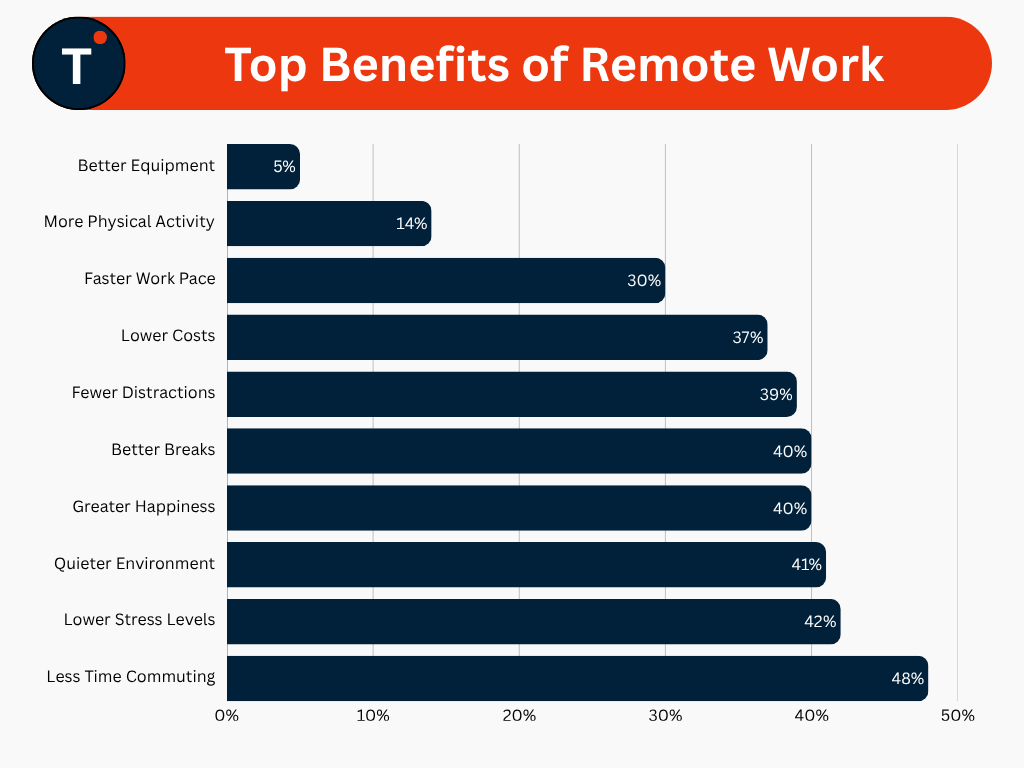
- 48% of employees identify reduced commuting time as the most significant advantage of remote work, highlighting the value of time savings and improved convenience.
- 42% associate remote work with lower stress levels, reflecting its positive impact on employee well-being.
- A quieter work environment benefits 41% of employees, supporting improved concentration and productivity.
- 40% value the ability to take better breaks throughout the workday, contributing to enhanced work-life integration.
- 40% associate remote work with greater overall happiness, underscoring its role in improving employee satisfaction.
- 39% benefit from fewer workplace distractions, enabling a more focused work environment.
- 37% cite lower personal expenses as a key advantage, reflecting cost savings associated with remote work arrangements.
- A faster work pace is experienced by 30% of employees, indicating productivity gains in remote settings.
- 14% associate remote work with increased physical activity and greater flexibility in managing personal wellness.
- 5% identify access to better equipment as a benefit of remote work, making it the least-cited advantage among those analyzed.
Workplace Mental Health Support Statistics
- 92% of employees consider organizational commitment to emotional and psychological well-being an important factor in the workplace, including 57% who view it as very important.
- 92% place importance on access to employer-provided mental health support, with 52% rating it as very important.
- 95% view workplace respect as an essential component of the employee experience, including 66% who consider it very important.
- 95% emphasize the importance of maintaining clear boundaries between work and personal life, with 61% assigning high importance to this factor.
- Mental health and substance use disorder coverage is available through employer-sponsored health insurance plans for 43% of employees.
- A workplace culture that actively encourages breaks is available to 35% of employees.
- 29% have access to Employee Assistance Programs (EAPs) through their employer.
- 21% benefit from meeting-free days designed to support focus and well-being.
- 17% have access to 4-day workweek arrangements.
- Company-wide mental health days are offered to 15% of employees.
- On-site personnel with mental health training are available in workplaces representing 12% of employees.
Consequences of Low Job Satisfaction
- Organizations incur annual financial losses ranging from US$450 billion to US$550 billion due to disengaged and dissatisfied employees.
- 65% of employees report experiencing some level of job dissatisfaction, highlighting the widespread nature of workplace disengagement.
- 33% of employees are considering leaving their current employer within the next year as a result of job dissatisfaction.
- Companies with elevated levels of employee dissatisfaction experience a 25% increase in workforce turnover rates.
- Dissatisfied employees contribute to significant productivity losses, resulting in an average of 15 lost workdays per employee annually.
- Replacing employees carries substantial financial implications, with replacement costs ranging from 50% to 200% of an employee’s annual salary.
- Absenteeism associated with low job satisfaction leads to a 20% decline in team productivity.
- Only 40% of dissatisfied employees express commitment to their current employer, indicating weakened organizational loyalty.
- Employees experiencing low job satisfaction are 50% more likely to avoid optional company events, professional development programs, and training opportunities.
- 30% of dissatisfied employees do not envision remaining in their current role beyond the next 2 years, reflecting elevated retention risks.
- Organizations with high levels of employee dissatisfaction experience a 20% reduction in overall productivity.
- Unengaged employees spend an average of 2 hours per day without being fully focused on their work responsibilities, contributing to lower operational efficiency.
Future of Work and Workforce Transformation Statistics
- The global labor market is projected to achieve a net employment gain of 78 million jobs by 2030, driven by the creation of 170 million new roles and the displacement of 92 million existing positions.
- Skill requirements are evolving rapidly, with changes occurring 66% faster in AI-exposed occupations than in roles with limited exposure to artificial intelligence.
- Professionals possessing AI-related skills command a 56% salary premium, representing a substantial increase from 25% in the previous year.
- Wage growth in AI-intensive industries is occurring at twice the rate observed in less AI-exposed sectors, highlighting the technology’s role in enhancing workforce productivity and value creation.
- 44% of employees prioritize access to upskilling and reskilling opportunities, indicating the growing importance of continuous learning in career decisions.
- Leadership responsibilities continue to present challenges, with 40% of managers experiencing a decline in mental health following promotion into management roles.
- Workplace authenticity remains a concern, with 63% of employees concealing aspects of their identity or personality at work, up from 55% in the previous year.
- Employee well-being demonstrates a strong relationship with job satisfaction, as 45% of individuals who exercise daily report loving their job, compared with 28% among those who exercise less than once per month.
- Industries with the highest capacity to leverage artificial intelligence generate 3 times greater revenue growth per employee than industries with lower AI adoption potential.
Conclusion
- Job satisfaction remains a critical determinant of workforce engagement, productivity, retention, and overall organizational performance.
- Compensation, career development opportunities, leadership quality, workplace flexibility, and work-life balance continue to be the primary factors shaping employee satisfaction levels.
- Organizations that prioritize employee well-being, mental health support, recognition, and professional development consistently achieve stronger engagement and higher satisfaction outcomes.
Flexible work arrangements, including hybrid and remote models, have emerged as important drivers of employee satisfaction and talent retention.
Add TriCityLocalNews as a Preferred Source on Google for instant updates!