






Dropshipping is an eCommerce fulfillment model in which retailers sell products without maintaining inventory. Instead, when a customer places an order, the retailer purchases the product from a third-party supplier, who is responsible for processing, packaging, and shipping the order directly to the customer. This fulfillment approach eliminates the need for inventory storage and warehouse management while enabling businesses to streamline order fulfillment, reduce operational costs, and improve scalability.
Editor’s Choice
- 1.5% of dropshipping stores generate monthly revenue exceeding US$50,000, highlighting the highly competitive nature of the market.
- 80.9% of the top 1% of dropshipping stores primarily serve the U.S. market, followed by Canada (5.2%) and the U.K. (4.1%).
- Clothing products accounted for 16% of all products sold through Shopify dropshipping stores, making it one of the leading product categories.
- DSers, CJdropshipping, and Zendrop ranked as the most widely adopted dropshipping applications.
- DSers led the market with 185,000 installations, followed by CJdropshipping (71,000) and Zendrop (31,000).
- 7% of dropshipping stores have implemented upselling or cross-selling applications to increase average order value.
- Free shipping remains the leading online purchase driver, cited by 49.8% of consumers.
- The TikTok Pixel is installed on 35% of dropshipping stores, reflecting the growing importance of social commerce and digital advertising.
- 27% of active dropshipping stores were established in 2022.
- 45% of active dropshipping stores were launched in 2021 or earlier, indicating a relatively mature seller base.
- 175,000 new dropshipping stores were created during the first quarter of 2023.
- 25% of the top 1% of dropshipping stores offer between 250 and 999 products, while 4.5% sell fewer than 10 products.
- Electronics and media is projected to be the fastest-growing product category in the U.S. dropshipping market, registering a CAGR of 28.7%.
- 27.2% of dropshipping stores maintain product catalogs containing fewer than 10 products.
- 85% of the top 1% of dropshipping stores offer at least one product priced above US$100.
- 57.4% of the top 1% of dropshipping stores have installed more than 10 applications, reflecting greater investment in store optimization.
- 5% of dropshipping stores utilize a page builder, with PageFly being the most widely adopted solution.
General Statistics
- Products addressing specific consumer problems achieve 2.2x higher success rates in dropshipping and Amazon FBA markets.
- 60% of dropshipping sellers prefer suppliers offering U.S. or European shipping to improve delivery speed and customer satisfaction.
- Private suppliers sourced through agent networks or platforms such as Zendrop generate 25%–35% higher average profit margins than conventional suppliers.
- A 3x markup over product cost remains the standard benchmark for evaluating the profitability of print-on-demand (POD) and dropshipping products.
- More than 60% of Amazon sales are generated by independent sellers. In 2025, U.S. independent sellers averaged more than US$375,000 in annual sales, while over 75,000 sellers exceeded US$1 million in annual sales.
- 57.6% of internet users aged 16–64 make online purchases every week, highlighting strong consumer engagement in eCommerce.
- 34% of dropshipping stores have implemented an email marketing application, with Shopify Inbox and Klaviyo being the most widely adopted platforms.
- 55% of dropshipping stores utilize Meta Pixel to monitor visitor behavior and optimize digital marketing performance.
- 32% of dropshipping stores have integrated a Pinterest Tag to strengthen marketing and advertising strategies.
- Dawn is the most widely used Shopify theme, adopted by 30.6% of dropshipping stores, followed by Debut (7.5%) and Warehouse (7.3%).
- Dropshipping businesses implementing structured customer retention programs achieve 5.4x higher customer lifetime value than acquisition-focused businesses.
- 29% of dropshipping businesses have adopted subscription models, resulting in an average 427% increase in customer lifetime value.
- Post-purchase email engagement campaigns increase repeat purchase rates by 73%, demonstrating the effectiveness of customer retention strategies.
Global Dropshipping Market Highlights
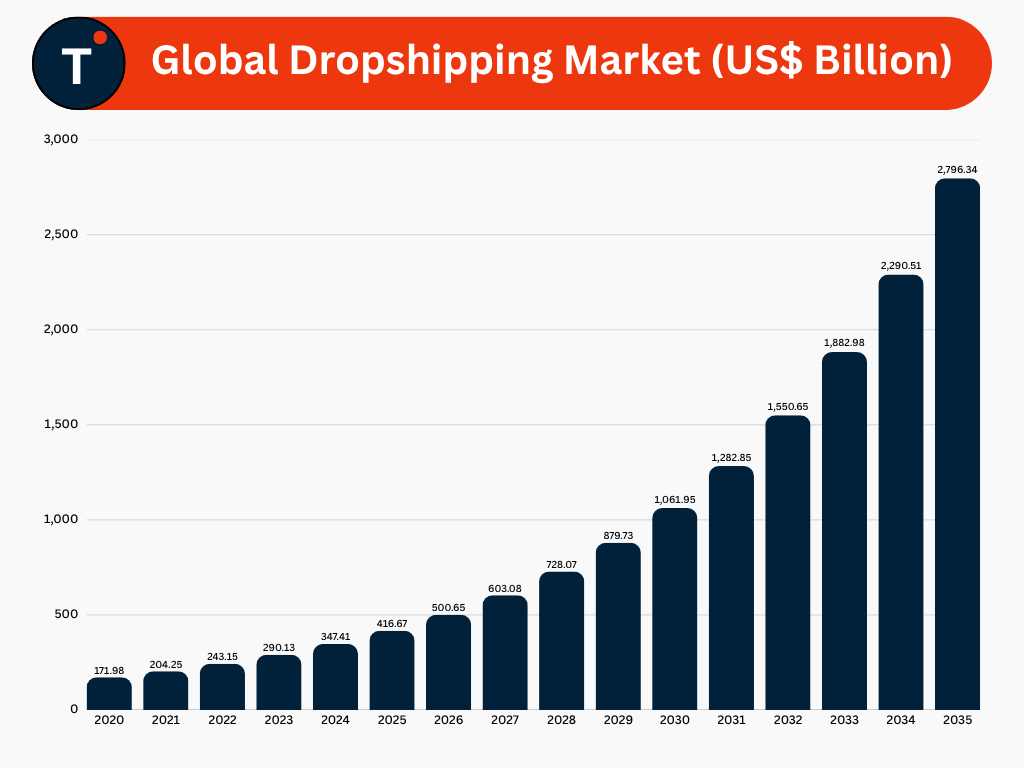
- The global dropshipping market is projected to grow from US$416.67 billion in 2025 to US$500.65 billion in 2026, reflecting strong year-over-year market expansion.
- The global dropshipping market is anticipated to register a CAGR of 21.1% during the forecast period, reaching US$2,796.34 billion by 2035.
Dropshipping Market Revenue Split by Geographies:
| Region | Market Share in 2025 | Market Share in 2035 |
| North America | 36.1% | 35.6% |
| Europe | 23.6% | 20.8% |
| Asia Pacific | 32.6% | 38.3% |
| Middle East & Africa | 3.5% | 2.6% |
| Latin America | 4.1% | 2.7% |
- North America dominated the global dropshipping market, accounting for 36.1% of total market revenue in 2025.
- The North American dropshipping market is projected to grow from US$150.61 billion in 2025 to US$996.86 billion by 2035, registering a CAGR of 20.9%.
- The United States was the largest contributor to the North American market, accounting for 72.1% of regional revenue in 2025.
- The U.S. dropshipping market was valued at US$108.59 billion in 2025 and is expected to reach US$737.68 billion by 2035, expanding at a CAGR of 21.2%.
- Asia Pacific is projected to be the fastest-growing regional market, registering a CAGR of 23.1% during the forecast period.
- The Asia Pacific dropshipping market is expected to grow from US$135.93 billion in 2025 to US$1,071.27 billion by 2035.
- Europe accounted for 23.6% of the global dropshipping market in 2025, with a market value of US$98.43 billion.
- The European dropshipping market is projected to reach US$580.48 billion by 2035, expanding at a CAGR of 19.4%.
Product Category Performance
- Eco-friendly and sustainable products have recorded a 98% increase in dropshipping sales since 2021, reflecting growing consumer preference for environmentally conscious products.
- Fashion and accessories accounted for 28% of total dropshipping revenue, making it the largest product category despite intense market competition.
- Home and garden products contributed 18% of market revenue, supported by higher average order values and lower competition within niche segments.
- Electronics and accessories represented 15% of total revenue, driven by strong consumer demand despite ongoing quality and warranty challenges.
- Smart home devices and IoT products emerged as the fastest-growing product category, achieving 87% year-over-year sales growth.
- Health and beauty products accounted for 12% of market revenue, supported by increasing consumer demand and expanding product offerings.
- Health and wellness products focused on stress relief, sleep improvement, and immune support recorded 73% growth in dropshipping sales.
- Pet products represented 8% of total market revenue, benefiting from strong customer loyalty and high repeat purchase rates.
- Pet products designed for specific breeds and exotic pets experienced a 62% increase in sales, reflecting growing niche market demand.
- Baby and kids’ products accounted for 7% of market revenue, with supplier quality and product safety remaining key purchasing considerations.
- Sports and outdoor products contributed 6% of total revenue, supported by seasonal demand and active consumer communities.
- Automotive accessories represented 4% of market revenue, benefiting from higher average order values and specialized niche demand.
- Product categories with a total addressable market (TAM) between US$10 million and US$100 million demonstrate the strongest profitability potential for dropshipping businesses.
- Personalized and customizable products generate 34% higher profit margins than standard products, highlighting the growing demand for customized consumer offerings.
Online Purchase Drivers in the United States
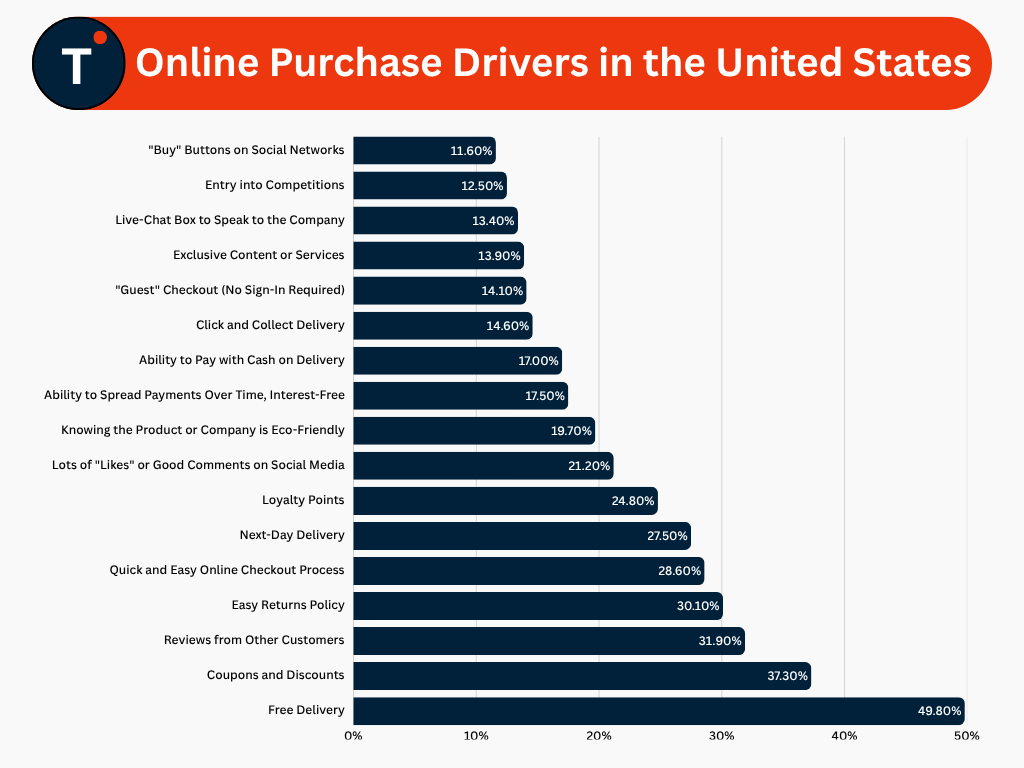
- Free delivery was the leading online purchase driver, cited by 49.8% of consumers.
- Coupons and discounts influenced 37.3% of online purchase decisions.
- Customer reviews were considered important by 31.9% of shoppers when making purchasing decisions.
- Easy return policies influenced 30.1% of consumers.
- A quick and easy online checkout process was preferred by 28.6% of shoppers.
- Next-day delivery influenced 27.5% of online purchase decisions.
- Loyalty points and rewards programs were valued by 24.8% of consumers.
- Positive social media engagement, including likes and comments, influenced 21.2% of shoppers.
- Eco-friendly products and companies were preferred by 19.7% of consumers.
- Interest-free installment payment options influenced 17.5% of online purchases.
- Cash on delivery was preferred by 17.0% of consumers.
- Click-and-collect delivery influenced 14.6% of shoppers.
- Guest checkout options were preferred by 14.1% of consumers.
- Exclusive content or services influenced 13.9% of purchase decisions.
- Live chat support was considered important by 13.4% of shoppers.
- Entry into competitions or giveaways influenced 12.5% of consumers.
- Social media “Buy” buttons influenced 11.6% of online purchase decisions.
Dropshipper Income and Profit Margin Statistics
- Beginner dropshippers typically generate US$0–US$2,000 in monthly income, equivalent to US$0–US$24,000 annually.
- Intermediate dropshippers generally earn US$2,000–US$10,000 per month, translating to US$24,000–US$120,000 in annual income.
- Advanced dropshippers typically achieve monthly earnings of US$10,000–US$50,000 or more, corresponding to annual income exceeding US$120,000, with top performers earning more than US$600,000 annually.
| Experience Level | Monthly Revenue | Cost of Goods Sold | Other Fees (ads, payment, apps) | Net Profit / Income |
| Beginner | $3,000 – $8,000 | $2,000 – $5,500 | $800 – $1,500 | $0 – $2,000 |
| Intermediate | $15,000 – $40,000 | $10,000 – $28,000 | $3,000 – $6,000 | $2,000 – $10,000 |
| Advanced | $60,000 – $200,000+ | $40,000 – $140,000 | $10,000 – $25,000+ | $10,000 – $50,000+ |
- Most dropshippers generate their first sale within 7–14 days of launching their online store.
- The majority of dropshippers require 6–12 months to achieve monthly revenue between US$5,000 and US$10,000.
- Scaling a dropshipping business beyond US$10,000 in monthly revenue generally requires more than six months of operational experience, increased advertising investment, and a strong emphasis on maintaining net profit margins.
Supplier and Fulfillment Statistics
- Fulfillment speed and delivery reliability remain the primary factors differentiating high-performing dropshipping businesses from lower-performing competitors.
- AliExpress suppliers typically offer standard delivery times of 15–30 days.
- U.S.-based suppliers generally provide delivery within 3–7 business days, improving customer experience and order satisfaction.
- Local warehouse fulfillment enables delivery within 2–5 business days, supporting faster order completion.
- Customer satisfaction reaches 85%–92% with fast shipping, compared with 55%–65% for slower delivery services.
- Stores offering faster shipping experience return rates of 5%–8%, while slower shipping methods are associated with return rates of 15%–25%.
- AliExpress remains the most widely used sourcing platform, adopted by 65% of dropshippers.
- U.S. and European local suppliers, supported by platforms such as Spocket and CJdropshipping, represent the fastest-growing sourcing channel in the dropshipping market.
Consumer Behavior and Demographic Trends
- 64% of dropshipping customers expect delivery within 3–5 days, compared with 7–10 days considered acceptable in 2020.
- 58% of consumers prefer to know whether a product is being fulfilled through dropshipping before making a purchase.
- 78% of shoppers review estimated delivery times before completing an online purchase.
- Providing order tracking information reduces customer support inquiries by 30%–40%, improving the post-purchase experience.
- 76% of Gen Z and Millennial consumers are willing to pay a 10%–15% premium for products offered by brands that align with their social values.
- Gen Z adoption rates are 35%–45% higher than those of older consumer demographics.
- Millennial spending in the dropshipping market increased 18% year-over-year.
- Customer reviews influence 89% of purchasing decisions, while products rated below 4.2 stars experience 63% lower conversion rates.
- Mobile commerce accounted for 75% of dropshipping sales in 2025, increasing from 58% in 2020, with iOS users spending 26% more per order than Android users.
- Consumers aged 25–34 represented the largest customer segment, accounting for 31% of dropshipping purchases, followed by 35–44-year-olds at 27%.
- Suburban consumers generated 52% of dropshipping purchases, followed by urban areas (29%) and rural locations (19%).
- Female consumers accounted for 56% of dropshipping purchases, while male consumers recorded a 23% higher average order value.
- Consumers aged 55 and above represented the fastest-growing demographic, with 47% year-over-year growth, primarily driven by purchases in health, wellness, and home improvement categories.
- Hispanic and Latino consumers recorded the highest engagement with dropshipping stores, with purchase frequency 37% above the overall average.
- The average cart abandonment rate in dropshipping ranged from 75% to 82%, primarily due to shipping time concerns.
- Branded dropshipping stores achieved repeat purchase rates of 15%–25%, compared with 5%–10% for generic stores.
Retail and eCommerce Integration
- 25% of global online sales are fulfilled through the dropshipping business model, highlighting its growing role in the eCommerce ecosystem.
- 29% of eCommerce businesses worldwide have adopted dropshipping as part of their retail operations.
- 67% of traditional retailers have implemented or plan to implement dropshipping to strengthen their omnichannel strategies.
- Major online marketplaces, including Amazon and Walmart, continue to expand their dropshipping programs, with Amazon reporting a 43% increase in dropshipping partners in 2023.
- 29% of online retailers reported that dropshipping improved profit margins by at least 30% through reduced inventory and warehousing costs.
- Cross-border dropshipping transactions increased by 54% in 2025, while 62% of consumers indicated a willingness to purchase products from international sellers.
- 72% of successful dropshippers operate across multiple sales platforms, reflecting the growing importance of omnichannel selling strategies.
Technology and Automation Trends
- 79% of successful dropshippers utilize automated order processing systems, reducing manual errors by 94%.
- Automated pricing optimization tools increase profit margins by an average of 23% through dynamic pricing strategies.
- 62% of dropshipping businesses have adopted AI-powered customer service solutions, with chatbots handling 47% of customer inquiries.
- 47% of top-performing dropshippers use AI-powered product selection tools, with 83% reporting improved product and inventory decisions.
- Predictive analytics enables dropshipping businesses to reduce advertising expenditure by an average of 31% through more accurate audience targeting and campaign optimization.
- 59% of successful dropshipping stores utilize AI-generated product descriptions, resulting in 27% higher conversion rates compared with standard supplier content.
- Machine learning-based fraud detection systems reduce chargeback rates by 67%, improving transaction security and operational efficiency.
- Dropshipping businesses leveraging advanced automation technologies operate with 57% fewer employees while managing 3.2 times more products than businesses relying on manual processes.
- Real-time inventory synchronization technology reduces out-of-stock incidents by 83%, improving inventory visibility and order fulfillment accuracy.
Marketing Channel Performance
- Paid advertising remains the primary driver of dropshipping revenue, with social media platforms leading customer acquisition efforts.
- Facebook and Instagram advertising are utilized by 72% of dropshipping businesses, generating an average return on ad spend (ROAS) of 2x–4x.
- TikTok advertising is adopted by 45% of dropshippers and represents the fastest-growing marketing channel, delivering an average ROAS of 2.5x–5x.
- Google Shopping is used by 38% of dropshipping businesses, generating an average ROAS of 3x–6x for established stores.
- Influencer marketing is adopted by 15%–25% of dropshippers, delivering an average ROAS of 3x–8x when campaigns are effectively targeted.
- Email marketing contributes 20%–30% of total revenue for established dropshipping stores, while email capture tools such as spin-wheel pop-ups achieve opt-in rates of 5%–12%.
- The average customer acquisition cost (CAC) for dropshipping businesses ranges between US$15 and US$35.
Biggest Challenges for Dropshippers
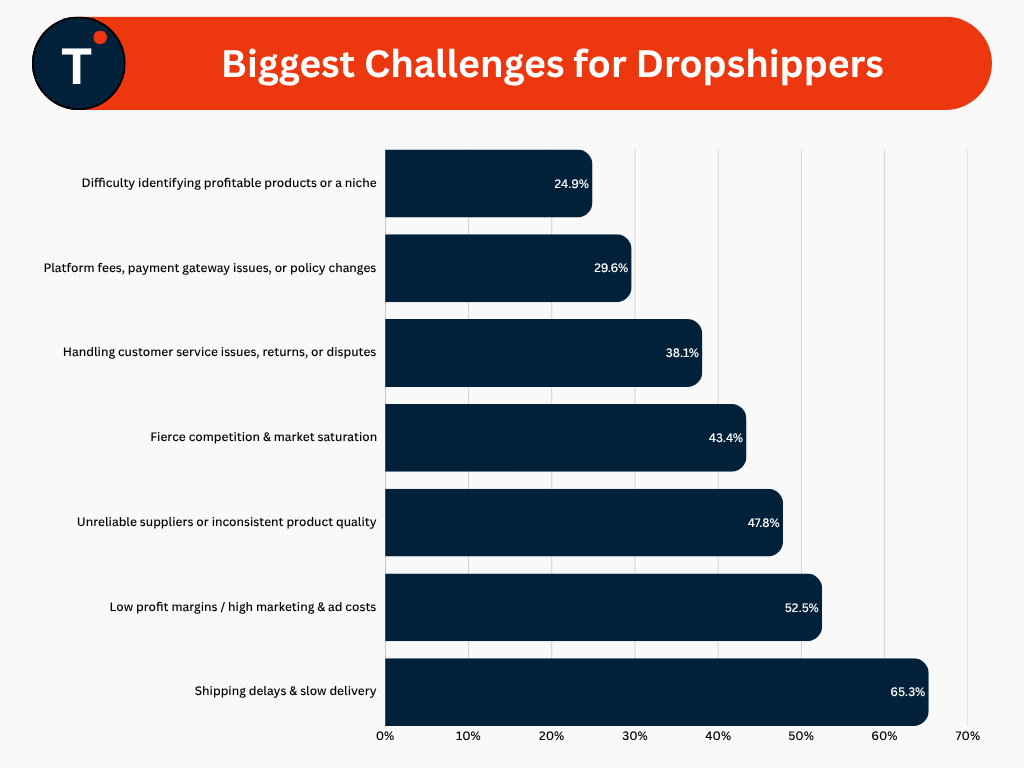
- Shipping delays and slow delivery were identified as the leading challenge, cited by 65.3% of dropshippers.
- Low profit margins and high marketing and advertising costs were reported by 52.5% of respondents, impacting overall business profitability.
- Unreliable suppliers and inconsistent product quality were identified by 47.8% of dropshippers as major operational challenges.
- Intense market competition and saturation affected 43.4% of respondents, making customer acquisition and differentiation more challenging.
- Customer service issues, product returns, and dispute management were cited by 38.1% of dropshippers.
- Platform fees, payment gateway issues, and policy changes were reported as challenges by 29.6% of respondents.
- Identifying profitable products and niche markets remained a challenge for 24.9% of dropshippers.
Reasons for Online Shopping Cart Abandonment
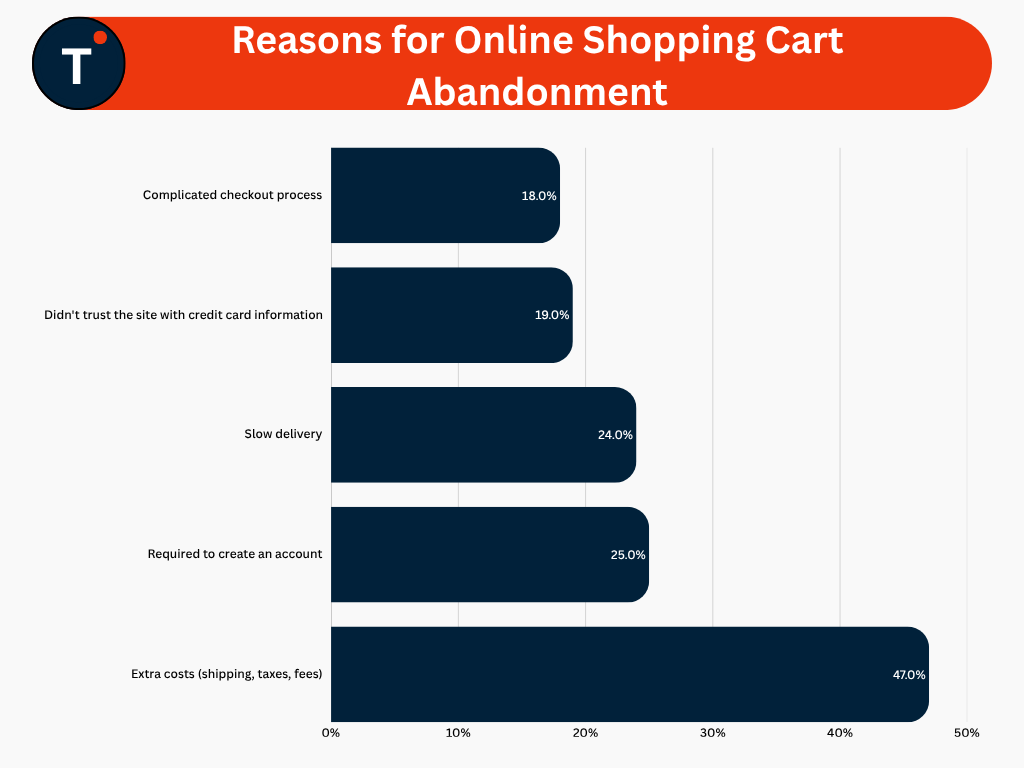
- Additional costs, including shipping fees, taxes, and other charges, were the leading cause of cart abandonment, cited by 47% of consumers.
- Mandatory account creation prompted 25% of shoppers to abandon their online purchases.
- Slow delivery times influenced 24% of consumers to leave their shopping carts before completing a purchase.
- Concerns about sharing credit card information resulted in 19% of consumers abandoning the checkout process.
- Complicated checkout processes were identified by 18% of shoppers as a key reason for cart abandonment.
Conclusion
- The global dropshipping market is poised for strong growth, driven by expanding eCommerce adoption, digital transformation, and increasing demand for low-investment retail business models.
- North America continues to dominate the market, with the United States remaining the largest revenue contributor, while Asia Pacific is expected to emerge as the fastest-growing regional market.
- Consumers are placing greater emphasis on fast delivery, free shipping, competitive pricing, easy returns, and secure checkout, making customer experience a key factor influencing purchase decisions and brand loyalty.
- Artificial intelligence, automation, predictive analytics, and omnichannel marketing are enhancing operational efficiency, improving profitability, and enabling data-driven decision-making across dropshipping businesses.
- Despite challenges such as shipping delays, supplier reliability, rising customer acquisition costs, and intense market competition, businesses that prioritize efficient fulfillment, trusted supplier partnerships, and customer retention strategies are well positioned for sustained growth.
- As cross-border commerce, mobile shopping, and personalized online experiences continue to expand, the global dropshipping market is expected to present significant long-term opportunities for retailers, suppliers, and technology providers.
Add TriCityLocalNews as a Preferred Source on Google for instant updates!