
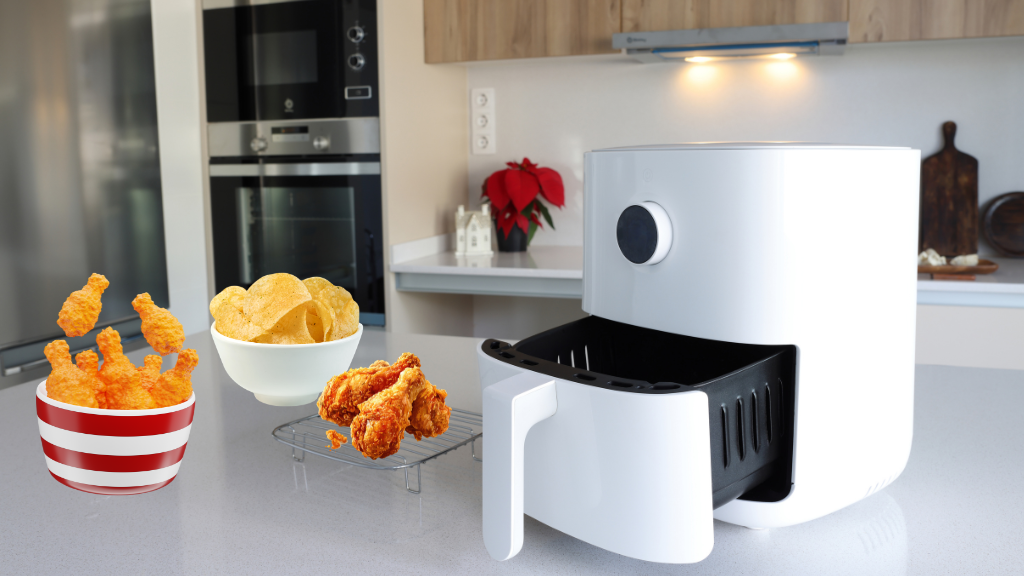







Air fryers have witnessed significant growth in popularity as consumers increasingly seek healthier cooking alternatives to traditionally fried foods. An air fryer is a kitchen appliance that utilizes rapidly circulating hot air to cook food, delivering a crispy texture while requiring substantially less oil than conventional deep-frying methods.
The technology operates similarly to a convection oven, using a high-speed fan to distribute hot air evenly around food placed in a perforated basket or tray. This continuous circulation of hot air ensures that all surfaces of the food are exposed to consistent heat, enabling uniform cooking and browning. As a result, air fryers provide a convenient and efficient cooking solution that produces crispy, fried-like results with reduced oil consumption and shorter cooking times.
Editor’s Choice
- 33% of Americans use an air fryer at least once per week.
- 76% of weekly air fryer users cite simplicity as the leading factor influencing usage, followed by crispy food quality, shorter cooking times, and reduced oil consumption.
- 16% of U.S. consumers plan to purchase an air fryer within the next 12 months.
- 14% of air fryer owners have shared air fryer-related content on social media platforms.
- 31% of air fryer owners report that they do not allow others to borrow or use their air fryer.
- 35.3% of air fryer owners discuss or recommend their air fryer to friends and family.
- 62.4% of air fryers are kept on kitchen countertops.
- 67% of U.S. households own at least one air fryer.
- Amazon India reported a 132% year-over-year increase in air fryer sales during the January–March quarter.
- 33% of households globally own an air fryer.
- In the United Kingdom, 58% of consumers own an air fryer, making it the third most-used cooking appliance in the country.
- In France, 27% of households own an air fryer, ranking it as the second most popular small kitchen appliance in the market.
General Statistics
- 48% of air fryer users report reducing their oven usage since 2022.
- 27% of consumers use air fryers as a substitute for traditional cooker hobs during meal preparation.
- Air fryers can reduce the fat content of foods by up to 75% compared with conventional deep-frying methods.
- Air fryer usage during dinner occasions has increased by more than 60% over the past two years.
- With 80% of meals being prepared at home since the pandemic, demand has increased for appliances that support faster, healthier, and more convenient cooking.
- Air fryers consume up to 60% less energy than conventional ovens.
- Cooking times in air fryers are 20%–25% shorter than those of traditional ovens.
- The average retail price of an air fryer ranges between US$40 and US$200.
- 75% of consumers rely on peer recommendations and reviews before purchasing an air fryer.
- Household air fryers typically operate within a power range of 800 to 2,000 watts.
- Operating a 1,500-watt air fryer for 20 minutes results in an estimated electricity cost of US$2.52 per use.
- China accounts for 46% of global air fryer production, followed by North America at 23% and Europe at 13%.
Air Fryer Market Size and Growth Statistics
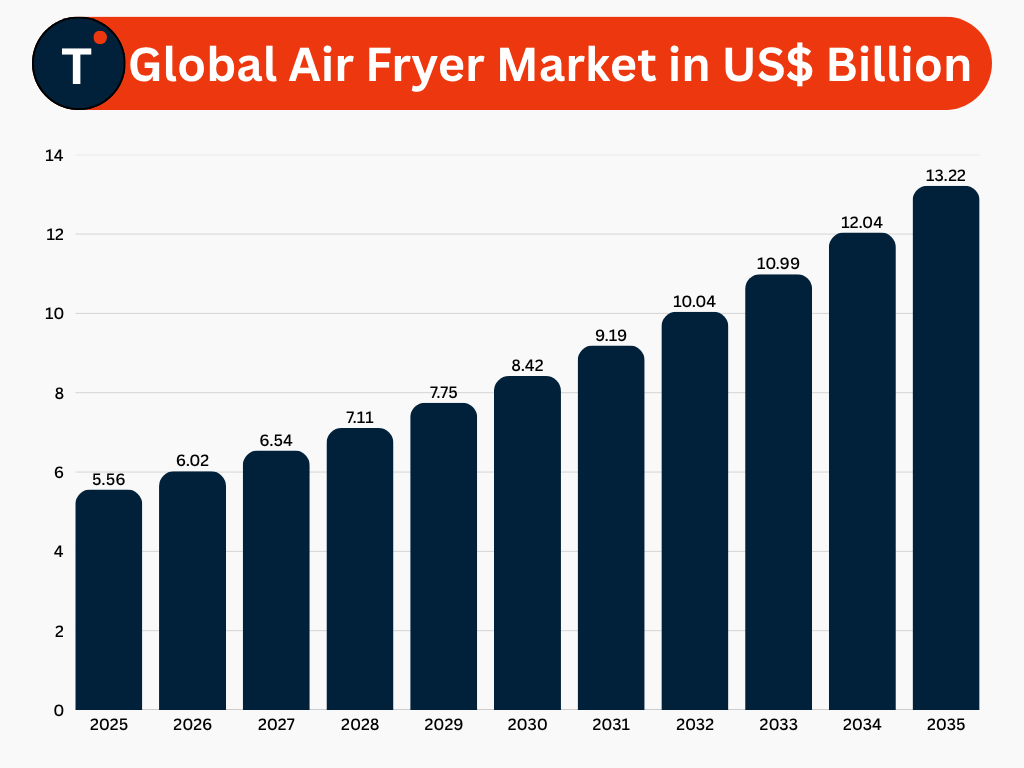
- The global air fryer market was valued at US$ 5.56 billion in 2025.
- The market is projected to reach US$ 6.02 billion in 2026, reflecting continued year-over-year revenue growth.
- The global air fryer market is forecast to attain US$ 13.22 billion by 2035, expanding at a CAGR of 9.1% from 2026 to 2035.
Global Air Fryer Market by Geography
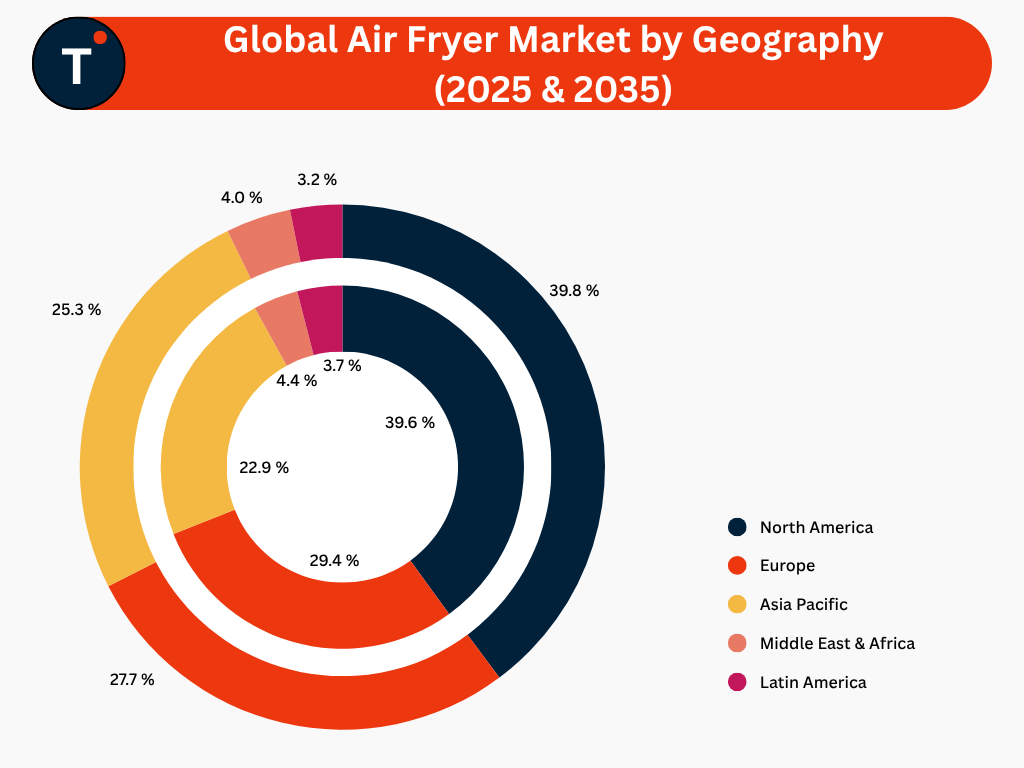
- North America accounted for 39.6% of the global air fryer market in 2025, making it the largest regional market.
- The North American air fryer market was valued at US$ 2.20 billion in 2025 and is projected to reach US$ 5.26 billion by 2035, expanding at a CAGR of 9.2%.
- Europe represented 29.4% of the global air fryer market in 2025, ranking as the second-largest regional market.
- The European air fryer market was valued at US$ 1.63 billion in 2025 and is forecast to reach US$ 3.66 billion by 2035, registering a CAGR of 8.4%.
- Asia Pacific is projected to record the fastest growth rate, with a CAGR of 10.3% during the forecast period.
- The Asia Pacific air fryer market was valued at US$ 1.27 billion in 2025 and is expected to attain US$ 3.35 billion by 2035.
- The Middle East & Africa air fryer market generated US$ 0.24 billion in revenue in 2025 and is projected to reach US$ 0.53 billion by 2035.
- The Latin America air fryer market was valued at US$ 0.21 billion in 2025 and is anticipated to grow to US$ 0.42 billion by 2035.
The US Air Fryer Market Outlook
- The United States accounted for 87.8% of the North American air fryer market in 2025, maintaining its position as the region’s largest market.
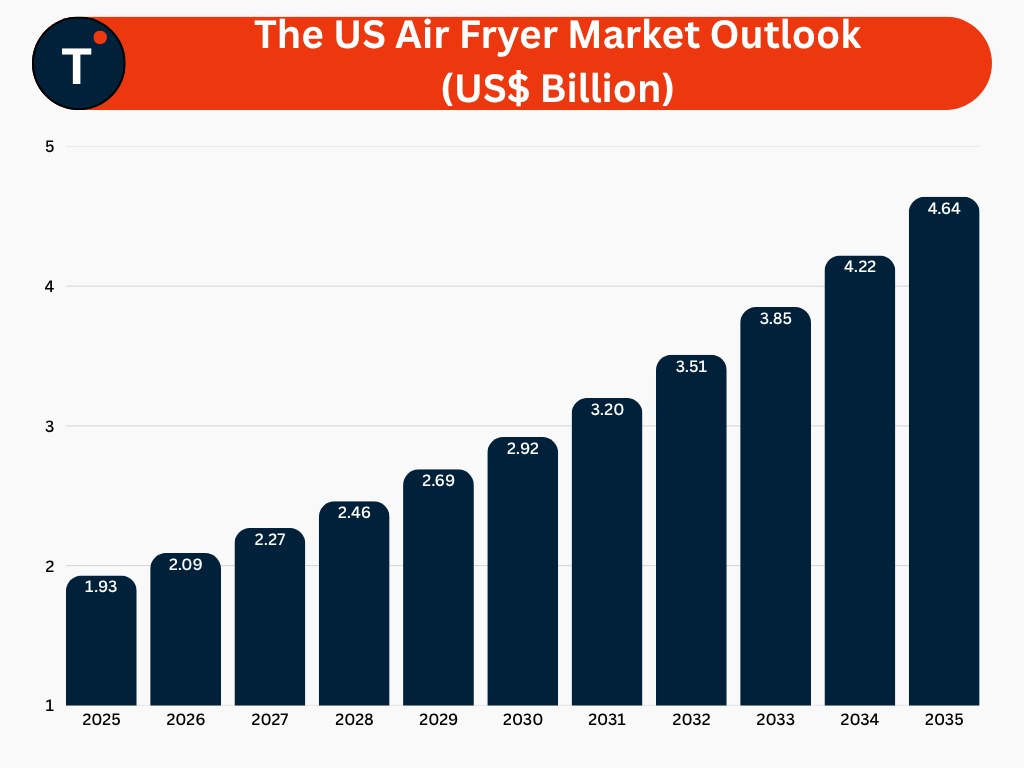
- The U.S. air fryer market was valued at US$ 1.93 billion in 2025.
- Air fryer sales in the United States are projected to reach US$ 2.09 billion in 2026.
- The U.S. air fryer market is forecast to attain US$ 4.64 billion by 2035.
- The U.S. air fryer market is expected to expand at a CAGR of 9.3% during the forecast period.
Air Fryer Market Revenue Split by Distribution Channel
| Distribution Channel | 2025 (US$ Billion) | 2035 (US$ Billion) |
| Online | 2.06 | 6.08 |
| Offline | 3.50 | 7.14 |
- The offline distribution channel accounted for 63% of global air fryer market revenue in 2025, representing the largest sales channel.
- Revenue generated through the offline sales channel reached US$ 3.50 billion in 2025 and is projected to increase to US$ 7.14 billion by 2035, registering a CAGR of 7.4%.
- The online distribution channel is expected to record the fastest growth, expanding at a CAGR of 11.6% during the forecast period.
- Revenue from online air fryer sales is forecast to grow from US$ 2.06 billion in 2025 to US$ 6.08 billion by 2035.
Air Fryer Revenue Distribution by End-users
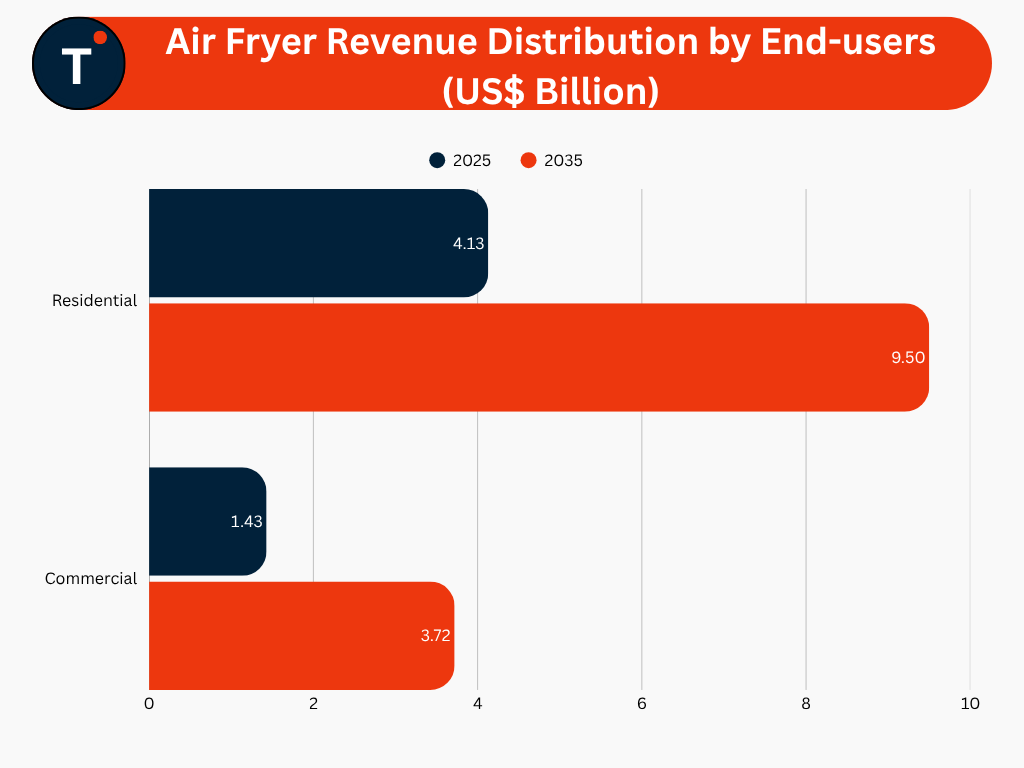
- The residential segment accounted for 74.3% of the global air fryer market revenue in 2025, making it the leading end-user category.
- The residential segment was valued at US$ 4.13 billion in 2025 and is projected to reach US$ 9.50 billion by 2035, expanding at a CAGR of 8.7%.
- The commercial segment is expected to register the highest growth rate, with a CAGR of 10.2% during the forecast period.
- The commercial segment generated US$ 1.43 billion in revenue in 2025 and is forecast to attain US$ 3.72 billion by 2035.
Air Fryer Capacity and Wattage Statistics
- Air fryers are primarily available in small, medium, and large capacity variants, catering to different household cooking requirements.
| Size of Air Fryer | Wattage |
| Small Air Fryers | 800W – 1,200W |
| Medium Air Fryers | 1,200W – 1,500W |
| Larger Air Fryers | 1,500W – 2,000W |
- Small air fryers typically operate within a power range of 800W to 1,200W.
- Medium-sized air fryers generally consume 1,200W to 1,500W and offer a cooking capacity of 3 to 5 quarts.
- Large air fryers commonly operate between 1,500W and 2,000W and can accommodate 6 to 8 quarts of food.
- Air fryers with capacities ranging from 4 to 6 quarts represent the most preferred size category in the market, balancing cooking capacity, countertop space, and energy consumption.
Most Popular Foods Cooked in Air Fryers
- 73% of air fryer users prepare chips in their air fryers, making them the most commonly cooked food item.
- 48% of users cook potatoes using air fryers.
- 47% of consumers use air fryers to prepare breaded chicken products.
- 44% of users cook sausages in air fryers.
- 44% of air fryer owners prepare chicken using the appliance.
- 42% of consumers cook breaded fish products in air fryers.
- 26% of users prepare fish using air fryers.
- 25% of air fryer owners cook vegetables in air fryers.
- 24% of consumers use air fryers to prepare beef burgers.
- 24% of users cook bacon in air fryers.
Air Fryer Purchase Statistics by Age Group
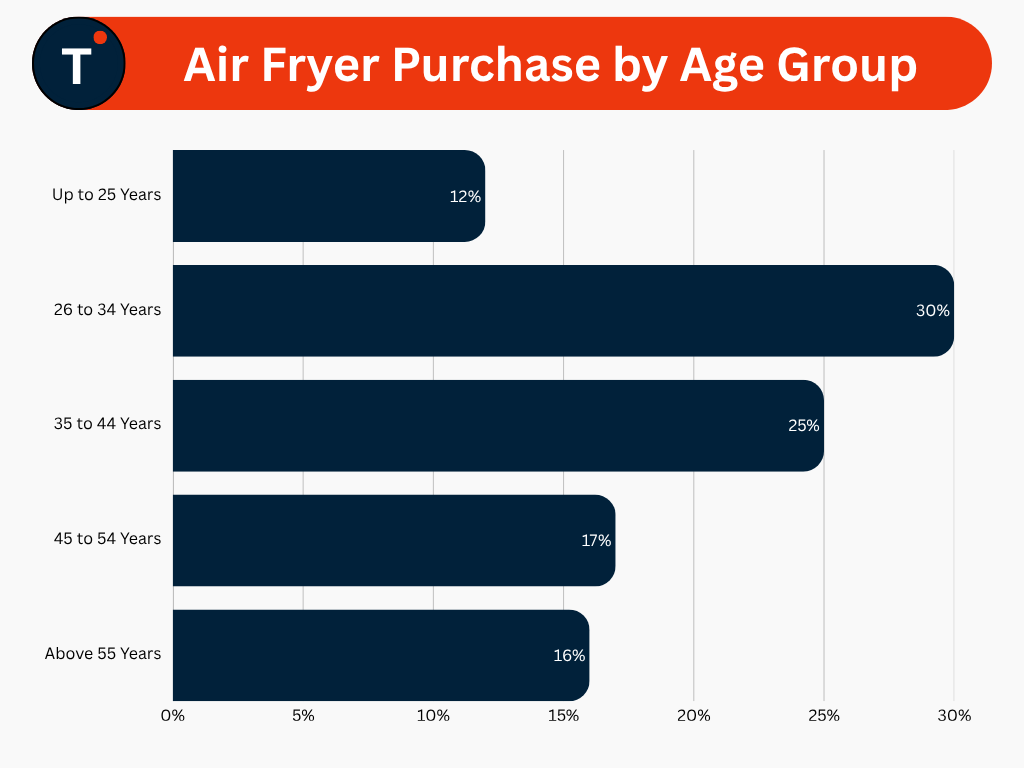
- Consumers aged 26 to 34 years accounted for the largest share of air fryer purchases, representing 30% of total purchases.
- The 35 to 44 years age group contributed 25% of air fryer purchases.
- Individuals aged 45 to 54 years represented 17% of total air fryer purchases.
- Consumers aged 55 years and above accounted for 16% of air fryer purchases.
- The up to 25 years age group contributed 12% of total air fryer purchases, representing the smallest share among the age categories analyzed.
Air Fryer Ownership by Income Level
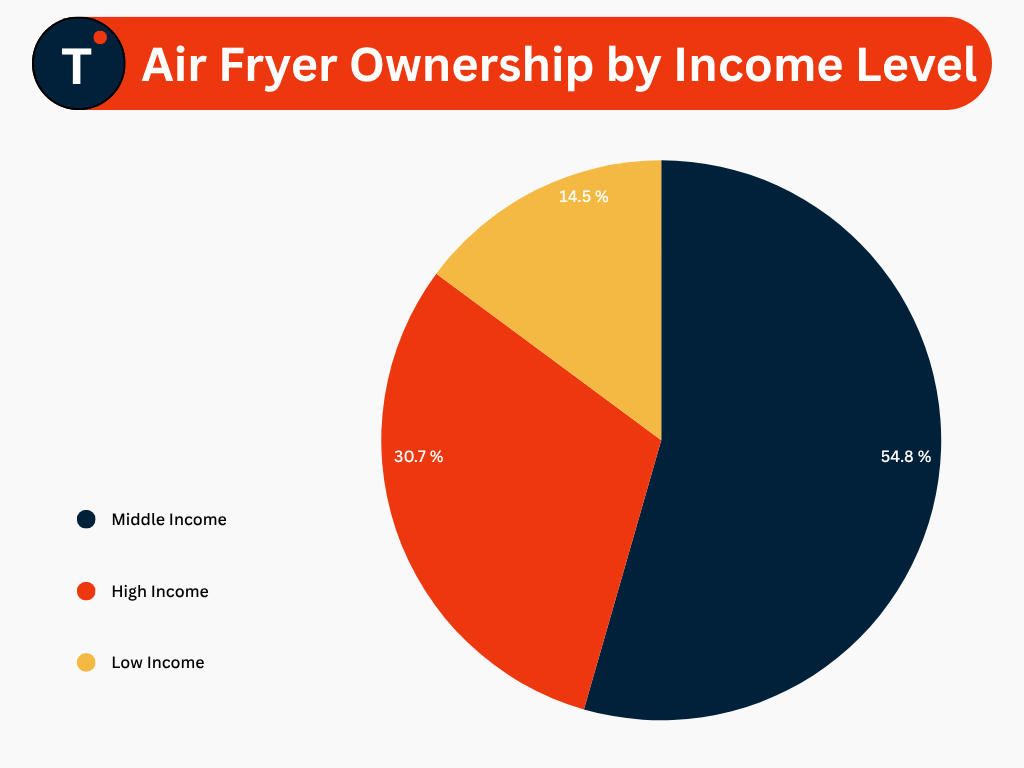
- Middle-income households accounted for 54.8% of air fryer ownership, representing the largest share among all income groups.
- High-income households represented 30.7% of total air fryer ownership.
- Low-income households accounted for 14.5% of air fryer ownership.
- Middle- and high-income households collectively represented 85.5% of air fryer ownership, indicating a strong concentration of ownership within these income segments.
Consumer Buying Behavior Analysis for Air Fryers
- Ease of use influences 90% of purchasing considerations, making it the most important factor in portable air fryer selection.
- Cooking performance accounts for 84% of consumer preference, indicating strong demand for efficient cooking and consistent food quality.
- Customer service contributes 82% to purchase evaluation, highlighting the importance of brand support and after-sales service.
- Ease of cleaning represents 80% of purchase consideration, reflecting consumer preference for convenient and low-maintenance appliances.
- Durability influences 76% of purchasing decisions, making product longevity an important, although comparatively lower-ranked, buying factor.
Competitive Landscape Analysis
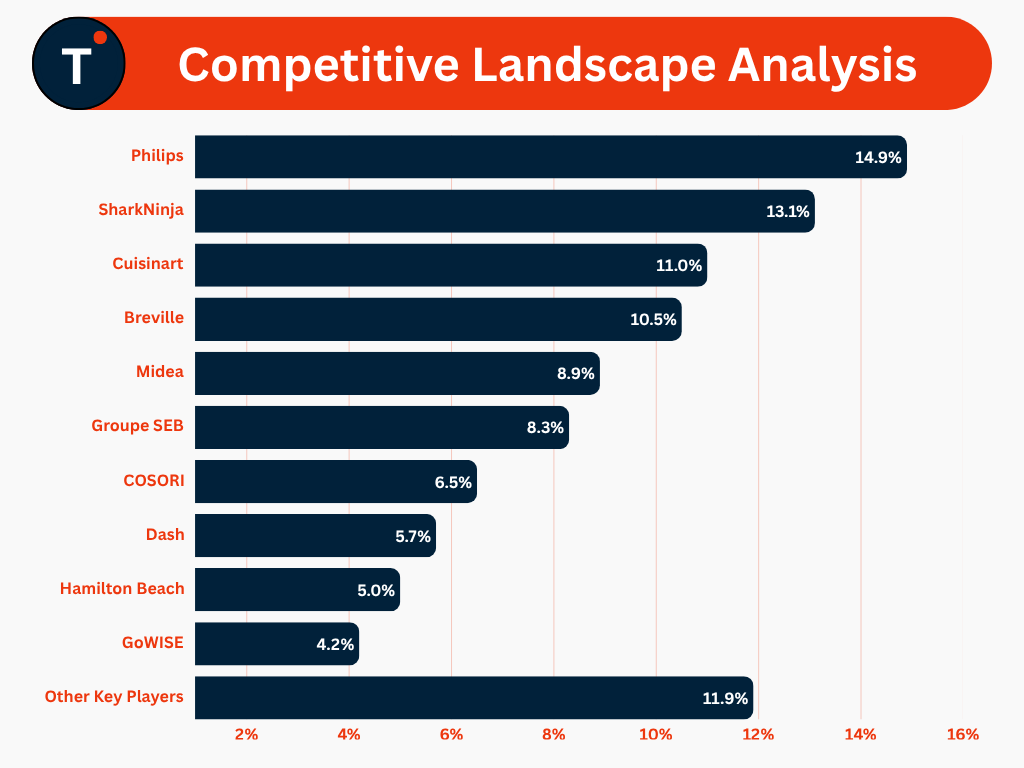
- Philips led the market in 2025 with a 14.9% share, securing the highest position among key manufacturers.
- SharkNinja followed with 13.1%, establishing itself as a major competitor in the category.
- Cuisinart captured 11.0%, strengthening its presence across the air fryer segment.
- Breville accounted for 10.5%, placing it among the industry’s leading brands.
- Midea contributed 8.9% of total market revenue.
- Groupe SEB recorded an 8.3% share, reflecting its strong position within the competitive landscape.
- COSORI represented 6.5% of industry revenue.
- Dash secured 5.7%, maintaining a notable presence in the market.
- Hamilton Beach contributed 5.0% of total sales.
- GoWISE accounted for 4.2%, ranking among the established market participants.
- Other manufacturers collectively represented 11.9%, highlighting the presence of several regional and niche brands.
Strategic Initiatives and Product Launches
- July 2026: Philips expanded its product portfolio with the launch of its largest air fryer to date, featuring a 10-liter basket capacity and 3-in-1 cooking functionality.
- May 2026: Cuisinart introduced the ClearView Air Fryer collection, comprising a 4-quart glass air fryer and a 9-quart large-capacity model designed to enhance cooking visibility and control.
- December 2025: Nestlé partnered with Ninja to launch the Maggi Air Fryer Mixes range across the Middle East and North Africa (MENA) region.
- October 2025: Ninja unveiled the Ninja CRISPi PRO Countertop Glass Air Fryer, an advanced addition to its CRISPi Portable Cooking System lineup.
- October 2025: Cuisinart expanded its air fryer portfolio with the introduction of the 11-Quart Dual Basket Air Fryer Pro (ADZ-112) and the 15-in-1 Extra-Large Digital Air Fryer Oven (TOA-112).
- May 2025: Nestlé broadened its air fryer-focused product offerings across the Americas, strengthening its presence in the growing air fryer meal solutions segment.
Conclusion
- Rising consumer preference for healthier cooking methods, lower energy consumption, and faster meal preparation continues to drive adoption across residential and commercial applications.
- North America remains the largest regional market, while Asia Pacific is positioned as the fastest-growing region, reflecting expanding consumer awareness and increasing household appliance penetration.
- The United States accounts for the majority of North American demand, supported by high household ownership rates and strong consumer spending on kitchen appliances.
- Offline retail channels continue to generate the largest share of revenue, although online sales are expanding at a faster pace, driven by the growth of e-commerce platforms.
- The residential segment dominates market demand, while commercial adoption is gaining traction as foodservice operators increasingly incorporate air fryer technology into their operations.
- Continuous product launches, technological advancements, and strategic partnerships among leading manufacturers are expected to intensify competition and support long-term market expansion.