
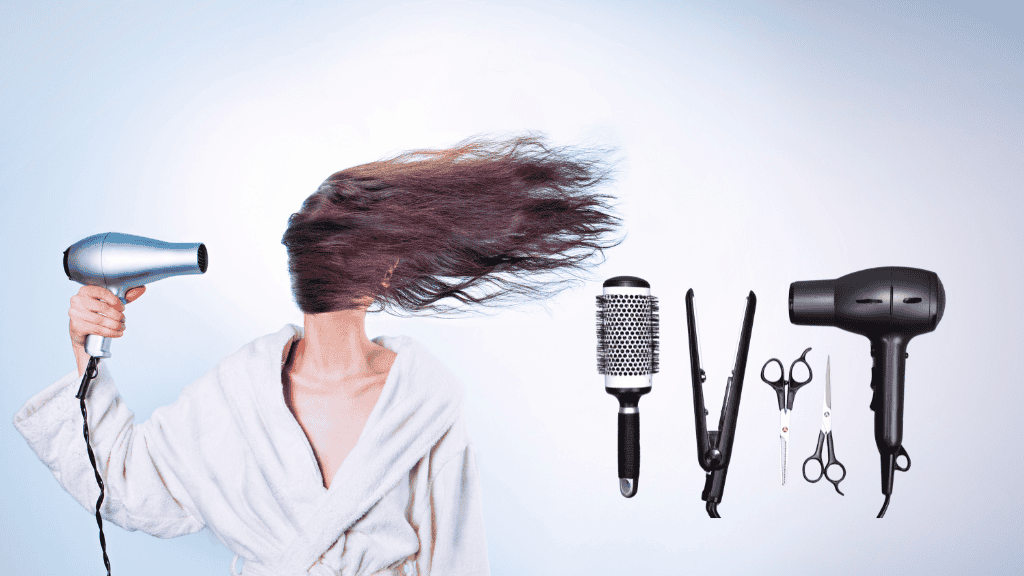


Hair dryers have evolved from basic drying appliances into advanced personal care devices that integrate innovative technologies to improve styling performance, user convenience, and hair protection. Continuous advancements in design, motor efficiency, and intelligent features have transformed hair dryers into essential grooming tools for both household and professional applications.
The market has also witnessed a growing emphasis on sustainability and user well-being. Manufacturers are increasingly introducing energy-efficient models to reduce electricity consumption, while advanced features such as ionic technology, temperature control, and integrated air purification systems enhance hair care performance and minimize exposure to airborne pollutants. These innovations continue to shape consumer purchasing preferences and drive product development across the global hair dryer market.
Editor’s Picks
- Global hair dryer sales reached 257.7 million units in 2025, reflecting strong consumer demand across personal care markets.
- The United States accounted for 65.3 million hair dryer unit sales in 2025.
- U.S. hair dryer sales are projected to increase to 67.8 million units in 2026.
- Annual hair dryer sales in the United States are expected to reach 97.0 million units by 2035.
- Women account for 71.6% of the U.S. hair dryer market, while men represent 28.4%.
- Foldable-handle hair dryers reduce overall product length by 25% to 47% compared with fixed-handle models.
- Lightweight travel hair dryers typically weigh less than 1.5 pounds (680 grams).
- The top eight hair dryer brands collectively account for 32% of the market, while the remaining share is distributed among numerous manufacturers.
- The average selling price of a hair dryer reached US$37.80 in 2025.
- The average operating cost of a hair dryer is US$1.30 per month, equivalent to US$15.54 annually.
General Statistics
- Men spend an average of 37 minutes per day on hair care, while women spend an average of 52 minutes daily, reflecting greater time dedicated to hair maintenance among female consumers.
- Individuals aged 16–24 years spend the most time on washing and drying their hair, averaging 45 minutes per day.
- Consumers aged 55 years and above spend the least time on hair care, averaging 21 minutes per day.
- 54.5% of men do not style their hair, indicating a preference for minimal hair styling routines.
- Healthy hair is most commonly associated with shine (36%), followed by smoothness (29%) and a healthy scalp (26%).
- Eight out of ten consumers wash their hair every alternate day.
- Straight hairstyles are preferred by 36% of consumers, while 31% favor middle or side-parted hairstyles.
- Meeting friends or going out (33%) and preparing for work (33%) are the leading occasions for styling hair.
- 86% of Americans incorporate shampoo or conditioner into their hair care routine, while 18% use serums, hair masks, or leave-in treatments, 16% apply hair oils, 11% rely on home remedies, 9% opt for salon treatments, and 5% report not following any hair care routine.
- Consumers aged 18–34 years demonstrate the highest engagement in hair care, with nearly 90% using shampoo or conditioner, 25% using serums or hair masks, and 23% applying hair oils.
- Consumers aged 35–54 years report 85% usage of shampoo or conditioner, while 22% use serums or hair masks and 19% apply hair oils.
- Consumers aged 55 years and above exhibit the lowest adoption of advanced hair care products, with 11% using serums or hair masks and 5% relying on home remedies.
- 93% of women use shampoo or conditioner, compared with 79% of men, indicating higher utilization of basic hair care products among female consumers.
Global Hair Dryer Market Highlights
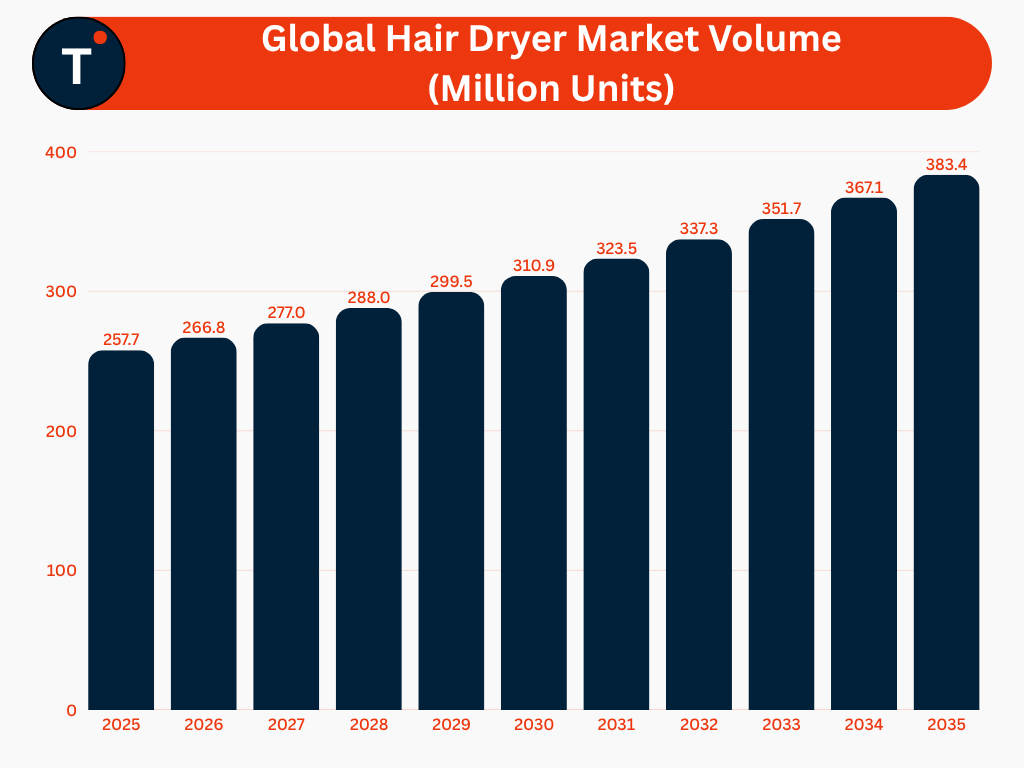
- Global hair dryer sales reached 257.7 million units in 2025 and are projected to increase to 383.4 million units by 2035, expanding at a CAGR of 4.1%.
- Asia Pacific recorded 93.3 million units in hair dryer sales in 2025, with volume forecast to reach 145.9 million units by 2035 at a CAGR of 4.7%.
- North America accounted for 74.7 million units in 2025, making it the second-largest regional market. Sales are projected to reach 110.6 million units by 2035, registering a CAGR of 4.0%.
- Europe generated 72.2 million units in hair dryer sales in 2025 and is expected to attain 103.1 million units by 2035, growing at a CAGR of 3.6%.
- The Middle East & Africa recorded 9.5 million units in 2025, with sales projected to increase to 13.2 million units by 2035, reflecting a CAGR of 3.3%.
- Latin America accounted for 8.0 million units in 2025, and sales are forecast to reach 10.7 million units by 2035, expanding at a CAGR of 3.0%.
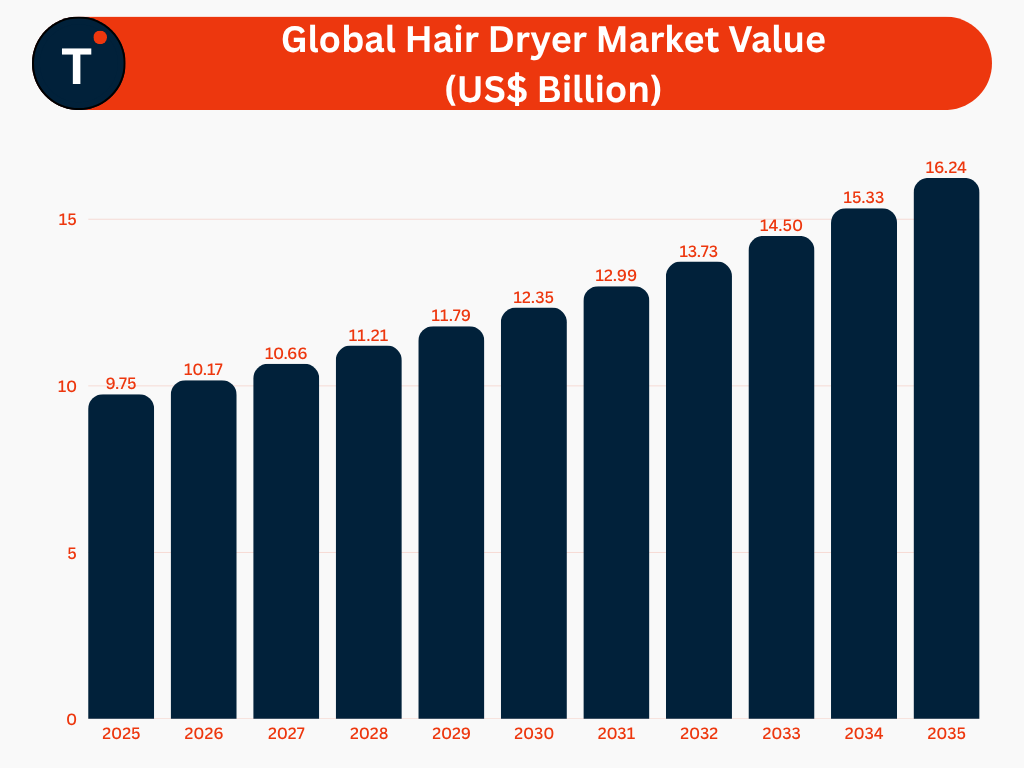
- The global hair dryer market was valued at US$9.75 billion in 2025.
- The market is projected to reach US$10.17 billion in 2026, reflecting continued growth in consumer demand.
- Global hair dryer market revenue is expected to reach US$16.24 billion by 2035.
- The market is forecast to expand at a CAGR of 5.3% during the 2026–2035 period.
Hair Dryer Market Value Distribution by Geography

- Asia Pacific accounted for the largest share of the global hair dryer market, capturing 36.2% of revenue in 2025.
- The Asia Pacific hair dryer market was valued at US$3.53 billion in 2025 and is projected to reach US$6.18 billion by 2035, expanding at a CAGR of 5.9%.
- North America represented 29.0% of the global hair dryer market in 2025, making it the second-largest regional market.
- The North America hair dryer market generated US$2.82 billion in revenue in 2025 and is forecast to reach US$4.68 billion by 2035, registering a CAGR of 5.3%.
- Europe accounted for 18.0% of the global hair dryer market in 2025, ranking as the third-largest regional market.
- The Europe hair dryer market was valued at US$2.73 billion in 2025 and is anticipated to reach US$4.37 billion by 2035, growing at a CAGR of 4.9%.
- The Middle East & Africa hair dryer market was valued at US$0.36 billion in 2025 and is projected to reach US$0.56 billion by 2035, reflecting a CAGR of 4.5%.
- The Latin America hair dryer market generated US$0.30 billion in revenue in 2025 and is expected to reach US$0.45 billion by 2035, expanding at a CAGR of 4.2%.

The U.S. Hair Dryer Market Value (US$ Billion)

- The U.S. hair dryer market was valued at US$2.47 billion in 2025.
- The U.S. hair dryer market is projected to reach US$2.58 billion in 2026, reflecting continued market expansion.
- The market is expected to grow at a CAGR of 5.3% during the 2026–2035 forecast period.
- The U.S. hair dryer market is forecast to attain a value of US$4.11 billion by 2035.
Global Hair Dryer Market by Product Type

- Corded hair dryers dominated the global market, accounting for 73.0% of total revenue in 2025.
- The corded hair dryer market was valued at US$7.11 billion in 2025 and is projected to reach US$11.11 billion by 2035, expanding at a CAGR of 4.6%.
- Global sales of corded hair dryers reached 205.8 million units in 2025 and are forecast to increase to 292.8 million units by 2035, registering a CAGR of 3.6%.
- Cordless hair dryers are projected to be the fastest-growing product segment, with the market expected to increase from US$2.63 billion in 2025 to US$5.13 billion by 2035, at a CAGR of 7.1%.
- Global cordless hair dryer sales totaled 51.9 million units in 2025 and are anticipated to reach 90.6 million units by 2035, growing at a CAGR of 5.9%.
Global Hair Dryer Market Share (%) by Distribution Channel

- The offline distribution channel dominated the global hair dryer market, accounting for 73.8% of total revenue in 2025.
- The offline distribution channel generated US$7.19 billion in revenue in 2025 and is projected to reach US$11.15 billion by 2035, expanding at a CAGR of 4.6%.
- The online distribution channel is projected to register the fastest growth, with a CAGR of 7.3% during the forecast period.
- Revenue generated through online hair dryer sales is expected to increase from US$2.56 billion in 2025 to US$5.09 billion by 2035.
Global Hair Dryer Market Size by End-user
| End-user (US$ Billion) | 2025 | 2030 | 2035 |
| Individual | 6.25 | 7.69 | 9.82 |
| Professional | 2.48 | 3.38 | 4.73 |
| Commercial | 1.01 | 1.29 | 1.69 |
- The individual segment dominated the global hair dryer market, accounting for 64.1% of total revenue in 2025.
- The individual segment was valued at US$6.25 billion in 2025 and is projected to reach US$9.82 billion by 2035, expanding at a CAGR of 4.7%.
- The professional segment is expected to grow from US$2.48 billion in 2025 to US$4.73 billion by 2035, registering the fastest CAGR of 6.8% during the forecast period.
- The commercial segment generated US$1.01 billion in revenue in 2025 and is forecast to reach US$1.69 billion by 2035, growing at a CAGR of 5.4%.
Hair Dryer Price Trend Analysis

- The average selling price of a hair dryer was US$37.82 in 2025.
- The average hair dryer price is projected to increase to US$39.73 by 2030.
- The average selling price of a hair dryer is forecast to reach US$42.35 by 2035.
United States Hair Dryer Adoption Rate by Age Group

- Consumers aged 20–29 years account for the highest hair dryer adoption rate in the United States, representing 29.6% of total users.
- The 30–39 years age group contributes 24.2% of hair dryer adoption, making it the second-largest user segment.
- Individuals aged up to 19 years account for 19.4% of hair dryer adoption in the U.S. market.
- Consumers aged 40–49 years represent 16.5% of the total hair dryer user base.
- Adults aged above 50 years account for 10.3% of hair dryer adoption, representing the smallest share among the age groups analyzed.
Hair Dryer Electricity Consumption Statistics
- Hair dryers typically operate within a power range of 1,500–2,000 watts, with 1,800 watts representing the average power consumption for standard models.
- Using a 1,800-watt hair dryer for 5 minutes per day consumes 1.05 kWh of electricity per week, 4.56 kWh per month, and 54.75 kWh annually.
- Operating a 1,800-watt hair dryer for 10 minutes per day results in electricity consumption of 2.10 kWh per week, 9.13 kWh per month, and 109.50 kWh per year.
- Using a 1,800-watt hair dryer for 15 minutes per day increases electricity consumption to 3.15 kWh per week, 13.69 kWh per month, and 164.25 kWh annually.
How Many Watts Do Different Hair Dryers Use In A Year?
| Hair dryer wattage | Hours per year run | Yearly kWh of electricity |
| 1,500 W | 60.8 hours | 91.2 kWh |
| 1,600 W | 60.8 hours | 97.3 kWh |
| 1,700 W | 60.8 hours | 103.4 kWh |
| 1,800 W | 60.8 hours | 109.5 kWh |
| 1,900 W | 60.8 hours | 115.5 kWh |
| 2,000 W | 60.8 hours | 121.6 kWh |
Monthly and Yearly Costs to Run a Hair Dryer by the U.S. State
| State | Average electricity rate | Cost per month | Cost per year |
| California | 22.00 ¢ / kWh | $2.01 | $24.09 |
| New York | 20.59 ¢ / kWh | $1.88 | $22.55 |
| Texas | 12.56 ¢ / kWh | $1.15 | $13.75 |
| Massachusetts | 22.59 ¢ / kWh | $2.06 | $24.74 |
| Florida | 12.21 ¢ / kWh | $1.11 | $13.37 |
| Virginia | 12.58 ¢ / kWh | $1.15 | $13.78 |
| New Jersey | 16.20 ¢ / kWh | $1.48 | $17.74 |
| Maryland | 14.48 ¢ / kWh | $1.32 | $15.86 |
| Washington | 10.38 ¢ / kWh | $0.95 | $11.37 |
| US Average | 14.19 ¢ / kWh | $1.30 | $15.54 |
Hair Dryer Selection Recommendations by Hair Type
- Fine, thin, or damaged hair is best suited for hair dryers with a power rating of 1,000–1,200 watts, as lower heat settings help minimize the risk of heat-related damage.
- Normal or wavy hair is recommended to use hair dryers with a wattage range of 1,200–1,600 watts, providing a balanced combination of drying performance and portability.
- Thick, coarse, or curly hair is better suited for hair dryers rated between 1,400–1,875 watts, as higher power output reduces drying time while helping manage frizz.
Hair Dryer Testing Metric Weightings

- Styling ability accounts for 35% of the overall hair dryer evaluation, making it the most influential performance criterion.
- Drying ability contributes 30% of the total assessment, reflecting its importance in measuring product efficiency.
- Ease of use represents 25% of the overall testing criteria, emphasizing user comfort, ergonomics, and operational convenience.
- Packability accounts for the remaining 10% of the evaluation, highlighting the importance of portability, particularly for travel-friendly hair dryer models.
Hair Dryer Market Company Share Analysis
| Key Players | Market Share |
| Dyson | 2.2% |
| Laifen | 2.9% |
| Panasonic | 3.6% |
| Philips | 3.1% |
| Flyco | 3.4% |
| Conair | 11.2% |
| Remington | 3.5% |
| Xiao Mi | 2.0% |
| Others | 68.0% |
- Conair holds the largest market share among the listed manufacturers at 11.2%, positioning it as the leading branded player.
- Panasonic accounts for 3.6% of the market, maintaining a notable presence in the global hair dryer industry.
- Remington captures 3.5% of the global hair dryer market.
- Flyco represents 3.4% of the market, reflecting its competitive position among leading manufacturers.
- Philips holds a market share of 3.1% in the global hair dryer market.
- Laifen accounts for 2.9% of the market, contributing to the competitive landscape.
- Dyson captures 2.2% of the global hair dryer market, supported by its premium product portfolio.
- Xiaomi accounts for 2.0% of the market, representing its presence in the personal care appliance segment.
- The “Others” category accounts for the largest share of the global hair dryer market, representing 68.0%, indicating a highly fragmented competitive landscape.
Recent Developments
- In July 2026, Laifen expanded its U.S. retail presence by launching its best-selling SE High-Speed Hair Dryer at selected Costco warehouse locations, marking the company’s largest retail expansion in the United States and increasing the availability of its hair care technology to Costco members.
- In April 2026, Dyson introduced the Supersonic Travel Hair Dryer, engineered for travelers with a design that is 32% smaller and 25% lighter than the standard model while maintaining advanced hair protection and styling performance.
- In March 2026, Bio Ionic launched the AeroGravity Featherlight Dryer, a next-generation hair dryer designed to deliver high-performance drying capabilities in a lightweight form factor.
- In February 2026, GHD introduced the Speed Ionic Hair Dryer to commemorate its 25th anniversary, featuring ultra-fast drying performance and powerful airflow while strengthening the company’s position in the hair technology tools market.
Conclusion
- The hair dryer market continues to expand steadily, supported by rising consumer demand, technological advancements, and increasing adoption of premium and high-performance hair care appliances.
- Asia Pacific remains the largest regional market, while the United States continues to represent a significant revenue contributor, driven by high product adoption and consistent consumer spending on personal grooming.
- Product innovation remains a key competitive strategy, with manufacturers focusing on lightweight designs, energy efficiency, intelligent temperature control, high-speed motors, and travel-friendly features to enhance user experience.
- The competitive landscape remains highly fragmented, with numerous regional and global manufacturers competing through product differentiation, technological innovation, and retail expansion initiatives.
- Continued investment in advanced styling technologies, sustainable product development, and expanding distribution networks is expected to support long-term growth and strengthen the global hair dryer market through 2035.