An air compressor is a device that converts power from sources such as electric motors, diesel engines, or gasoline engines into potential energy stored as pressurized air. The compressor continuously forces air into a storage tank, increasing the internal pressure until it reaches the equipment’s specified upper limit, at which point compression stops.
The stored compressed air remains available until required for an application. When released, the air generates kinetic energy that can be used across various applications as the storage tank depressurizes. Once the pressure falls to the designated lower limit, the compressor restarts to restore the required pressure.
How Does an Air Compressor Work?
An air compressor converts external power from sources such as electricity or combustion engines into potential energy stored in compressed air. The operating process involves several stages:
Air Intake: Ambient air enters the compressor through an inlet valve, typically passing through a filter to remove contaminants before compression.
Air Compression: A piston or rotary element compresses the incoming air within the compression chamber, reducing its volume and increasing its pressure.
Compressed Air Storage: The pressurized air is transferred to a storage tank, where it remains available as a high-pressure air supply until required.
Air Release and Application: When compressed air is needed, the discharge valve releases it to operate equipment such as power tools, pneumatic tools, spray guns, and nail guns, depending on the application.
Editor’s Choice
Compressed air accounts for 10% of global energy consumption.
The global air compressor market was valued at US$37.88 billion in 2025 and is projected to reach US$62.57 billion by 2035, registering a CAGR of 5.3%.
China and the US held 22% and 19.6% of the global air compressor market, respectively, in 2025.
The US air compressor market reached US$7.44 billion in 2025 and is projected to expand at a CAGR of 4.4%, reaching US$11.28 billion by 2035.
The Midwest accounted for the largest share at 28%, followed by the Southeast at 26%, Northeast at 18%, West at 15%, and Southwest at 13%.
Air compressor technicians in the US earn an average annual salary of US$63,428.
Energy efficiency was a purchasing priority for 68% of air compressor buyers in 2025.
On January 10, 2025, the US Department of Energy (DOE) began enforcing efficiency regulations for oil-flooded rotary air compressors. The regulation covers models ranging from 35–1,250 cfm and 75–200 psi (5.2–13.8 bar), which must meet minimum isentropic efficiency requirements. Air compressor models manufactured on or after January 10 for sale in the US must also be registered with the DOE.
Cleaning filters and reducing supply resistance below 200 mmAq can lower air compressor energy consumption by 1%.
General Statistics
Air consists primarily of 78% nitrogen and 21% oxygen, along with other gases.
Compressed air systems in the US account for US$3.2 billion in wasted energy costs annually.
According to CAGI, compressed air systems typically need to operate at full capacity for only 60–100 hours per week.
Approximately 300 firms currently operate in the US compressed air industry, collectively providing direct employment to about 20,000 people.
35% of globally produced compressed air is lost through leaks, while an air audit can help an average operator reduce operating costs by up to 25%.
Compressed air systems typically lose 30%–50% of their volume through leaks, with poorly maintained systems experiencing losses of up to 80%.
A 1/8-inch diameter leak in a compressed air system operating at 100 PSI can result in more than US$12,000 in annual energy losses.
For a typical SCFM installation, compressed air energy waste averages US$9,600, while a 1,500 CFM installation can incur more than US$32,000 in annual losses from wasted compressed air.
Each 10 PSI of excess pressure generated by a compressed air unit increases power costs by 5%.
Regular maintenance of compressed air equipment can eliminate up to 50% of system-related electricity costs.
70% of manufacturers use compressed air systems in their operations.
Air compressors convert up to 90% of their electrical energy into heat.
How Are Air Compressors Classified by Pressure?
Low-pressure air compressors (LPACs) operate at a discharge pressure of 150 psi or less.
Medium-pressure air compressors (MPACs) operate within a discharge pressure range of 151–1,000 psi.
High-pressure air compressors (HPACs) operate at discharge pressures above 1,000 psi.
Compressor Life Cycle Cost Breakdown
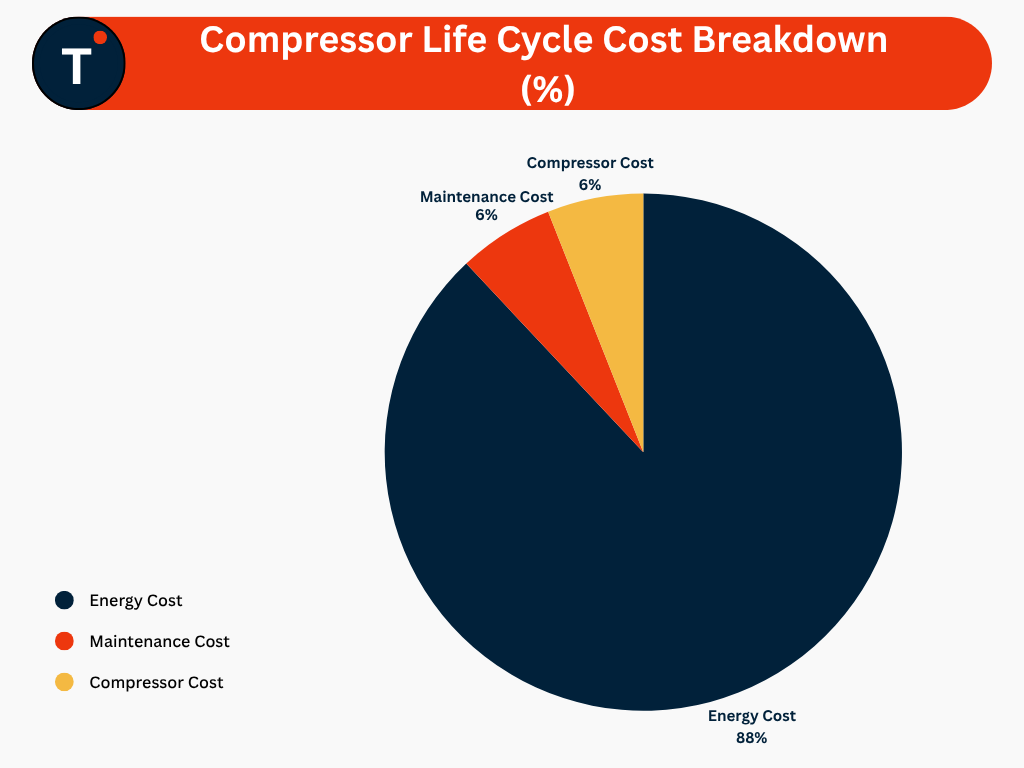
Energy costs account for 88% of the compressor life cycle cost.
Maintenance costs represent 6% of the total compressor life cycle cost.
Compressor costs account for the remaining 6% of the life cycle cost.
How is the Global Air Compressor Market Expected to Grow?
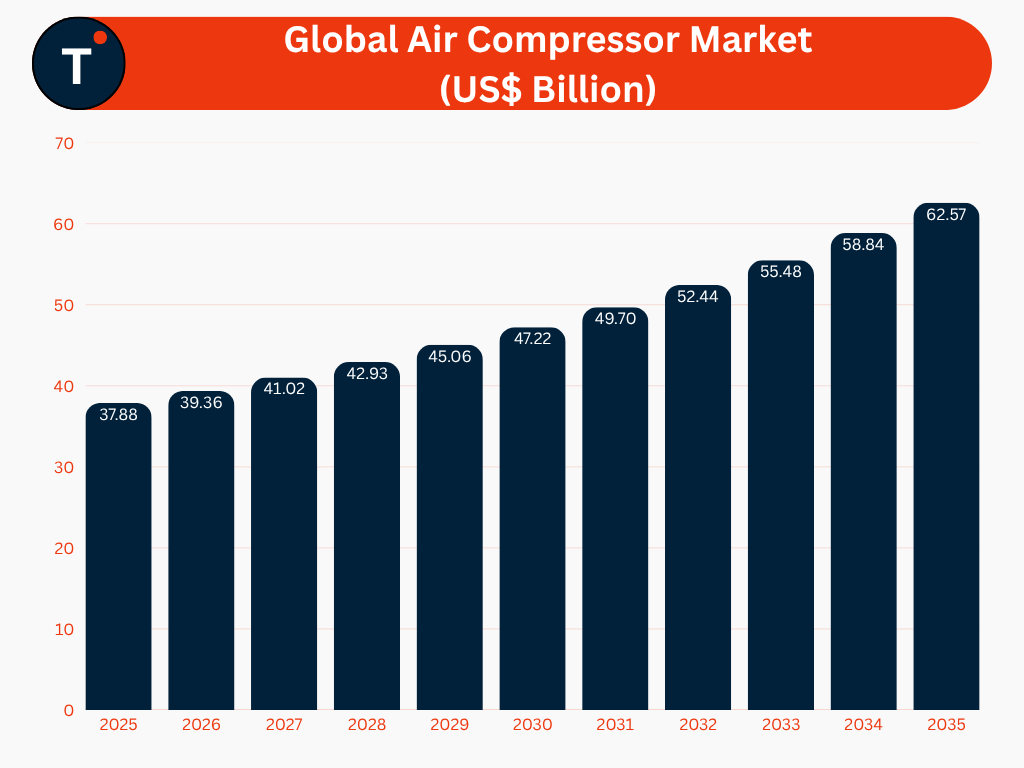
The global air compressor market recorded sales of US$37.88 billion in 2025.
Sales in the global air compressor market are projected to reach US$39.36 billion in 2026.
From 2026 to 2035, the global air compressor market is expected to register a CAGR of 5.3%.
By 2035, the global air compressor market is forecast to reach US$62.57 billion.
Global Air Compressor Market by Region
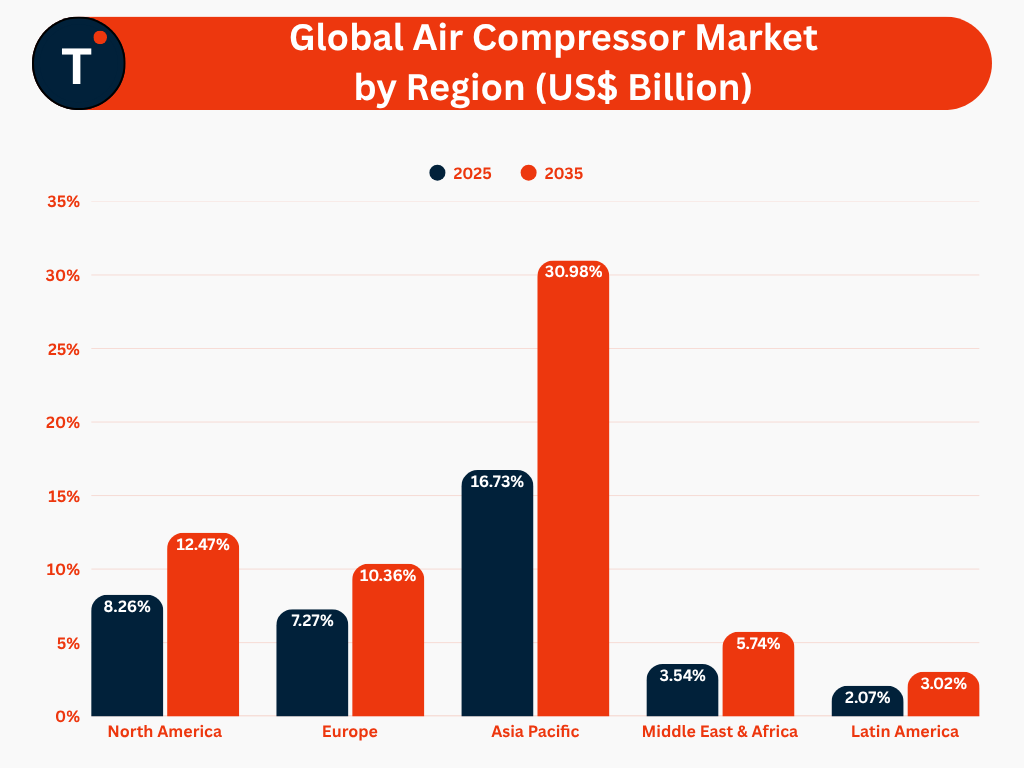
Asia Pacific accounted for 44.2% of the global air compressor market in 2025, with the Asia Pacific air compressor market valued at US$16.73 billion. By 2035, the Asia Pacific air compressor market is projected to reach US$30.98 billion, registering a CAGR of 6.5%.
North America held a 21.8% share of the global air compressor market in 2025, making it the second-largest regional market. The North America air compressor market is projected to increase from US$8.26 billion in 2025 to US$12.47 billion by 2035, at a CAGR of 4.3%.
Europe accounted for 19.2% of the global air compressor market in 2025, with the Europe air compressor market valued at US$7.27 billion. By 2035, the Europe air compressor market is anticipated to reach US$10.36 billion, reflecting a CAGR of 3.7%.
The Middle East & Africa represented 9.3% of the global air compressor market in 2025, while the Middle East & Africa air compressor market was valued at US$3.54 billion. The market is estimated to reach US$5.74 billion by 2035, growing at a CAGR of 5.1%.
Latin America held a 5.5% share of the global air compressor market in 2025, with the Latin America air compressor market valued at US$2.07 billion. By 2035, the market is projected to reach US$3.02 billion, registering a CAGR of 4.0%.
Which are the Leading Countries in the Air Compressor Market?
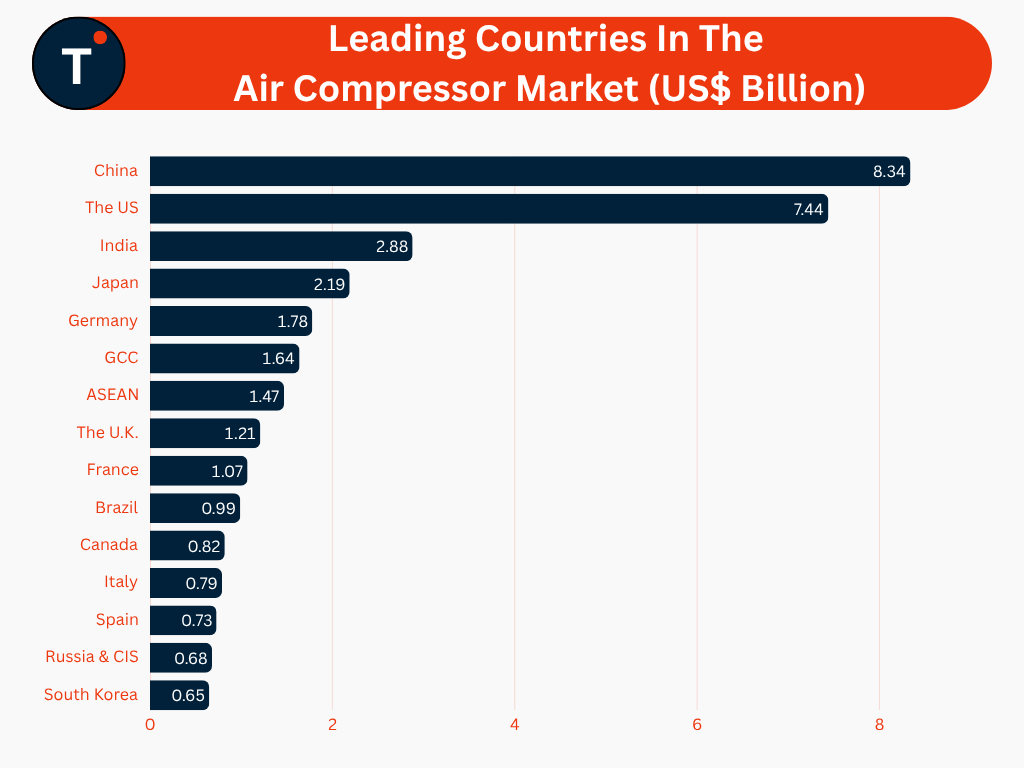
China had the largest air compressor market, valued at US$8.34 billion.
The US air compressor market stood at US$7.44 billion.
India’s air compressor market reached US$2.88 billion.
Japan had an air compressor market value of US$2.19 billion.
Germany’s air compressor market stood at US$1.78 billion.
The GCC air compressor market was valued at US$1.64 billion.
The ASEAN air compressor market reached US$1.47 billion.
The U.K. air compressor market stood at US$1.21 billion.
France had an air compressor market value of US$1.07 billion.
Brazil’s air compressor market reached US$0.99 billion.
Canada had an air compressor market value of US$0.82 billion.
Italy’s air compressor market stood at US$0.79 billion.
Spain reached an air compressor market value of US$0.73 billion.
Russia & CIS had an air compressor market value of US$0.68 billion.
South Korea’s air compressor market stood at US$0.65 billion.
Global Air Compressor Market by Type
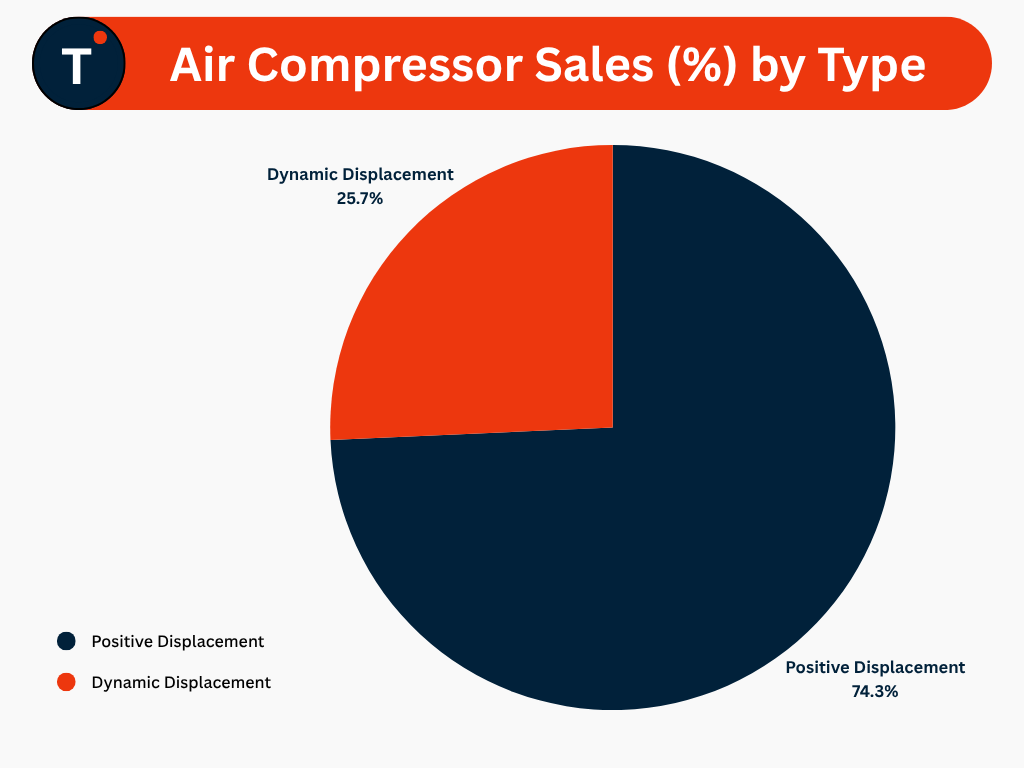
Positive displacement air compressors accounted for 74.3% of the global air compressor market in 2025, with a market value of US$28.15 billion. The positive displacement air compressor market is projected to reach US$45.86 billion by 2035, registering a CAGR of 5.1%.
Reciprocating air compressors held a 25.5% share of the global positive displacement air compressor market in 2025, with a market value of US$7.16 billion. The reciprocating air compressor market is projected to reach US$11.05 billion by 2035, at a CAGR of 4.5%.
Rotary air compressors accounted for 74.5% of the global positive displacement air compressor market in 2025, with a market value of US$20.99 billion. By 2035, the rotary air compressor market is estimated to reach US$34.81 billion, registering a CAGR of 5.3%.
Rotary screw air compressors captured 86.1% of the global rotary air compressor market in 2025, with a market value of US$18.07 billion. The rotary screw air compressor market is expected to reach US$30.35 billion by 2035, growing at a CAGR of 5.5%.
Rotary scroll air compressors represented 8.7% of the global rotary air compressor market in 2025, with a market value of US$1.82 billion. The rotary scroll air compressor market is projected to reach US$2.81 billion by 2035, registering a CAGR of 4.5%.
Dynamic displacement air compressors are projected to be the fastest-growing type, with a CAGR of 5.7% from 2026 to 2035. The dynamic displacement air compressor market is expected to increase from US$9.72 billion in 2025 to US$16.71 billion by 2035.
Centrifugal air compressors accounted for 93% of the global dynamic displacement air compressor market in 2025, with a market value of US$9.04 billion. The centrifugal air compressor market is projected to reach US$15.76 billion by 2035, registering a CAGR of 5.9%.
Axial air compressors represented 7% of the global dynamic displacement air compressor market in 2025, with a market value of US$0.68 billion. By 2035, the axial air compressor market is anticipated to reach US$0.95 billion, at a CAGR of 3.4%.
Why Is Demand for Oil-Free Rotary Screw/Scroll Air Compressors Growing?
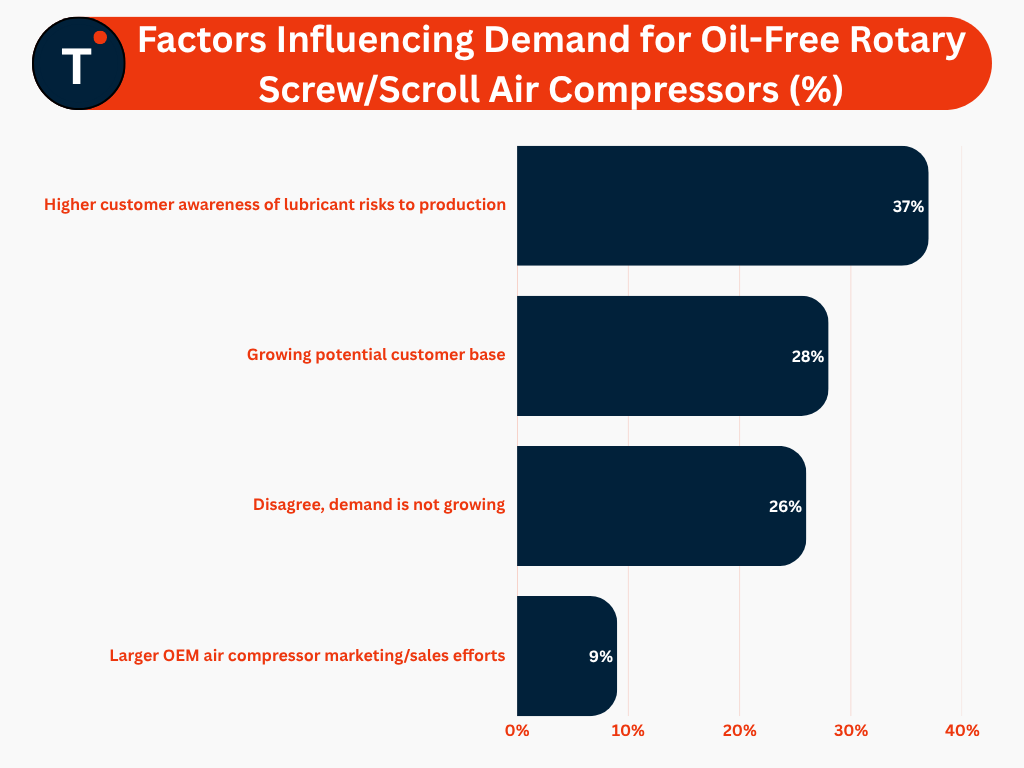
Higher customer awareness of lubricant risks to production accounts for 37% of the factors influencing demand for oil-free rotary screw/scroll air compressors.
A growing potential customer base represents 28% of the factors contributing to demand for oil-free rotary screw/scroll air compressors.
26% of the demand factors indicate that demand is not growing, representing the largest opposing response in the data.
Larger OEM air compressor marketing and sales efforts account for 9% of the factors supporting demand growth.
Global Air Compressor Market by Design
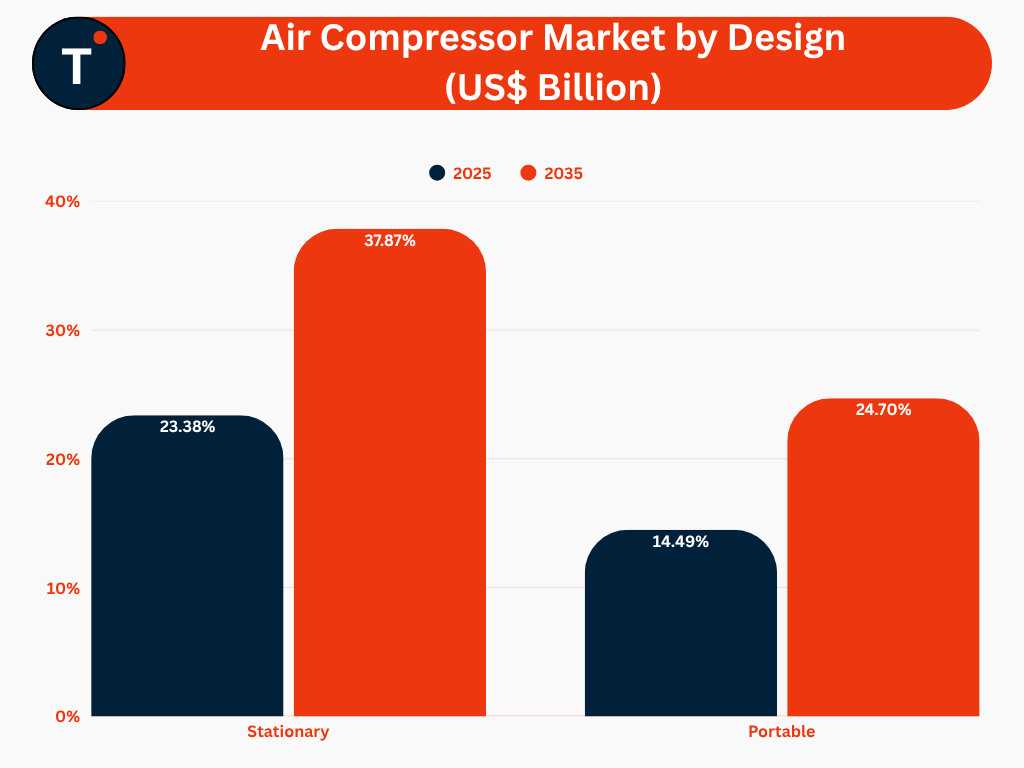
Stationary air compressors accounted for 61.7% of the global air compressor market in 2025.
The stationary air compressor market was valued at US$23.38 billion and is projected to reach US$37.87 billion by 2035, registering a CAGR of 5.1%.
Portable air compressors held a 38.3% market share in 2025 and are projected to be the fastest-growing design type, with a CAGR of 5.6%.
The portable air compressor market is expected to increase from US$14.49 billion in 2025 to US$24.70 billion by 2035.
Global Air Compressor Market by Operating Mode
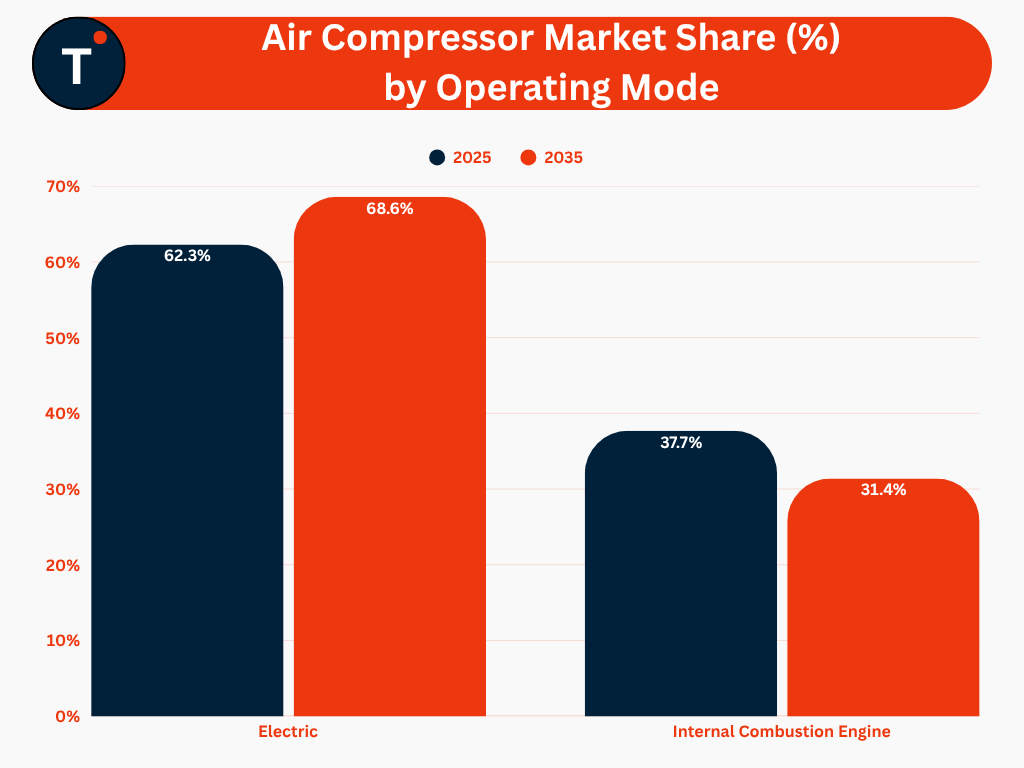
Electric air compressors are projected to account for 68.6% of the global air compressor market by 2035.
The electric air compressor market is expected to increase from US$23.59 billion in 2025 to US$42.91 billion by 2035, registering a CAGR of 6.4%.
Internal combustion engine air compressors represented 37.7% of the global air compressor market in 2025, with a market value of US$14.28 billion.
By 2035, the internal combustion engine air compressor market is estimated to reach US$19.66 billion, at a CAGR of 3.2%.
Oil-Injected vs. Oil-Free Air Compressors
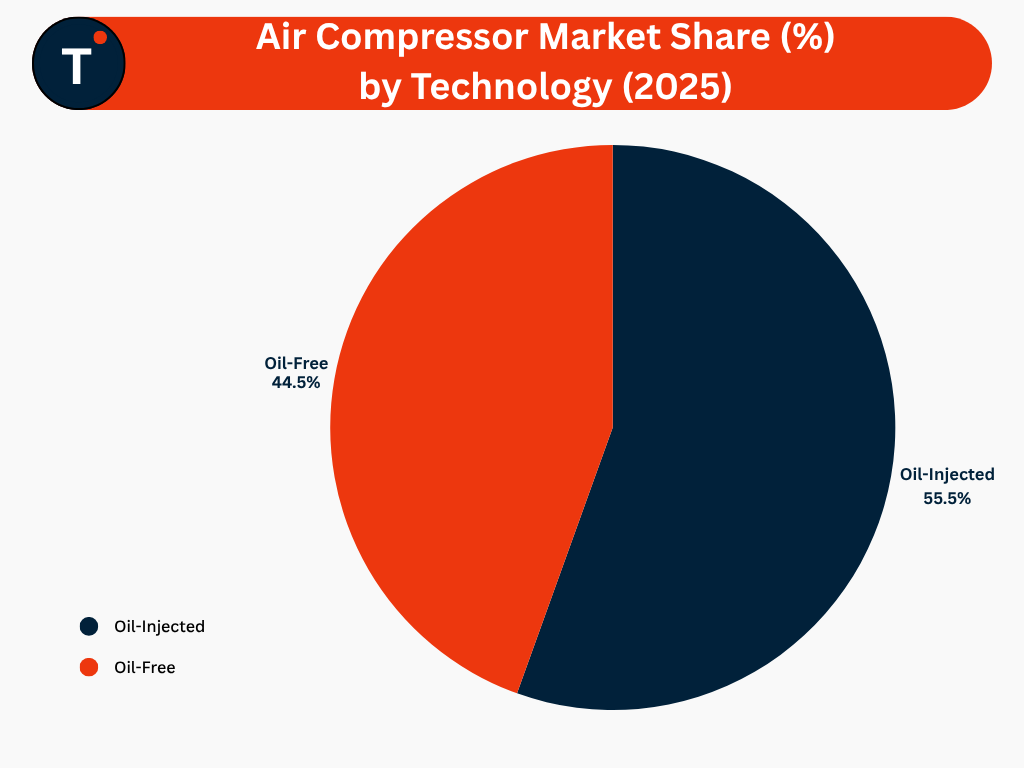
Oil-injected air compressors held the largest share of the global air compressor market at 55.5% in 2025.
The oil-injected air compressor market was valued at US$21.04 billion and is projected to reach US$32.74 billion by 2035, registering a CAGR of 4.7%.
Oil-free air compressors are projected to be the faster-growing technology, with a CAGR of 6.0%.
By 2035, oil-free air compressors are expected to account for 47.7% of the global air compressor market, with market value reaching US$29.83 billion, up from US$16.84 billion in 2025.
Global Air Compressor Market by Coolant Type
Coolant Type
2025 (US$ Bn)
2030 (US$ Bn)
2035 (US$ Bn)
Air-cooled
29.91
37.39
50.17
Water-cooled
7.96
9.83
12.40
Air-cooled compressors accounted for 79% of the global air compressor market in 2025.
The air-cooled compressor market was valued at US$29.91 billion and is projected to reach US$50.17 billion by 2035, registering a CAGR of 5.5%.
Water-cooled compressors held the remaining 21% market share in 2025, with the water-cooled air compressor market valued at US$7.96 billion.
By 2035, the water-cooled air compressor market is projected to reach US$12.40 billion, at a CAGR of 4.6%.
Global Air Compressor Market by Power Range
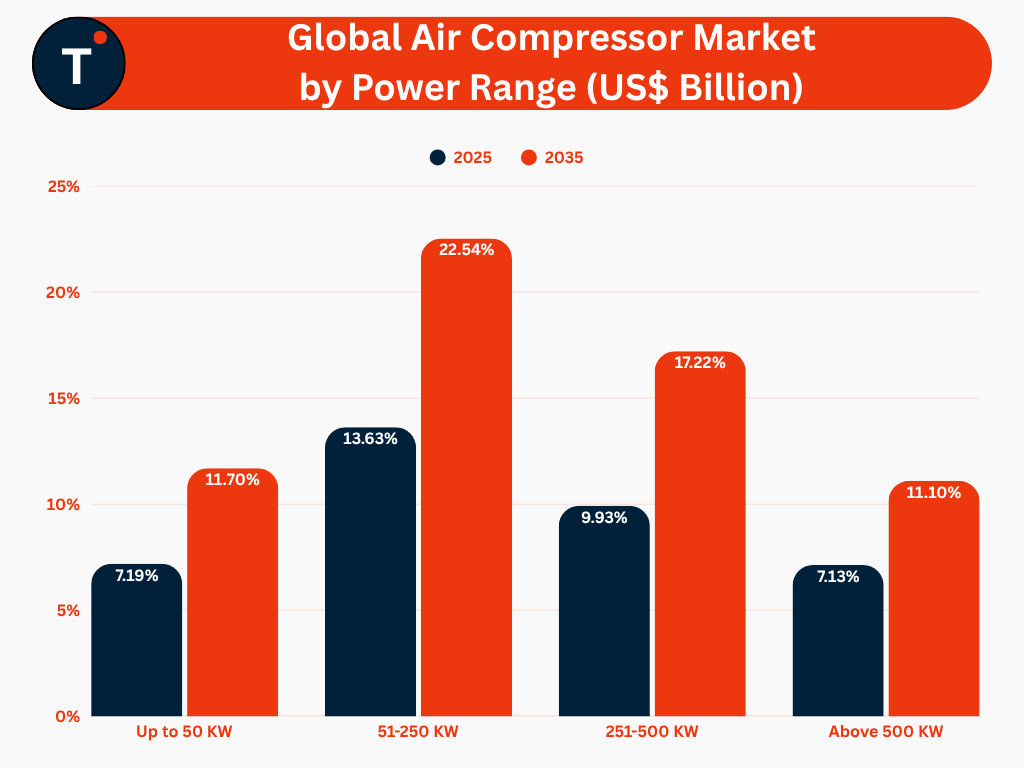
The 51–250 kW power range dominated the global air compressor market in 2025. The 51–250 kW air compressor market stood at US$13.63 billion in 2025 and is forecast to reach US$22.54 billion by 2035, at a CAGR of 5.4%.
The 251–500 kW power range accounted for 26.2% of the global air compressor market in 2025. Valued at US$9.93 billion in 2025, the 251–500 kW air compressor market is forecast to reach US$17.22 billion by 2035, registering a CAGR of 5.7%.
Air compressors up to 50 kW held a 19% share of the global market in 2025. The up to 50 kW air compressor market stood at US$7.19 billion and is forecast to reach US$11.70 billion by 2035, at a CAGR of 5.1%.
Air compressors above 500 kW represented 18.8% of the global market in 2025, with the above 500 kW air compressor market valued at US$7.13 billion. By 2035, the above 500 kW air compressor market is forecast to reach US$11.10 billion, registering a CAGR of 4.6%.
Global Air Compressor Market by Pressure Range
Pressure Range
2025 (US$ Bn)
2030 (US$ Bn)
2035 (US$ Bn)
Up to 20 Bar
15.29
19.38
26.09
21-100 Bar
15.63
19.24
25.60
Above 100 Bar
6.96
8.61
10.88
Air compressors operating at 21–100 bar held the largest market share at 41.3% in 2025. The 21–100 bar air compressor market is projected to increase from US$15.63 billion in 2025 to US$25.60 billion by 2035, registering a CAGR of 5.2%.
Air compressors operating at up to 20 bar are projected to account for 41.7% of the global air compressor market by 2035. The up to 20 bar air compressor market is expected to grow from US$15.29 billion in 2025 to US$26.09 billion by 2035, at a CAGR of 5.6%.
Air compressors operating above 100 bar accounted for 18.4% of the global market in 2025, with the above 100 bar air compressor market valued at US$6.96 billion. By 2035, the above 100 bar air compressor market is estimated to reach US$10.88 billion, registering a CAGR of 4.7%.
Which Industries Generate the Highest Air Compressor Sales?
End-use
2025 (US$ Bn)
2030 (US$ Bn)
2035 (US$ Bn)
Chemical & Petrochemical
6.89
8.33
11.66
Healthcare & Medical
2.74
3.53
4.65
Metals & Mining
2.52
3.07
3.81
Oil & Gas
6.55
8.00
10.38
Automotive & Transportation
5.39
6.89
8.98
Food & Beverage
5.68
7.37
10.15
Energy & Power
3.24
4.15
5.64
Building & Construction
1.95
2.40
3.01
Others
2.91
3.50
4.28
Chemical & Petrochemical accounted for the largest share of air compressor sales in 2025 at 18.2%, with sales of US$6.89 billion. Air compressor sales in the Chemical & Petrochemical industry are forecast to reach US$11.66 billion by 2035.
Oil & Gas represented 17.3% of air compressor sales in 2025, amounting to US$6.55 billion. Air compressor sales in the Oil & Gas industry are projected to reach US$10.38 billion by 2035.
Food & Beverage accounted for 15.0% of air compressor sales in 2025, with sales reaching US$5.68 billion. The industry’s air compressor sales are forecast to reach US$10.15 billion by 2035.
Automotive & Transportation held a 14.2% share of air compressor sales in 2025, equivalent to US$5.39 billion. Air compressor sales in Automotive & Transportation are projected to reach US$8.98 billion by 2035.
Energy & Power accounted for 8.6% of air compressor sales in 2025, with sales of US$3.24 billion. The industry is expected to generate US$5.64 billion in air compressor sales by 2035.
Healthcare & Medical accounted for 7.2% of air compressor sales in 2025, with sales of US$2.74 billion. Air compressor sales in Healthcare & Medical are forecast to reach US$4.65 billion by 2035.
Metals & Mining held a 6.6% share in 2025, with air compressor sales valued at US$2.52 billion. The industry’s air compressor sales are projected to reach US$3.81 billion by 2035.
Building & Construction represented 5.2% of air compressor sales in 2025, generating US$1.95 billion. Air compressor sales in Building & Construction are expected to reach US$3.01 billion by 2035.
How Long Should a Truck-Mounted Air Compressor Last?
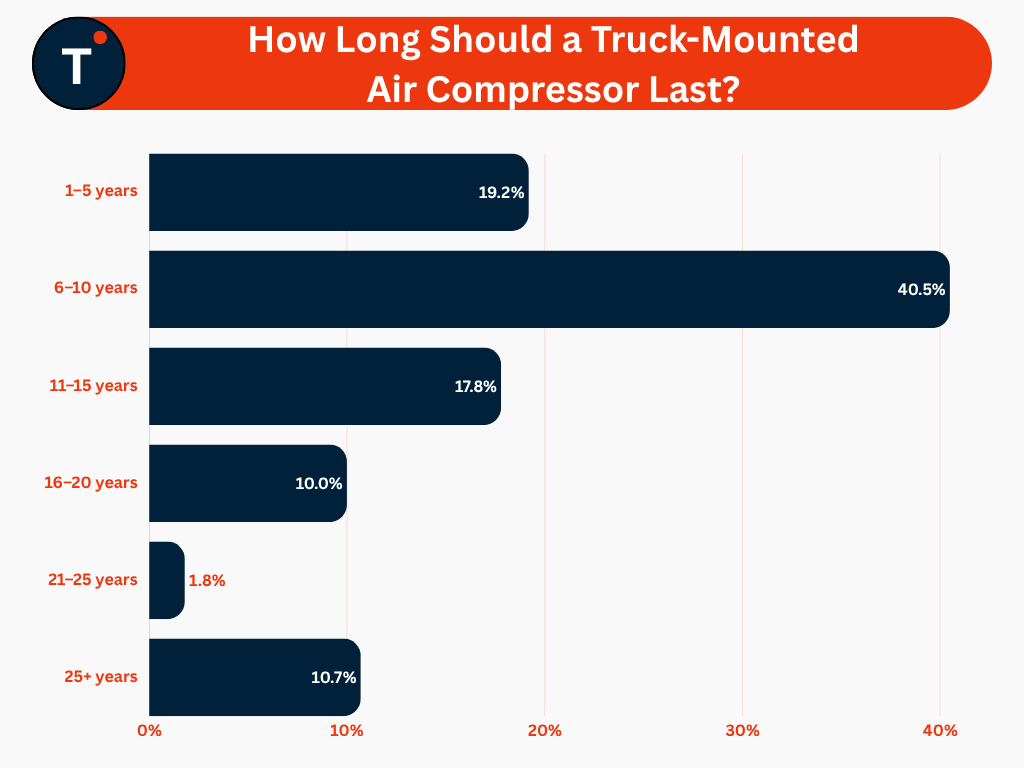
6–10 years represented the most common expected lifespan, accounting for 40.5% of responses.
1–5 years accounted for 19.2% of the expected lifespan distribution.
11–15 years represented 17.8% of responses.
25+ years accounted for 10.7% of the distribution.
16–20 years represented 10.0% of responses.
21–25 years accounted for 1.8%, representing the smallest share.
Which US Cities Offer the Highest Pay for Air Compressor Technicians?
City
Annual Salary
Monthly Pay
Weekly Pay
Hourly Wage
Nome, AK
$78,682
$6,556
$1,513
$37.83
Berkeley, CA
$77,664
$6,472
$1,493
$37.34
Sitka, AK
$76,411
$6,367
$1,469
$36.74
Mountain View, CA
$74,825
$6,235
$1,438
$35.97
San Francisco, CA
$74,729
$6,227
$1,437
$35.93
Santa Clara, CA
$74,492
$6,207
$1,432
$35.81
Sunnyvale, CA
$74,443
$6,203
$1,431
$35.79
Livermore, CA
$74,400
$6,200
$1,430
$35.77
San Jose, CA
$74,271
$6,189
$1,428
$35.71
Milpitas, CA
$73,917
$6,159
$1,421
$35.54
What Is the Best Air Compressor on the Market?
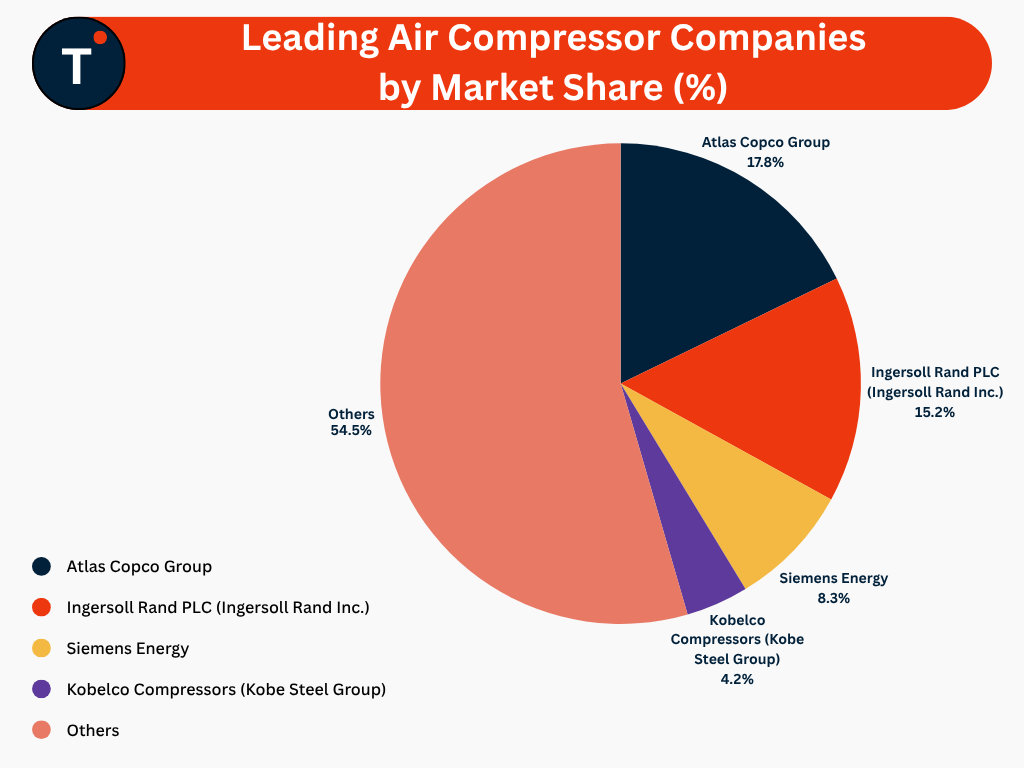
Atlas Copco Group held an 17.8% share of the air compressor market, representing the largest share among the named companies.
Ingersoll Rand PLC (Ingersoll Rand Inc.) accounted for 15.2% of the air compressor market.
Siemens Energy represented 8.3% of the market.
Kobelco Compressors (Kobe Steel Group) held a 4.2% market share.
Other air compressor manufacturers collectively accounted for 54.5% of the market, indicating a highly fragmented competitive landscape beyond the leading companies.
Recent Industry Developments
In May 2026, Ingersoll Rand and Garrett Motion entered a multiyear strategic partnership to advance next-generation oil-free compressor technology for industrial air compression systems, targeting key verticals such as food and beverage and life sciences.
In May 2026, Atlas Copco acquired LVC Solutions N.V. (LVC), a Belgian compressed air distributor, strengthening its distribution presence in the compressed air market.
In April 2026, Atlas Copco launched the X-Air+ 900-435 in the USA, a silenced, two-stage, oil-injected screw compressor developed for demanding drilling applications. The high-pressure compressor combines advanced compressor management with a broad working pressure range to support productivity while controlling fuel consumption and operating costs.
In April 2026, Bobcat Company expanded its portable air compressor portfolio with the Bobcat PA375V, designed for ease of use and extended service intervals.
In March 2026, Atlas Copco introduced the X-Air 900-20, expanding its DrillAir portfolio with a flexible, application-driven portable air compressor designed for mining and construction operations worldwide.
In March 2026, Hitachi Industrial Equipment Systems Co., Ltd. launched GREEN SCREW OIL, a plant-based lubricant for oil-flooded screw air compressors. The lubricant is designed to reduce manufacturing-stage CO₂ emissions by approximately 90% and lifecycle CO₂ emissions by approximately 40% compared with conventional synthetic oils.
In January 2026, Atlas Copco Group acquired Air Compressor Works Inc., a compressed air distributor based in Florida, further expanding its distribution network in the U.S.
In November 2025, FS-Curtis launched the ECO-Pure Oil-Free Rotary Screw Air Compressor Series, offering Class 0 certified oil-free air for industries requiring high air purity, along with efficiency, low maintenance, and long-term reliability.
Conclusion
The air compressor market is being shaped by industrial expansion and the need for reliable compressed-air systems, with demand extending across manufacturing, energy, chemicals, food and beverage, healthcare, construction, and other applications.
Energy efficiency has become a central consideration in compressor adoption, as operating losses from leaks, excessive pressure, and inefficient systems continue to create significant cost burdens for end users.
The industry is experiencing a shift toward electric, oil-free, and more efficient compressor technologies, driven by requirements for cleaner air, lower operating costs, reduced maintenance, and improved environmental performance.
Technological development is increasingly focused on application-specific solutions, including high-pressure drilling compressors, portable systems, oil-free rotary screw technology, and advanced lubrication solutions.
Asia Pacific remains a key regional market, while North America and Europe continue to contribute significantly through industrial applications, technological adoption, and equipment upgrades.
The competitive landscape indicates continued technological advancement as manufacturers focus on improving compressor efficiency, reliability, service life, air purity, and overall operating performance.
Add TriCityLocalNews as a Preferred Source on Google for instant updates!
Jeff Goldman is a veteran technology journalist with over 15 years of experience covering the intersection of enterprise IT and digital innovation. He holds a B.A. in Computer Science, from Harvard University. Since 2010, Jeff has been a dedicated contributor to leading technology publications, breaking down complex industry shifts into actionable insights. His reporting primarily focuses on cybersecurity, enterprise networking, cloud storage, and emerging mobile technologies. Armed with a deep technical background, Jeff specializes in making highly specialized IT concepts accessible to both industry professionals and tech enthusiasts alike.
We use cookies to ensure that we give you the best experience on our website. If you continue to use this site we will assume that you are happy with it.