








Workplace violence encompasses acts or threats of violence occurring in a work-related environment. It includes a broad spectrum of behaviors, ranging from verbal abuse and intimidation to physical assault directed at employees while performing their job responsibilities. Workplace violence can occur across all industries, occupations, and work environments.
The consequences of workplace violence extend beyond physical harm, affecting employee well-being, organizational productivity, and workplace safety. Incidents may result in psychological trauma, physical injuries, lost workdays, and, in severe cases, fatalities.
The likelihood of fatal workplace violence is highest among employees in sales, protective services, and transportation occupations. In contrast, healthcare and social assistance workers experience the highest incidence of nonfatal workplace violence resulting in days away from work, underscoring the elevated safety risks within these sectors.
Editor’s Choice
- More than 20% of workers worldwide have experienced workplace violence during their careers.
- Nearly 2 million U.S. workers are affected by some form of workplace violence each year, according to the Occupational Safety and Health Administration (OSHA).
- The U.S. Bureau of Labor Statistics (BLS) recorded 740 workplace fatalities resulting from violent acts in 2023, out of 5,283 total fatal occupational injuries.
- Workplace homicides accounted for 458 fatalities in 2023, highlighting violence as a significant contributor to occupational deaths in the United States.
- More than 60% of U.S. states have enacted or are actively developing workplace violence prevention mandates.
- 73% of all nonfatal workplace violence incidents occur within the healthcare and social assistance sector, according to the U.S. Bureau of Labor Statistics.
- Healthcare workers are five times more likely to experience workplace violence than employees in other occupations.
- The workplace assault rate increased by 62% between 2011 and 2022, compared with a 13% increase in the national aggravated assault rate, according to the National Council on Compensation Insurance (NCCI).
- Workplace violence costs U.S. businesses an estimated US$167 billion annually, including expenses related to medical care, productivity losses, employee turnover, legal liabilities, and reputational damage.
- Comprehensive workplace violence prevention programs can reduce violent incidents by up to 25% and generate an estimated US$3 in savings for every US$1 invested.
- 28% of workplace sexual violence incidents occur within the accommodation, food services, and retail industries.
- 80% of emergency physicians report that workplace violence negatively affects the quality of patient care.
- 25% of workplace violence incidents remain unreported.
- Workplace productivity can decline by up to 50% following a violent workplace incident.
General Statistics
- Workplace assaults resulted in 77,780 DART (Days Away, Restricted, or Transferred) cases, including 54,230 DAFW (Days Away From Work) cases, during 2023–2024, while 470 workplace fatalities were attributed to violent incidents in 2024.
- Female workers accounted for 68.9% of DART cases during 2023–2024, whereas 15.3% of workplace violence fatalities in 2024 involved female workers.
- Workers aged 25–34 years recorded the highest number of both DART cases during 2023–2024 and workplace violence fatalities in 2024.
- 67% of workplace violence victims who experienced trauma were between 25 and 54 years of age.
- 64% of workers who died as a result of workplace violence were 25 to 54 years old.
- Taxi drivers face a workplace homicide risk more than 20 times higher than the average worker, according to the Occupational Safety and Health Administration (OSHA).
- The combined homicide and suicide rate remained at 0.5 per 100,000 full-time equivalent (FTE) workers in 2024, unchanged from 2023, despite an increase in the total number of incidents.
- The United States recorded 2.5 million nonfatal workplace injuries and illnesses in 2024, while 5,070 occupational fatalities were reported during the same year.
- One in seven employees report feeling unsafe in their workplace.
- Assaults account for 75% of all workplace violence incidents.
- 62% of workplace active shooter incidents involved perpetrators with mental health issues.
- Head injuries account for 35% of injuries resulting from workplace violence.
- 94% of employees report being affected by workplace bullying.
- Each workplace violence incident results in an average of eight employee sick days, reflecting its impact on workforce productivity and well-being.
The Scale of Workplace Violence
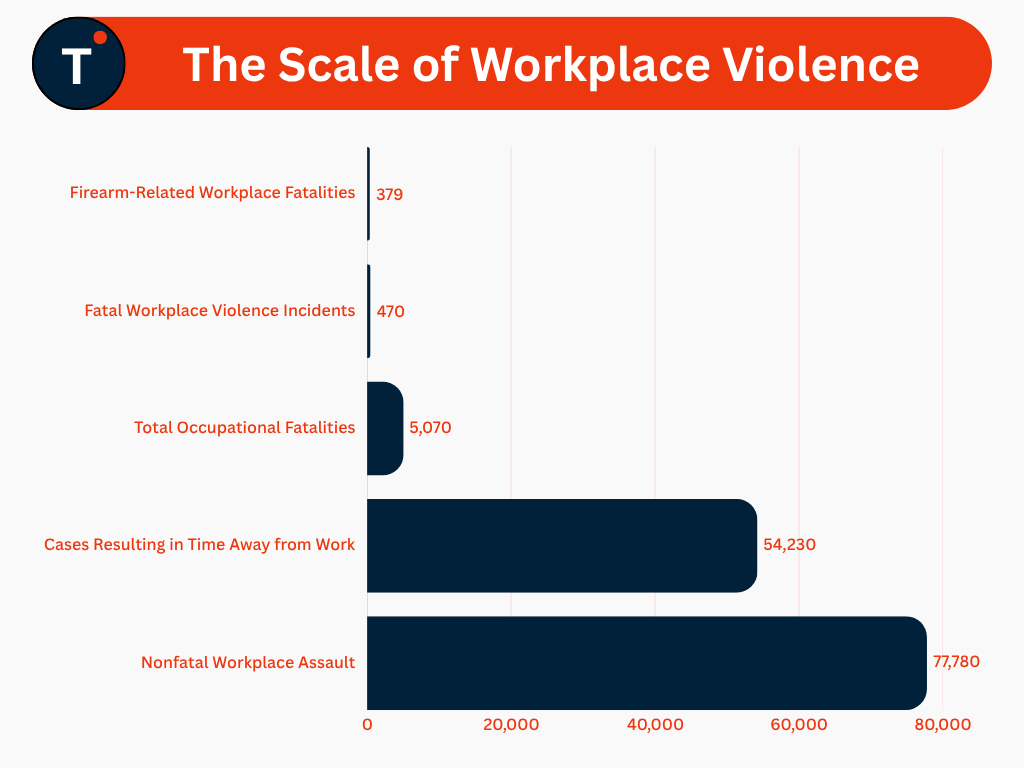
- Nonfatal workplace assaults accounted for 77,780 incidents, representing the largest category of workplace violence cases.
- 54,230 workplace violence incidents resulted in days away from work, reflecting the significant impact of violent events on workforce productivity.
- A total of 5,070 occupational fatalities were recorded across all workplace incidents.
- Fatal workplace violence incidents reached 470 cases, highlighting the continued risk of violence-related occupational deaths.
- Firearm-related incidents accounted for 379 workplace fatalities, representing a substantial share of fatal workplace violence cases.
Four Types of Workplace Violence
| Type | Definition | Share of Homicides | Highest-Risk Sectors | Risk Level |
| Type 1 — Criminal Intent | Violence committed by individuals with no legitimate relationship to the workplace, including robberies and armed assaults. | ~80% | Retail, food service, hospitality, gas stations | Highest |
| Type 2 — Customer / Client | Violence perpetrated by individuals receiving services, including patients, customers, students, or passengers. | ~10% | Healthcare (70-75% of nonfatal assaults), education, social services | High |
| Type 3 — Worker-on-Worker | Violence involving current or former employees, often associated with termination, disciplinary actions, or workplace conflicts. | ~7% | Manufacturing, logistics, office environments | Moderate |
| Type 4 — Personal Relationship | Domestic or personal relationship violence that extends into the workplace and disproportionately affects women. | ~3% | All sectors; women in healthcare and retail most affected (BLS) | Moderate |
Distribution of Workplace Violence Incidents
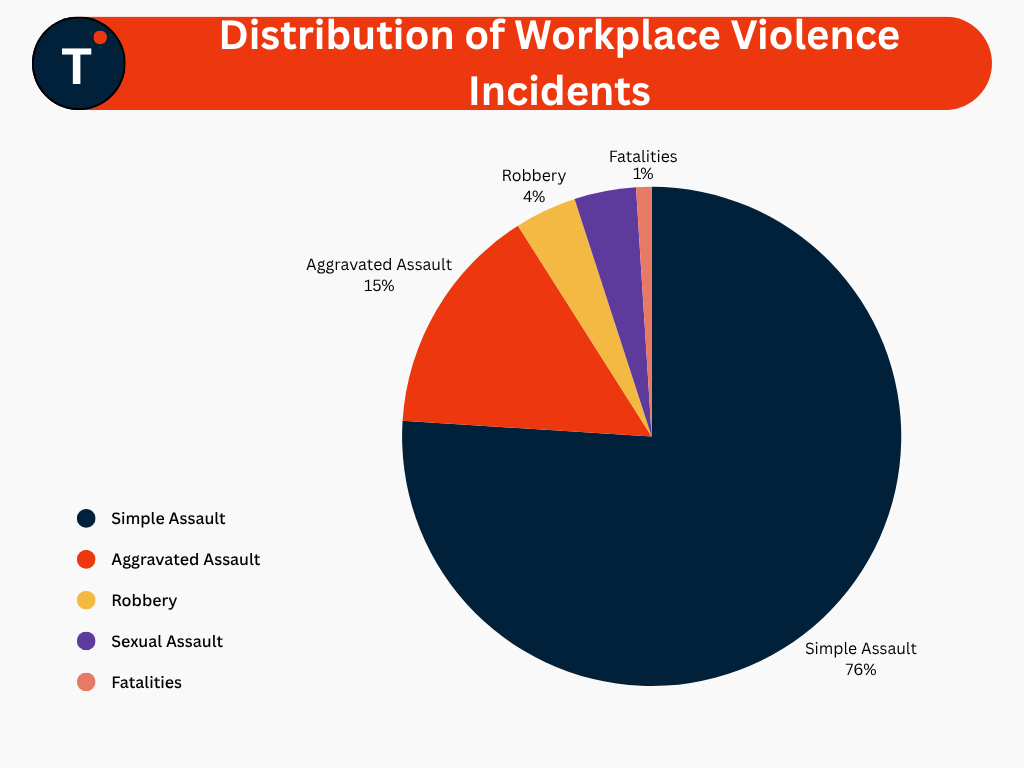
- Simple assaults account for 76% of workplace violence incidents, representing the most common form of workplace violence.
- Aggravated assaults comprise 15% of reported incidents, making them the second-largest category.
- Robberies contribute 4% of workplace violence incidents.
- Sexual assaults represent 4% of total workplace violence cases.
- Fatal incidents account for 1% of all workplace violence incidents, representing the smallest share of reported cases.
The Gender Gap in Workplace Violence
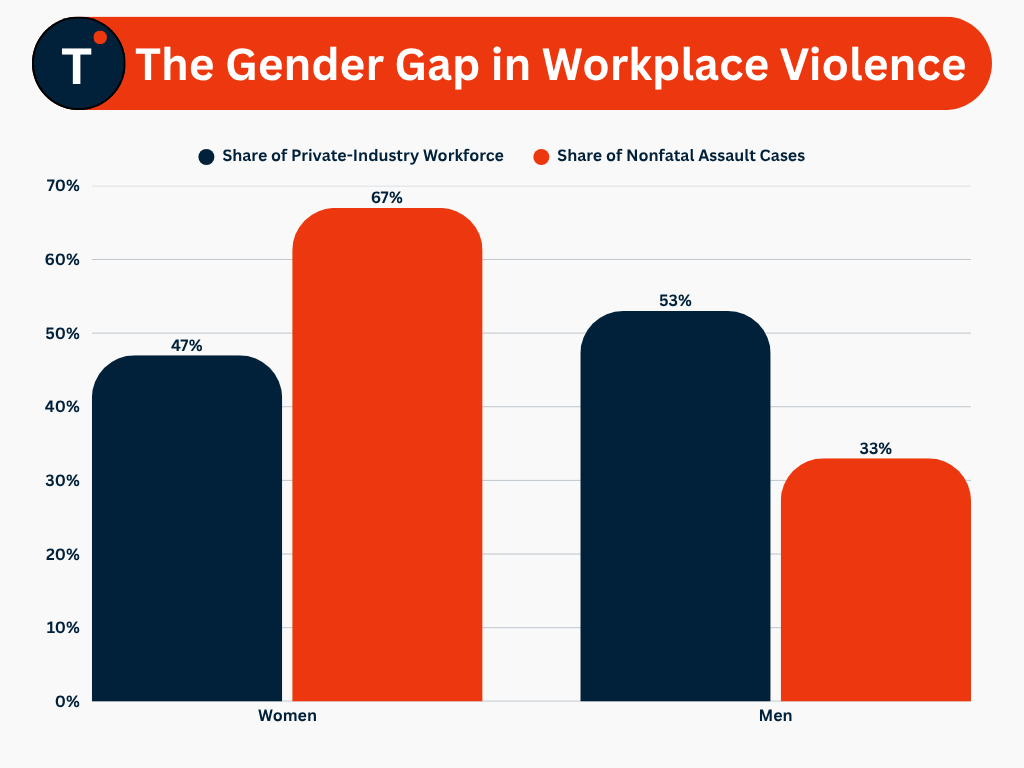
- Women represent 47% of the private-sector workforce but account for 67% of nonfatal workplace assault cases, indicating a disproportionately higher share of nonfatal workplace violence incidents.
- Men comprise 53% of the private-sector workforce while accounting for 33% of nonfatal workplace assault cases.
Workplace Violence by Industry
- The healthcare and social assistance sector recorded 55,980 serious workplace assault cases during 2023–2024, the highest among all industries, with an incidence rate of 17.1 cases per 10,000 full-time equivalent (FTE) workers.
- Educational services reported 5,530 serious workplace assault cases during 2023–2024, with an incidence rate of 8.4 cases per 10,000 FTE workers, representing the second-highest industry.
- The leisure and hospitality industry recorded 2,850 workplace violence cases during the same period.
- Retail trade accounted for 4,660 workplace assault cases, while professional and business services reported 4,410 cases between 2023 and 2024.
- U.S. restaurants reported 10,490 violent crime incidents in 2021, highlighting the continued prevalence of workplace violence within the food service industry.
- 37% of women and 14% of men employed in the restaurant industry experienced workplace sexual harassment.
- 53% of hotel workers reported experiencing workplace harassment.
- Assault incidents in grocery stores increased by 63% between 2018 and 2020, while convenience stores recorded a 75% increase over the same period.
- Three out of four healthcare workers report exposure to workplace violence during their careers.
The State of Workplace Violence in the Healthcare Sector
- 84.8% of nurses experienced at least one form of workplace violence during the previous year.
- General medical and surgical hospitals recorded a 150% increase in violent incidents over the past decade.
- Patient-perpetrated aggressive events occurred at a rate of 2.54 incidents per 20-patient bed unit, highlighting the frequency of violence in healthcare settings.
- 26.3% of nurses reported an increase in workplace violence between 2022 and 2023, while 81.6% experienced at least one type of workplace violence during the same period.
- 42.5% of nurses indicated that their employers did not implement changes to reduce workplace violence risks, while 22.8% reported that workplace violence incidents were ignored after being reported.
- 59.0% of nurses stated that their employers conduct investigations following workplace violence incidents, whereas 17.4% reported being reprimanded or blamed after reporting violent events.
- The annual financial impact of workplace violence on U.S. hospitals reached US$18.27 billion in 2023.
- Pre-incident prevention measures accounted for US$3.62 billion in annual costs, including investments in violence prevention within healthcare facilities and surrounding communities.
- Post-incident costs totaled US$14.65 billion annually, covering healthcare expenses, lost productivity, case management, staffing requirements, and infrastructure repairs.
Percentage Breakdown of Estimated 2023 Violence Costs to U.S. Hospitals & Health Systems (By Pre & Post-Event and Component Costs)
| Cost Category | Percentage Breakdown of Estimated 2023 Violence Costs to U.S. Hospitals & Health Systems (By Pre & Post-Event and Component Costs) |
| Pre-Event Costs | 19.8% |
| Training | 7.7% |
| Violence Prevention Programs | 5.3% |
| Technology | 2.5% |
| Security Personnel & Staff | 2.2% |
| Facility Modifications | 1.6% |
| Outreach to Build Public Trust | 0.4% |
| Policies & Procedures | 0.1% |
| Post-Event Costs | 80.2% |
| Health Care for Fatal & Nonfatal Injuries | 72.1% |
| Infrastructure Repair & Replacement | 3.2% |
| Staffing | 3.0% |
| Case Management | 1.4% |
| Work Loss Costs for Healthcare Workers | 0.4% |
| Public Relations | 0.1% |
Workplace Violence Experienced by Nurses in the U.S.
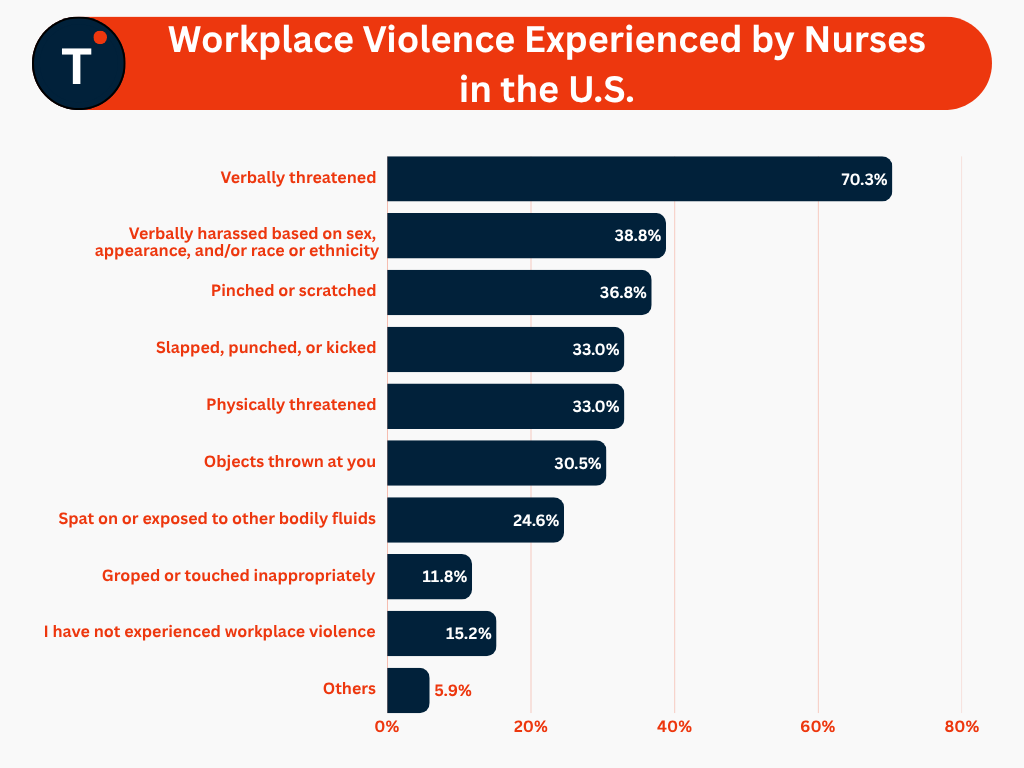
- 70.3% of nurses report being verbally threatened, making it the most common form of workplace violence.
- 38.8% of nurses experience verbal harassment related to sex, appearance, or other personal characteristics.
- 36.8% of nurses report being pinched or scratched while performing their duties.
- 33.0% of nurses experience physical threats in the workplace.
- 33.0% of nurses report being slapped, punched, or kicked while on duty.
- 30.5% of nurses experience incidents involving objects being thrown at them.
- 24.6% of nurses report being spat on or exposed to bodily fluids.
- 11.8% of nurses experience inappropriate touching or groping in the workplace.
- 15.2% of nurses report not experiencing workplace violence, indicating that the majority encounter at least one form of violence during their careers.
Impact of Workplace Violence on Nurses in the U.S.
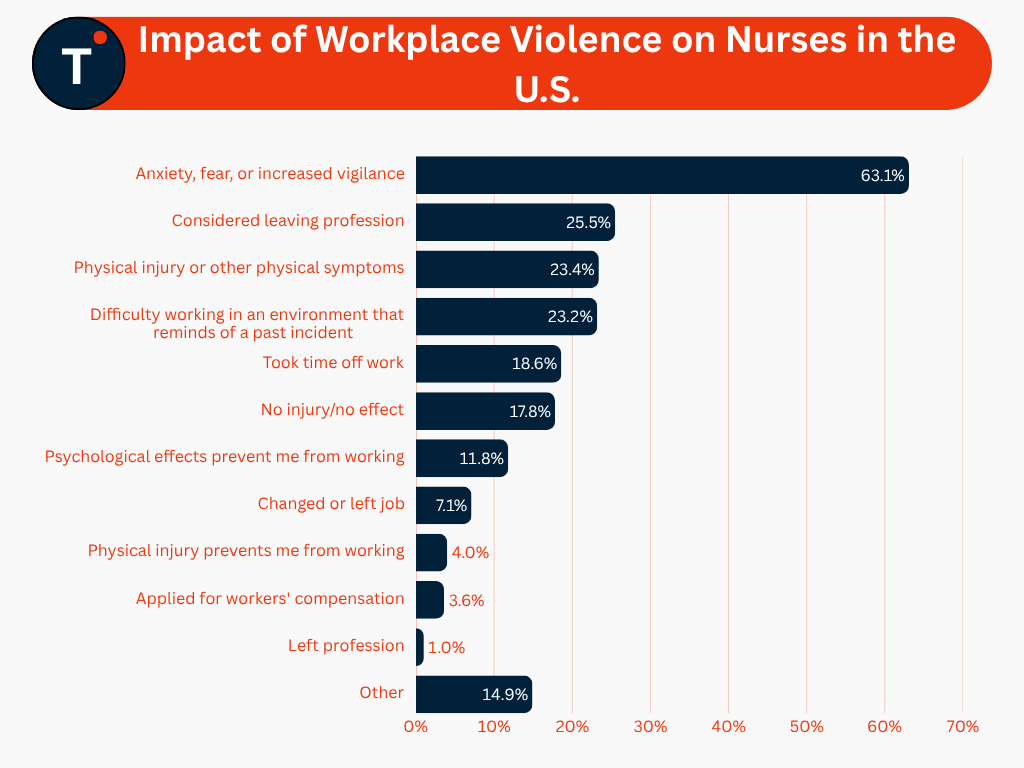
- 63.1% of nurses report experiencing anxiety, fear, or increased vigilance following workplace violence, making it the most common consequence.
- 25.5% of nurses have considered leaving the nursing profession due to workplace violence.
- 23.4% of nurses experience physical injuries or related symptoms, including headaches, stomach aches, and other health conditions.
- 23.2% of nurses report difficulty working in environments that remind them of previous violent incidents.
- 18.6% of nurses have taken time away from work following a workplace violence incident.
- 17.8% of nurses report no physical injury or lasting impact after experiencing workplace violence.
- 11.8% of nurses indicate that psychological effects prevent them from working.
- 7.1% of nurses have changed jobs or left their employer as a result of workplace violence.
- 4.0% of nurses report that physical injuries prevent them from returning to work.
- 3.6% of nurses have filed workers’ compensation claims following workplace violence incidents.
- 1.0% of nurses have left the nursing profession entirely due to workplace violence.
Workplace Injuries Sustained During Assaults
- A total of 77,780 workplace violence incidents were recorded during 2023–2024, with sprains and strains accounting for 18,750 cases (24%), making them the most common injury type.
- Bruises and contusions represented 16,230 cases (21%), ranking as the second most frequently reported workplace assault injury.
- Soreness and swelling accounted for 6,130 cases (7.9%) resulting from workplace assaults.
- Cuts and lacerations comprised 5,070 cases (6.5%) of all workplace violence-related injuries.
- Fractures totaled 2,860 cases (3.7%) and, despite their relatively lower frequency, often resulted in extended recovery periods and prolonged work absences.
- Hitting, kicking, or beating accounted for 73,490 assault-related injuries (94%), representing the primary mechanism of workplace violence.
- Workers providing medical or custodial care experienced 61,760 assault-related injuries, accounting for 79% of all workplace assault cases.
- Severe but less frequent injuries included 500 stabbing and cutting incidents, 210 shooting incidents, and 170 strangulation cases, reflecting the continued occurrence of high-severity workplace violence events.
Regulatory Landscape for Workplace Violence Prevention
| State | Regulations | Description |
| California | SB 553 — Workplace Violence Prevention Plan | Requires employers with 10 or more employees to maintain a written workplace violence prevention plan, conduct hazard assessments, and provide employee training. Enforcement began July 1, 2024, and applies across industries, including manufacturing, retail, and healthcare. |
| New York | NY HERO Act — Workplace Safety | Requires employers to implement comprehensive workplace safety plans. Healthcare facilities are subject to additional requirements under the Health and Essential Rights Act, including workplace violence prevention protocols and employee training. |
| Federal — OSHA | Proposed Healthcare Violence Standard | OSHA’s proposed standard would establish the first federal workplace violence prevention regulation specifically for the healthcare sector. Until implementation, healthcare employers remain subject to the OSHA General Duty Clause, which requires employers to maintain a workplace free from recognized hazards. |
| Illinois | HB 2493 — Hospital Patient Safety Act | Strengthens workplace violence prevention across Illinois hospitals by mandating structured prevention frameworks, standardized risk assessments, comprehensive incident reporting mechanisms, and real-time response capabilities supported by technology. |
| 38 States | Alyssa’s Law — K-12 School Safety | As of 2026, Alyssa’s Law has been enacted or introduced in 38 states, requiring K-12 schools to install silent panic alarm systems integrated with law enforcement first responder networks. Compliance deadlines vary between 2024 and 2027. |
| Texas / Florida | Sandra’s Law + FortifyFL | Texas and Florida have implemented safety initiatives requiring documented threat assessment programs and real-time incident reporting infrastructure across K-12 schools and higher education institutions to strengthen violence prevention and emergency response capabilities. |
Conclusion
- Workplace violence remains a critical occupational safety challenge, affecting employees across industries through physical assaults, verbal abuse, harassment, and other forms of violence, with significant implications for workforce well-being and organizational performance.
- The healthcare and social assistance sector continues to experience the highest incidence of workplace violence, with nurses and frontline healthcare professionals facing disproportionately greater exposure to violent incidents than workers in other industries.
- Workplace violence imposes substantial economic and operational costs through medical expenses, productivity losses, absenteeism, employee turnover, legal liabilities, and infrastructure damage, underscoring the importance of preventive risk management.
- Women account for a disproportionate share of nonfatal workplace assault cases, highlighting the need for targeted prevention strategies and enhanced employee protection measures in high-risk occupations.
- Assaults remain the predominant form of workplace violence, while projectiles, physical threats, verbal abuse, and severe incidents involving firearms and other weapons continue to present significant workplace safety risks.
Increasing adoption of workplace violence prevention legislation, employer training programs, risk assessments, incident reporting systems, and emergency response protocols reflects a growing regulatory emphasis on strengthening workplace safety standards.