Freelancing has emerged as a widely adopted employment model across diverse industries, offering professionals greater flexibility and access to project-based opportunities. The freelance workforce continues to expand as businesses increasingly leverage independent talent to address evolving operational requirements and specialized skill demands.
The freelance landscape is undergoing significant transformation, influenced by changing workforce preferences, advancements in artificial intelligence, digitalization, and shifting economic conditions. As organizations continue to embrace flexible work arrangements, staying informed about the latest freelance trends and market developments has become essential for understanding the evolving dynamics of the global workforce.
Editor’s Picks
39% of the U.S. workforce participated in freelance work, representing a 4% increase from 2025.
The U.S. freelance workforce is projected to reach 86.5 million by 2027, accounting for 50.9% of the total workforce.
38% of skilled knowledge workers operate as freelancers or independent professionals.
Freelancers generated US$1.5 trillion in earnings during 2024, underscoring their economic contribution.
29% of business executives identify freelancers as highly essential to their business operations.
92% of freelancers hold a bachelor’s degree or higher, compared with 69% of full-time employees.
78% of CEOs report that their highest-performing freelancers deliver greater value than degree-holding full-time employees.
77% of business leaders indicate that AI is increasing demand for fractional talent with specialized expertise.
Freelancers in the United States earn an average annual income of US$99,230.
In 2025, skilled full-time employees earned a median annual wage of US$109,000, compared with US$101,000 for skilled freelancers. However, the bottom 25% of full-time employees earned US$65,000, while the bottom 25% of freelancers earned US$80,000.
Women accounted for 52.3% of the freelance workforce, while men represented 47.7%.
Male freelancers charged 26.4% higher rates than female freelancers, on average.
General Statistics
87% of skilled knowledge freelancers prefer projects that enable them to develop new skills or enhance existing capabilities.
28% of freelancers work entirely remotely, compared with 5% of full-time employees.
35% of professionals identify remote work as their preferred work arrangement.
63% of freelancers have been freelancing for more than three years, including 8% with over 10 years of freelance experience.
41% of freelancers use AI agents to perform autonomous and complex tasks, compared with 34% of full-time employees.
Freelancers incorporating AI into their work earn 34% more per hour than those who do not use AI.
AI-enabled professional services recorded 72% year-over-year growth, while earnings increased 22%. Freelancers performing more complex AI-driven work experienced a 45% increase in earnings.
63% of freelancers work with multiple organizations simultaneously.
89% of freelancers report having more work opportunities than the previous year, compared with 70% of full-time employees.
58% of full-time knowledge workers are considering freelancing to access broader professional opportunities.
89% of skilled freelancers view AI as an opportunity to enhance their services, offerings, and workflows.
80% of freelancers believe the outlook for freelancing will continue to improve.
86% of freelancers express satisfaction with their compensation, compared with 68% of full-time employees.
81% of C-suite executives are adopting skills-based hiring practices, prioritizing demonstrated capabilities over academic qualifications.
Demand for AI-related skills increased by 109% year over year.
Generative AI and creative production services recorded 90% year-over-year growth.
55% of full-time employees report using unofficial or “shadow AI” tools in the workplace.
68% of professionals seek greater organizational support for AI experimentation, while 78% pursue AI learning opportunities outside their organizations when internal training is insufficient.
13% of freelancers identify as LGBT.
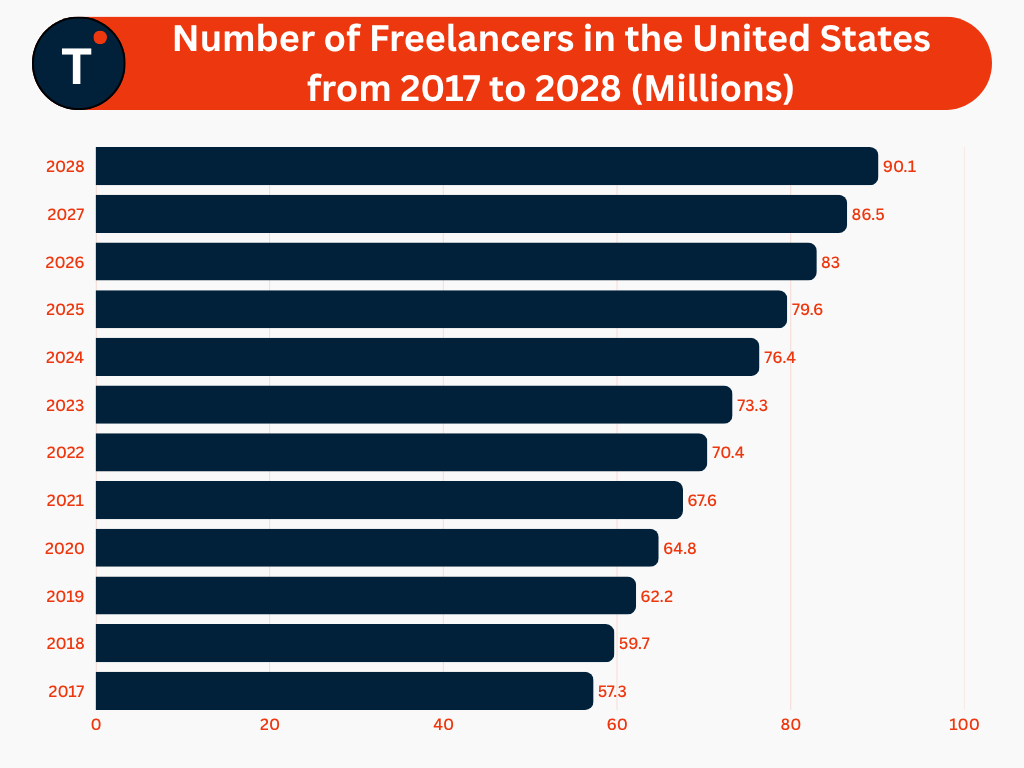
Number of Freelancers in the United States from 2017 to 2028 in Millions
The U.S. freelance workforce increased from 57.3 million in 2017 to 59.7 million in 2018.
The number of freelancers reached 62.2 million in 2019, followed by 64.8 million in 2020.
The freelance workforce expanded to 67.6 million in 2021 and 70.4 million in 2022, surpassing the 70 million milestone.
73.3 million freelancers were recorded in 2023, increasing to 76.4 million in 2024.
The U.S. freelance population reached 79.6 million in 2025 and is projected to grow to 83.0 million in 2026.
The freelance workforce is forecast to reach 86.5 million in 2027.
By 2028, the number of freelancers in the United States is projected to increase to 90.1 million, representing sustained growth over the forecast period.
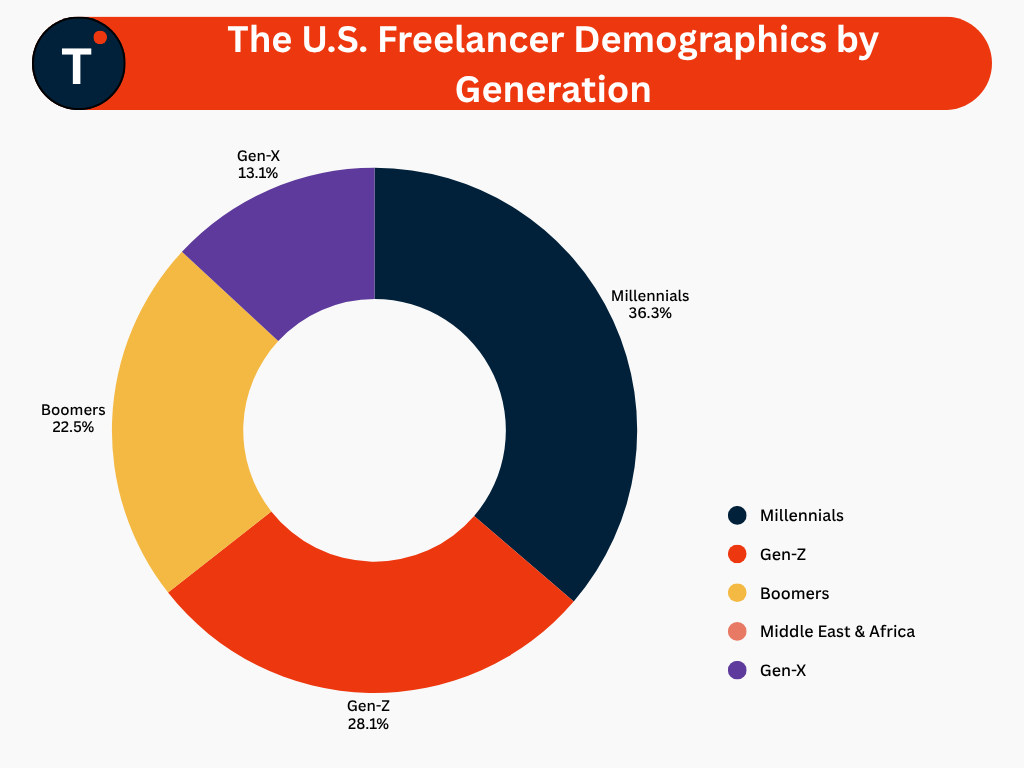
The U.S. Freelancer Demographics by Generation
Millennials account for 36.3% of the U.S. freelance workforce, representing the largest generational segment.
Generation Z comprises 28.1% of freelancers, making it the second-largest demographic group.
Baby Boomers represent 22.5% of the freelance workforce.
Generation X accounts for 13.1% of U.S. freelancers, recording the smallest share among the generations analyzed.
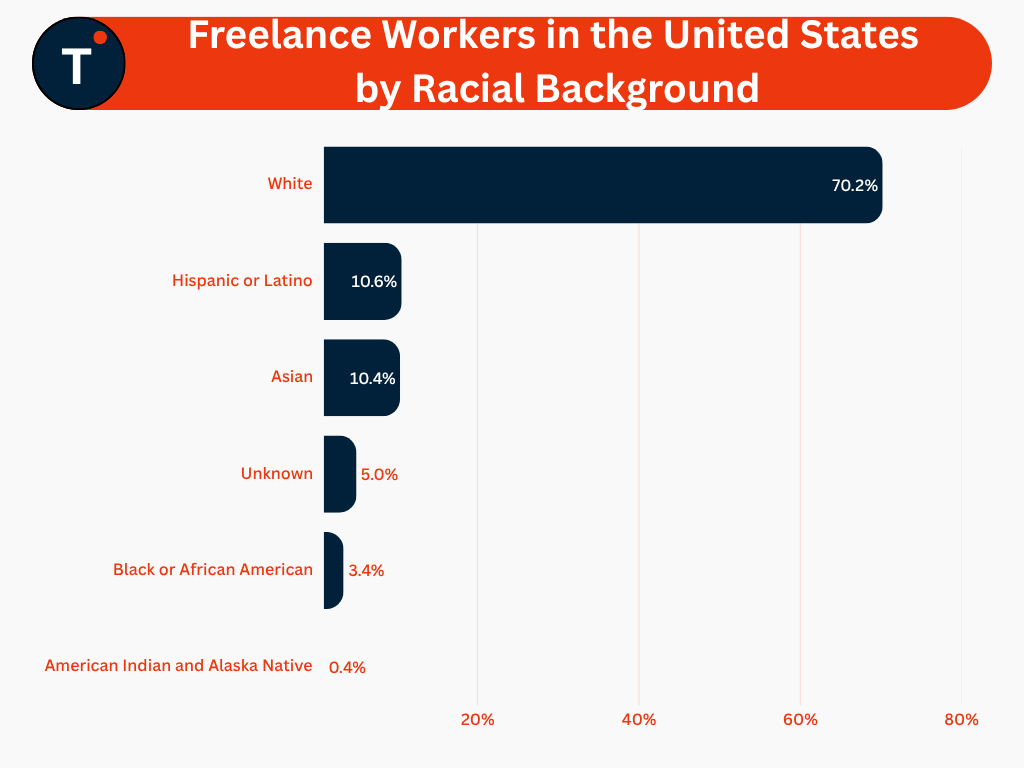
Freelance Workers in the United States by Racial Background
White professionals account for 70.2% of the U.S. freelance workforce, representing the largest racial group.
Hispanic or Latino professionals comprise 10.6% of freelancers in the United States.
Asian professionals represent 10.4% of the U.S. freelance workforce.
5.0% of freelancers have an undisclosed or unknown racial background.
Black or African American professionals account for 3.4% of freelancers.
American Indian and Alaska Native professionals represent 0.4% of the U.S. freelance workforce.
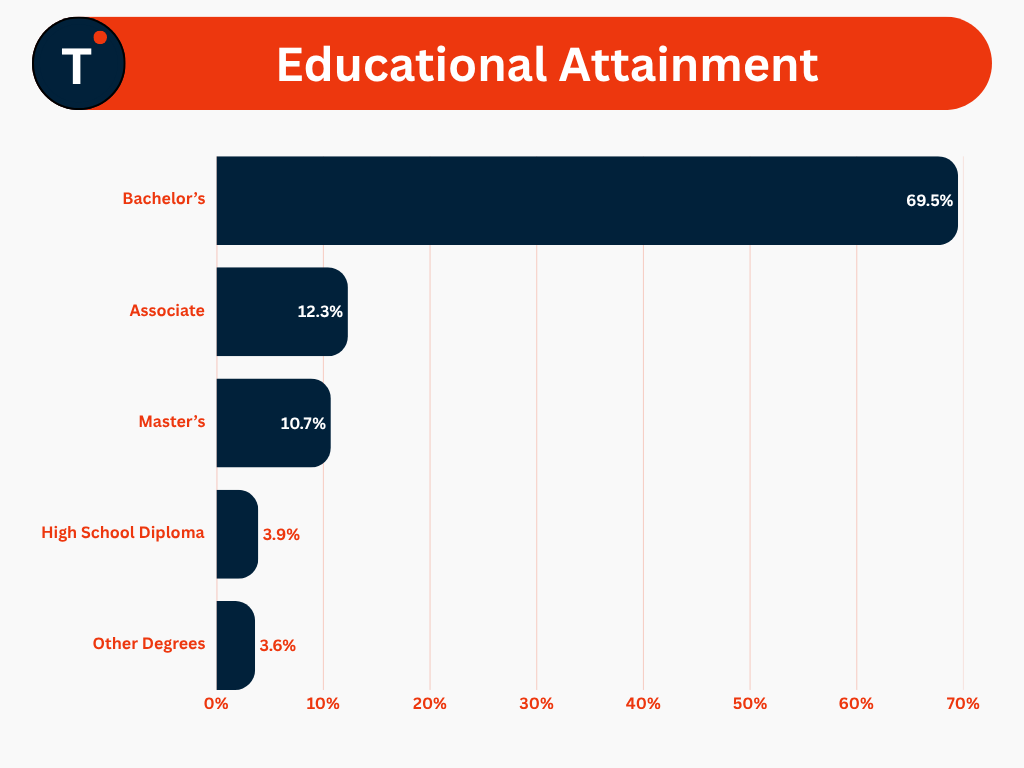
The U.S. Freelancers by Education
69.5% of U.S. freelancers hold a bachelor’s degree, representing the largest educational qualification within the freelance workforce.
12.3% of freelancers have an associate degree.
10.7% of U.S. freelancers possess a master’s degree.
3.9% of freelancers have a high school diploma as their highest educational qualification.
3.6% of freelancers hold other educational qualifications, accounting for the smallest share of the workforce.
United States Freelancer Earnings by Skills
Skill
Avg Rate (USD/hr)
YoY Growth
Generative AI / LLM development
$80–$150/hr
AI-enabled: +109%
Machine learning engineering
$70–$130/hr
+65% YoY
Cybersecurity
$60–$120/hr
+45% YoY
Blockchain / Web3 development
$65–$115/hr
+18% YoY
Cloud engineering
$60–$110/hr
+38% YoY
DevOps / platform engineering
$55–$105/hr
+32% YoY
Data engineering
$55–$100/hr
+28% YoY
Python development
$50–$100/hr
+25% YoY
Full-stack development
$50–$95/hr
+22% YoY
Mobile app development
$50–$90/hr
+15% YoY
React / front-end development
$45–$85/hr
+20% YoY
Prompt engineering
$40–$70/hr
+180% YoY
Data analytics / BI
$40–$75/hr
+22% YoY
UI/UX design
$40–$80/hr
+18% YoY
No-code / automation (Zapier, Make)
$35–$70/hr
+74% YoY
Video production and editing
$30–$65/hr
+25% YoY
SEO / content strategy
$25–$65/hr
+15% YoY
Copywriting
$25–$60/hr
+12% YoY
Social media marketing
$20–$55/hr
+36% YoY
Virtual assistance
$15–$35/hr
+10% YoY
Generative AI and LLM development command the highest freelance rates, ranging from US$80–US$150 per hour, while AI-enabled skills have grown by 109% year over year.
Machine learning engineering freelancers earn US$70–US$130 per hour, supported by 65% year-over-year growth.
Blockchain and Web3 development professionals charge between US$65–US$115 per hour, with demand increasing by 18% year over year.
Cybersecurity freelancers command hourly rates of US$60–US$120, accompanied by 45% year-over-year growth.
Cloud engineering services are priced between US$60–US$110 per hour, recording 38% year-over-year growth.
DevOps and platform engineering freelancers earn US$55–US$105 per hour, with demand rising by 32% year over year.
Data engineering professionals charge US$55–US$100 per hour, supported by 28% year-over-year growth.
Python development freelancers earn US$50–US$100 per hour, reflecting 25% year-over-year growth.
Full-stack development services are priced between US$50–US$95 per hour, with 22% year-over-year growth.
Mobile application development commands hourly rates of US$50–US$90, registering 15% year-over-year growth.
React and front-end development freelancers charge US$45–US$85 per hour, with demand increasing by 20% year over year.
Prompt engineering services are priced between US$40–US$70 per hour and recorded the highest year-over-year growth of 180%.
Data analytics and business intelligence professionals earn US$40–US$75 per hour, supported by 22% year-over-year growth.
UI/UX design freelancers charge US$40–US$80 per hour, with demand growing by 18% year over year.
No-code and automation services command hourly rates of US$35–US$70, recording 74% year-over-year growth.
Video production and editing freelancers earn US$30–US$65 per hour, reflecting 25% year-over-year growth.
SEO and content strategy services are priced between US$25–US$65 per hour, with 15% year-over-year growth.
Copywriting freelancers charge US$25–US$60 per hour, supported by 12% year-over-year growth.
Social media marketing professionals earn US$20–US$55 per hour, registering 36% year-over-year growth.
Virtual assistance services command hourly rates of US$15–US$35, with demand increasing by 10% year over year.
Freelance Penetration Across the U.S. Industries
Photography records the highest freelance penetration at 81%, reflecting the widespread adoption of freelance professionals within the industry.
Graphic design has a freelance penetration rate of 73%, followed by copywriting at 72%.
Virtual assistance reports a freelance penetration rate of 67%.
Social media management reaches 64% freelance penetration, highlighting strong demand for independent marketing professionals.
Software development records a freelance penetration rate of 62%.
Digital marketing accounts for 58% freelance penetration across the industry.
Data science reports a freelance penetration rate of 51%.
Consulting records a freelance penetration rate of 47%.
Accounting has the lowest freelance penetration among the industries analyzed, at 38%.
Freelance Earnings by Experience
Experience
Median Hourly
Annual (est.)
0–2 years
US$45/hr
US$52K
3–5 years
US$75/hr
US$82K
6–10 years
US$105/hr
US$112K
11–15 years
US$135/hr
US$145K
16+ years
US$165/hr
US$172K
Freelancers with 0–2 years of experience earn a median hourly rate of US$45, equivalent to an estimated annual income of US$52K.
Professionals with 3–5 years of experience command a median hourly rate of US$75, with estimated annual earnings of US$82K.
Freelancers with 6–10 years of experience earn a median hourly rate of US$105, translating to an estimated annual income of US$112K.
Professionals with 11–15 years of experience command a median hourly rate of US$135, with estimated annual earnings of US$145K.
Freelancers with more than 16 years of experience earn the highest median hourly rate of US$165, corresponding to an estimated annual income of US$172K.
Global Freelance Platform Market Highlights
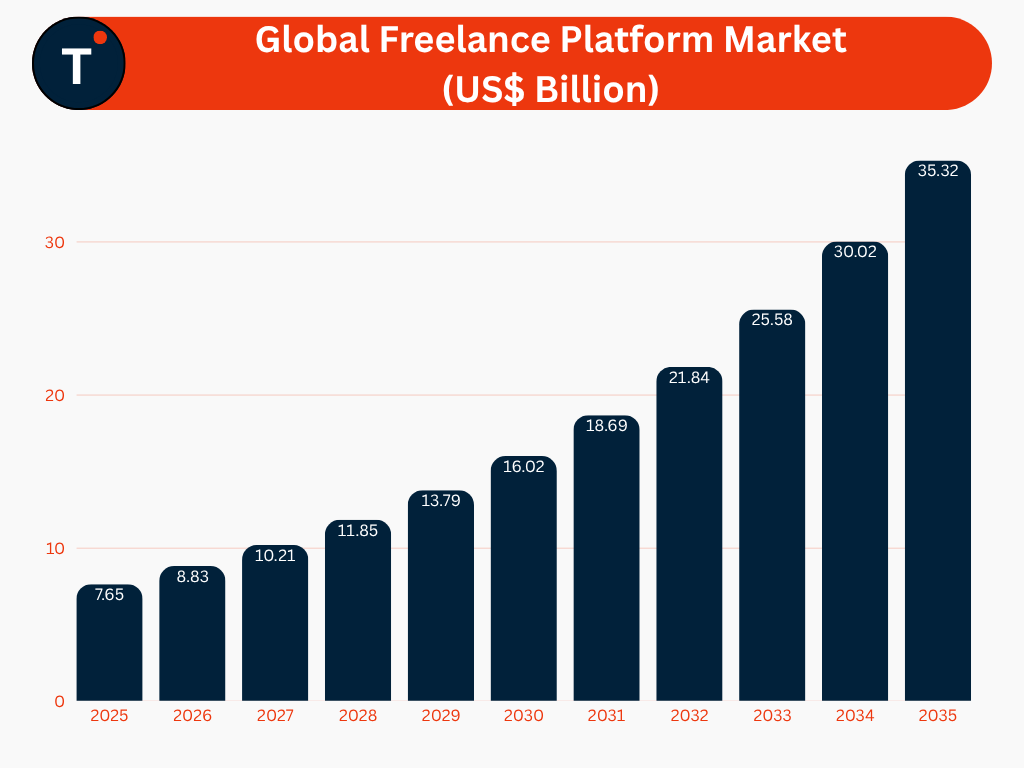
The global freelance platform market was valued at US$7.65 billion in 2025 and is projected to reach US$35.32 billion by 2035, expanding at a CAGR of 16.7%.
North America led the market with a 33.5% revenue share in 2025, generating US$2.56 billion.
Asia Pacific accounted for 28.1% of market revenue in 2025, reaching US$2.15 billion, and is projected to register the fastest growth with a CAGR of 20.1%.
Europe represented 24.7% of the market in 2025, generating US$1.89 billion in revenue.
Latin America captured a 7.9% market share, with revenue totaling US$0.60 billion in 2025.
The Middle East & Africa accounted for 5.8% of market revenue, reaching US$0.44 billion in 2025.
Top Freelance Marketplace
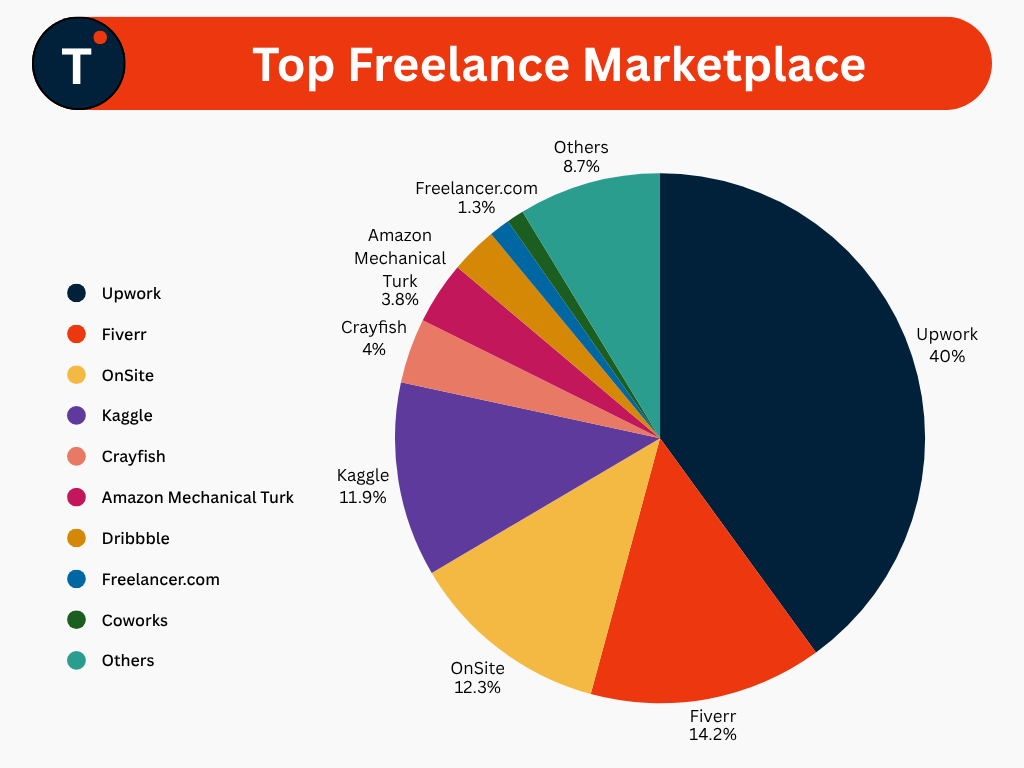
Upwork leads the freelance marketplace landscape with a 39.99% share, maintaining the largest platform presence.
Fiverr accounts for 14.22%, ranking as the second-largest freelance marketplace.
OnSite represents 12.31% of the marketplace ecosystem.
Kaggle captures 11.87%, reflecting its strong presence among specialized freelance platforms.
Crayfish holds a 3.96% share of the freelance marketplace landscape.
Amazon Mechanical Turk contributes 3.81% of total platform share.
Dribbble accounts for 2.84%, supported by its focus on creative professionals.
Freelancer.com represents 1.27% of the marketplace.
Coworks holds a 1.05% share, representing the smallest share among the platforms analyzed.
Other freelance marketplaces collectively account for 8.68% of the market.
Company Size Distribution of Freelance Clients
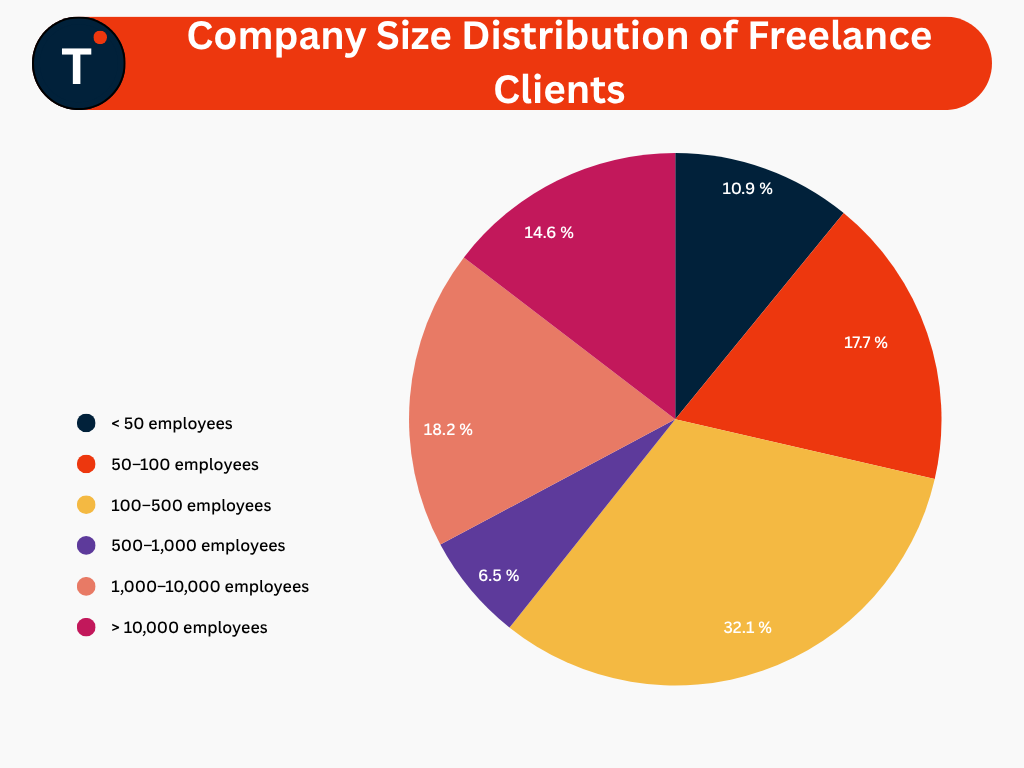
Companies with 100–500 employees account for 32.1% of businesses engaging freelance professionals, representing the largest client segment.
Organizations with 1,000–10,000 employees contribute 18.2% of freelance engagements.
Businesses employing 50–100 people represent 17.7% of the client base.
Enterprises with more than 10,000 employees account for 14.6% of companies utilizing freelance talent.
Small businesses with fewer than 50 employees comprise 10.9% of organizations hiring freelancers.
Companies with 500–1,000 employees represent 6.5% of the freelance client landscape.
Company Type Distribution of Freelance Clients
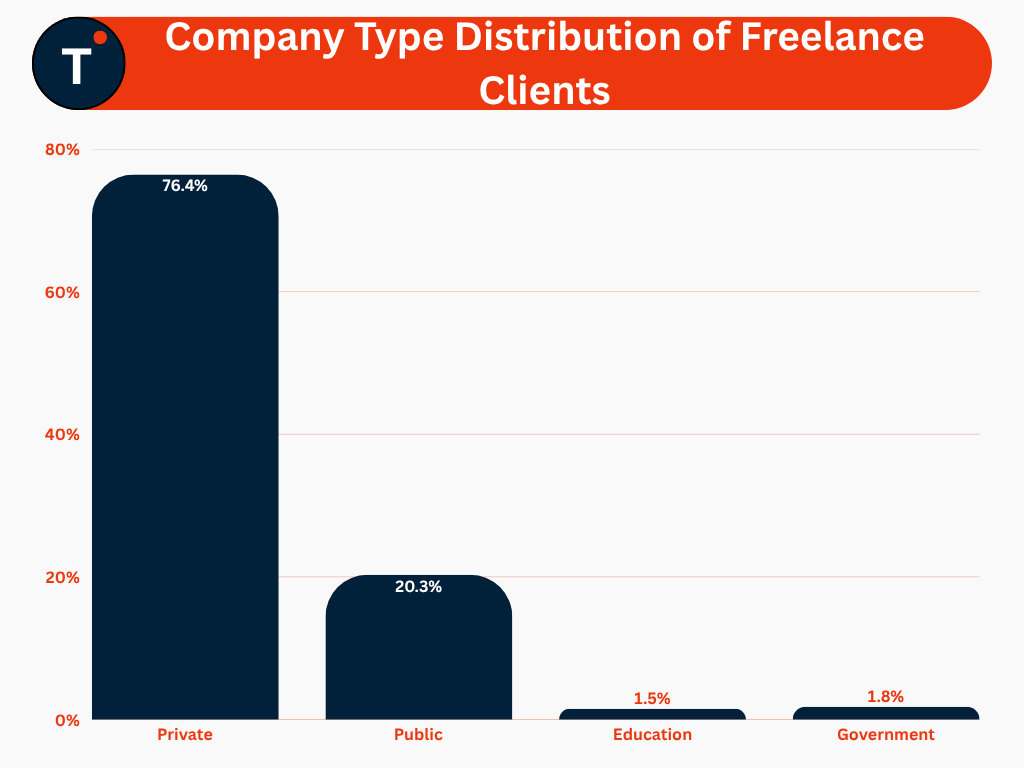
Private sector organizations account for 76.4% of companies engaging freelance professionals, representing the largest client segment.
Public sector organizations contribute 20.3% of freelance engagements.
Government organizations represent 1.8% of companies utilizing freelance talent.
Educational institutions account for 1.5% of the freelance client base.
Why LinkedIn Matters for Freelancers?
122 million professionals have secured job interviews through LinkedIn.
95% of recruiters use LinkedIn as a platform for talent sourcing and recruitment.
More than 6 million IT decision-makers are active on LinkedIn.
Six professionals are hired through LinkedIn every minute, highlighting the platform’s role in connecting talent with employers.
LinkedIn profiles featuring professional photographs receive 21 times more profile views and 36 times more messages than profiles without professional images.
Complete LinkedIn profiles are 40 times more likely to receive professional opportunities.
Professionals submit 55 job applications every second through LinkedIn.
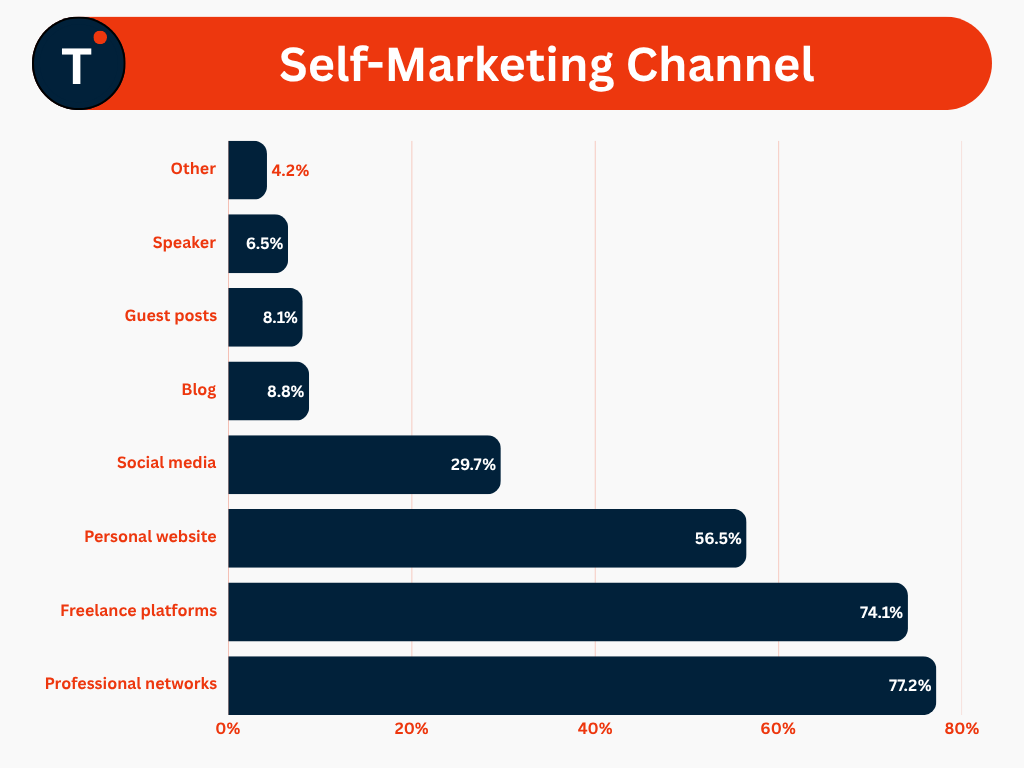
Self-Marketing Channel
Professional networks are utilized by 77.2% of freelancers, making them the most widely used self-marketing channel.
Freelance platforms are used by 74.1% of freelancers to acquire projects and expand their client base.
56.5% of freelancers promote their services through personal websites.
29.7% of freelancers leverage social media platforms to market their expertise and attract potential clients.
8.8% of freelancers use blogs as a channel for personal branding and showcasing their knowledge.
8.1% of freelancers publish guest posts to enhance professional visibility.
6.5% of freelancers utilize speaking engagements as part of their self-marketing strategy.
4.2% of freelancers rely on other marketing channels to promote their freelance services.
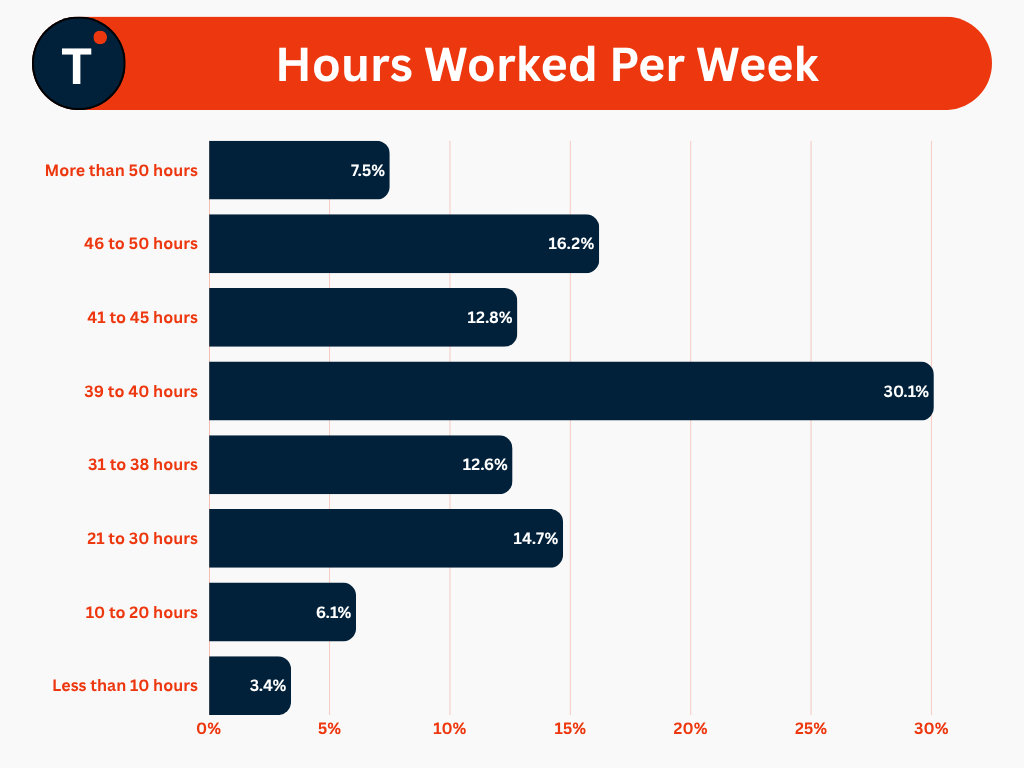
Freelancer Weekly Working Hours Statistics
30.1% of freelancers work 39 to 40 hours per week, representing the most common working schedule.
16.2% of freelancers work 46 to 50 hours per week.
14.7% of freelancers dedicate 21 to 30 hours per week to freelance work.
12.8% of freelancers work 41 to 45 hours per week.
12.6% of freelancers report working 31 to 38 hours per week.
7.5% of freelancers work more than 50 hours per week.
6.1% of freelancers spend 10 to 20 hours per week on freelance activities.
3.4% of freelancers work less than 10 hours per week, representing the smallest share of the workforce.
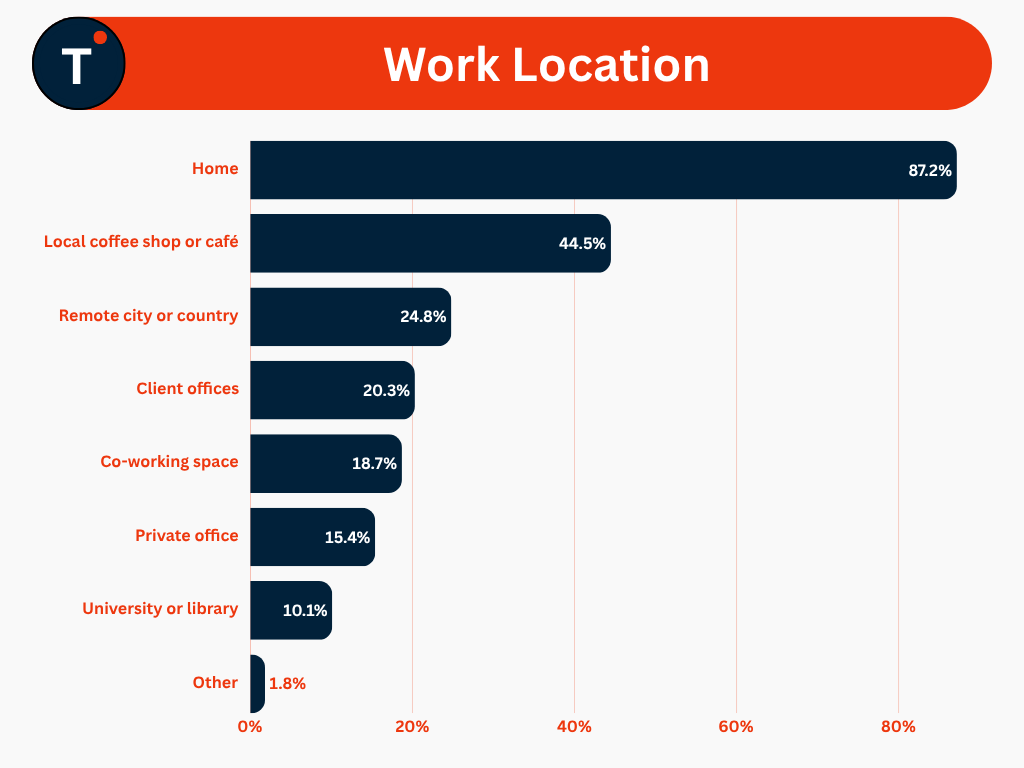
Where do Freelancers Work?
87.2% of freelancers work from home, making it the most preferred work location.
44.5% of freelancers work from local coffee shops or cafés, reflecting the growing adoption of flexible workspaces.
24.8% of freelancers operate from remote locations across different cities or countries.
20.3% of freelancers work from client offices when project requirements necessitate on-site collaboration.
18.7% of freelancers utilize co-working spaces as their primary work environment.
15.4% of freelancers work from a private office.
10.1% of freelancers use universities or libraries as their workspace.
1.8% of freelancers work from other locations, representing the smallest share of work environments.
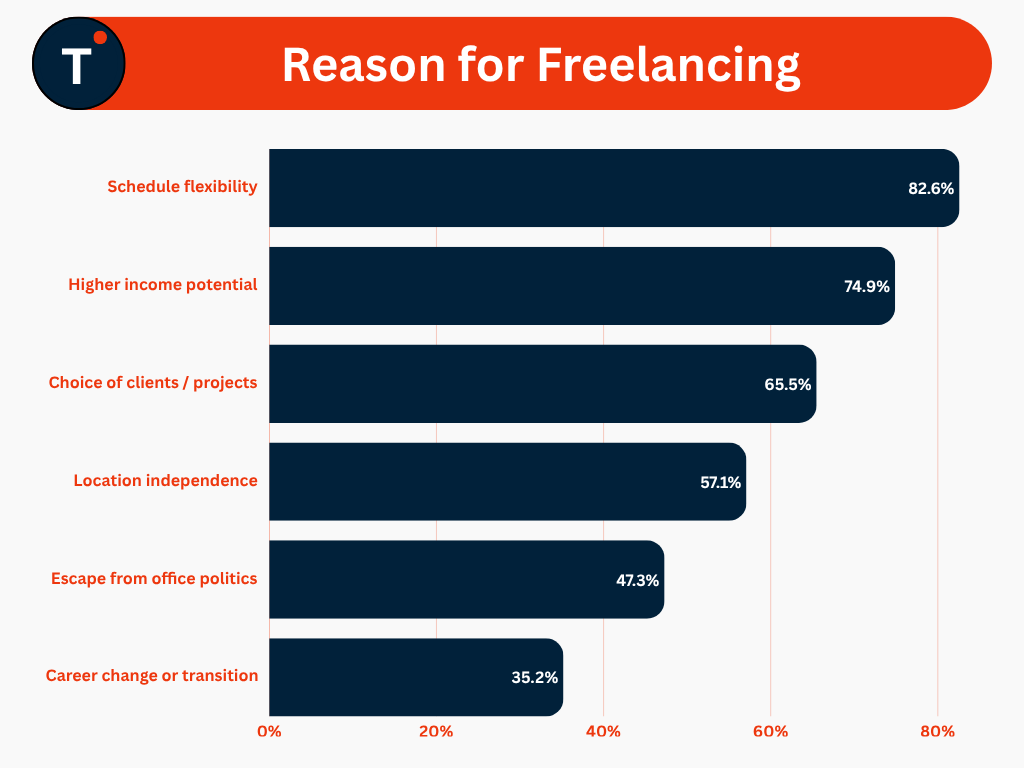
Why People Choose Freelancing?
82.6% of professionals choose freelancing for greater schedule flexibility, making it the leading reason for pursuing freelance work.
74.9% of freelancers cite higher income potential as a key factor influencing their decision.
65.5% of professionals choose freelancing to gain greater control over client and project selection.
57.1% of freelancers value location independence, enabling them to work from their preferred location.
47.3% of professionals pursue freelancing to avoid office politics and traditional workplace environments.
35.2% of individuals enter freelancing to support a career transition or change.
Best Countries for Hiring Freelancers
Country
Score
United States
97.46
India
95.71
United Kingdom
94.81
Philippines
91.05
Ukraine
90.46
Canada
89.88
Australia
89.01
Poland
88.11
Brazil
87.45
Portugal
87.23
Mexico
82.68
Indonesia
75.95
Argentina
75.29
Germany
70.74
Spain
70.34
The United States ranks first with a score of 97.46, making it the highest-ranked country for hiring freelancers.
India secures the second position with a score of 95.71.
The United Kingdom ranks third, recording a score of 94.81.
The Philippines holds the fourth position with a score of 91.05.
Ukraine ranks fifth, achieving a score of 90.46.
Canada secures the sixth position with a score of 89.88.
Australia ranks seventh, recording a score of 89.01.
Poland occupies the eighth position with a score of 88.11.
Brazil ranks ninth, with a score of 87.45.
Portugal completes the top ten, achieving a score of 87.23.
Mexico ranks eleventh with a score of 82.68.
Indonesia holds the twelfth position, recording a score of 75.95.
Argentina ranks thirteenth with a score of 75.29.
Germany secures the fourteenth position with a score of 70.74.
Spain ranks fifteenth, recording a score of 70.34.
Freelance Statistician Statistics
Freelance statisticians provide statistical analysis, data interpretation, and consulting services on a project or contract basis across multiple industries.
The average annual salary of a freelance statistician in the United States reached US$83,657 as of July, 2026.
Berkeley, California offers the highest average annual salary for freelance statisticians at US$102,432.
San Carlos, California follows with an average annual salary of US$101,014.
Sitka, Alaska ranks third, with freelance statisticians earning US$100,779 annually.
San Francisco, California reports an average annual salary of US$98,562.
Santa Clara, California offers an average annual salary of US$98,249.
Sunnyvale, California records an average annual salary of US$98,184.
Livermore, California provides an average annual salary of US$98,128.
Oakland, California reports an average annual salary of US$98,096.
San Jose, California offers freelance statisticians an average annual salary of US$98,045.
Patterson, Ohio rounds out the top locations with an average annual salary of US$97,487.
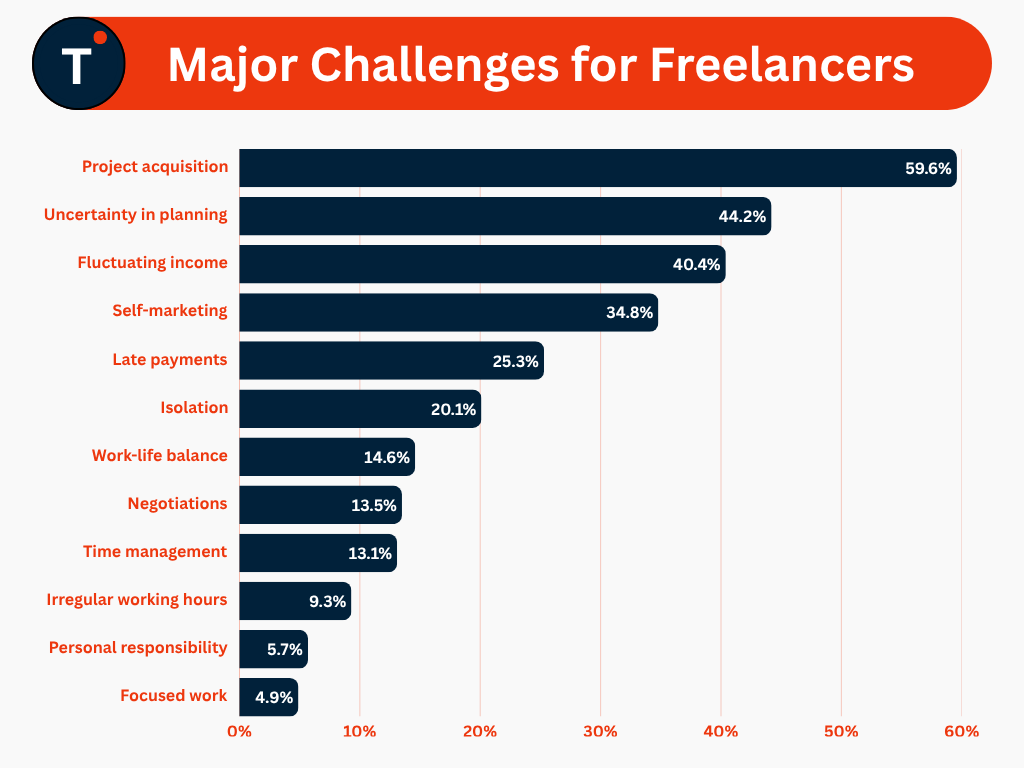
Major Challenges for Freelancers
59.6% of freelancers identify project acquisition as the biggest challenge in sustaining their freelance careers.
44.2% of freelancers report uncertainty in project planning and workload forecasting as a major concern.
40.4% of freelancers experience challenges associated with fluctuating income.
34.8% of freelancers consider self-marketing and client promotion to be a key obstacle.
25.3% of freelancers face challenges related to late client payments.
20.1% of freelancers cite professional isolation as a challenge of independent work.
14.6% of freelancers report difficulties in maintaining work-life balance.
13.5% of freelancers identify client negotiations as a recurring challenge.
13.1% of freelancers experience challenges with time management.
9.3% of freelancers report irregular working hours as a concern.
5.7% of freelancers identify personal responsibility associated with managing independent work as a challenge.
4.9% of freelancers cite maintaining focus on work as a challenge.
Conclusion
The freelance economy continues to expand, supported by increasing workforce participation, rapid digital transformation, and rising demand for specialized, project-based talent across industries.
Artificial intelligence is reshaping the freelance landscape by accelerating demand for AI-related skills, increasing earning potential, and creating new opportunities for highly specialized professionals.
Freelancing has become an integral component of business operations, with organizations increasingly adopting skills-based hiring and leveraging independent professionals to address evolving workforce requirements.
Digital freelance platforms, professional networking channels, and personal branding strategies continue to play a critical role in connecting freelancers with clients and expanding access to global opportunities.
Technology, software development, creative services, and digital marketing remain among the most freelance-intensive industries, while AI, machine learning, and cybersecurity command the highest earning potential.
North America maintains its leadership in the freelance platform market, while Asia Pacific is projected to record the fastest growth, reflecting the continued expansion of the global freelance ecosystem.
Add TriCityLocalNews as a Preferred Source on Google for instant updates!
Alice Meckler is a renowned business strategist and labor market analyst with deep expertise in employment dynamics, workforce optimization, and corporate growth. She holds a B.S. in Business, Economics, and Management from the California Institute of Technology (Caltech) in Pasadena, CA, where she developed a rigorous, data-driven foundation in economic theory and organizational behavior. To cement her specialization in human capital, Alice earned her M.B.A. with a concentration in Workforce Management from the Wharton School of the University of Pennsylvania. With over a decade of experience advising top-tier enterprises, Alice specializes in bridging the gap between complex labor analytics and high-impact corporate execution.
We use cookies to ensure that we give you the best experience on our website. If you continue to use this site we will assume that you are happy with it.