







The growing adoption of mobile technology has significantly increased the use of cell phones in workplace settings. Employees increasingly rely on smartphones for communication, collaboration, email management, and access to business applications, enhancing operational efficiency and connectivity. Industry studies reveal that mobile devices are checked frequently throughout the workday, highlighting their expanding role in supporting both professional and organizational activities.
Editor’s Choice
- In the U.S., 64% of adults use smartphones for work-related activities, compared with a global average of 54%.
- Millennial employees check their smartphones approximately every 20 minutes.
- Around 33% of individuals regularly check mobile devices during work hours, while 49% report infrequent workplace phone usage.
- Approximately 55% of employees use mobile phones for non-work-related activities during working hours.
- Mobile phones contribute to 55% of workplace distractions.
- Approximately 75% of employers report that employees lose an average of two productive hours per day due to mobile phone distractions.
- Employees spend an average of three hours per workday using mobile devices for personal activities.
- Employees who keep smartphones in non-visible locations demonstrate 26% higher focus levels.
- Mobile phone distractions reduce workplace efficiency by 45%.
- While 60% of individuals estimate interacting with their phones around 100 times daily, actual usage exceeds 2,500 touches, taps, and swipes per day.
- Approximately 70% of employees believe smartphones should be kept away during workplace meetings, although device visibility during meetings remains common.
- Around 80% of employees believe phones should not be checked during meetings; however, nearly half continue to do so.
General Statistics
- 77% of employees identify notifications from digital tools and mobile devices as a significant source of workplace distraction.
- More than 70% of employees keep their smartphones within immediate reach while working, contributing to frequent device engagement throughout the workday.
- 40% of U.S. professionals employed by large organizations use personal devices for work-related activities.
- 25% of employees using personal devices for work do so due to employer requirements, indicating that most workplace device usage is voluntary.
- 33.33% of employees check their phones whenever a notification is received, regardless of whether it originates from messaging platforms, social media, or mobile applications.
- 17% of employees check their smartphones multiple times per hour, while 15% engage with their devices at least once every hour.
- 15% of employees check their phones every few hours during the workday.
- 15% of employees restrict smartphone usage exclusively to designated break periods.
- 4% of employees refrain from checking smartphones during working hours altogether.
- 41% of employees feel pressure to remain continuously connected and respond promptly to emails, workplace messaging platforms, and calls.
- 26% of employees report that social media usage during work hours negatively impacts productivity.
- 51% indicate that social media usage does not adversely affect work performance, while 22% report that the issue is not applicable to their work environment.
Cell Phone Usage at Workplace by Sectors
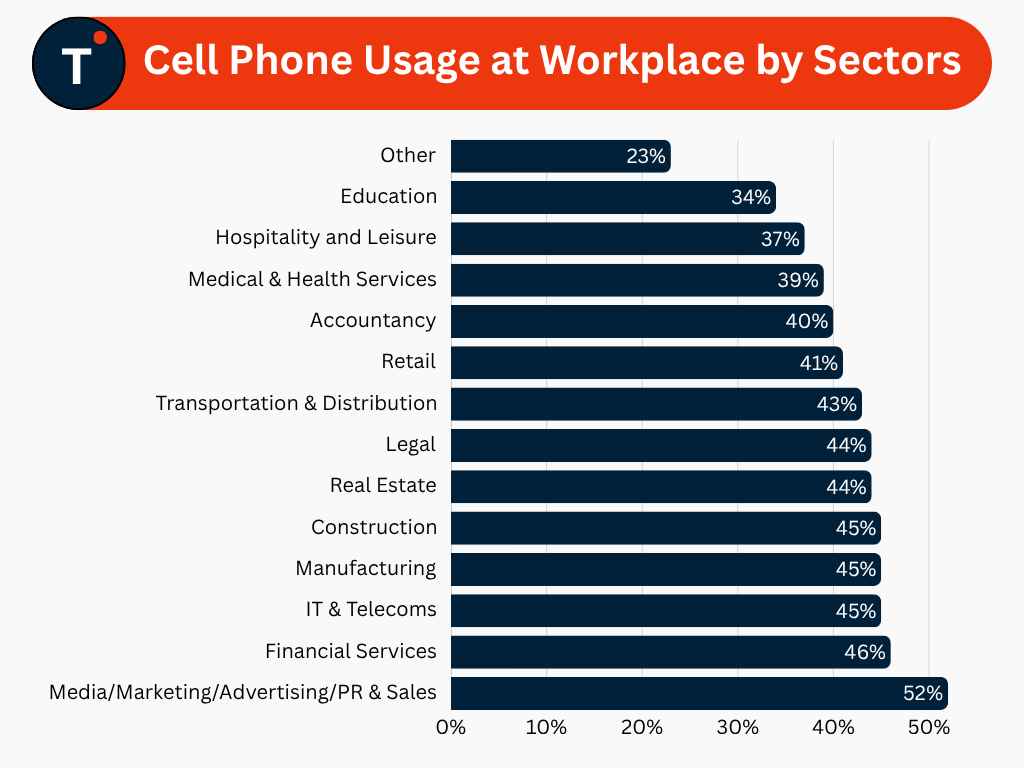
- Media, Marketing, Advertising, PR, and Sales professionals exhibit the highest workplace cell phone usage, accounting for 52.0%.
- Financial Services follows with a cell phone usage rate of 46.2%, reflecting the sector’s reliance on continuous communication and information access.
- IT and Telecommunications records a usage rate of 45.4%, highlighting the importance of mobile connectivity in technology-driven environments.
- Manufacturing employees demonstrate a workplace cell phone usage rate of 44.9%.
- Construction sector workers report a cell phone usage rate of 44.5%.
- Real Estate professionals account for 44.3% workplace cell phone usage, supported by the need for frequent client interactions.
- Legal services record a cell phone usage rate of 43.7%.
- Transportation and Distribution employees exhibit a workplace mobile phone usage rate of 43.1%.
- Retail sector employees report a cell phone usage rate of 40.6%.
- Accountancy professionals demonstrate a workplace mobile phone usage rate of 40.0%.
- Medical and Health Services employees record a cell phone usage rate of 38.5%.
- Hospitality and Leisure sector workers account for 37.0% workplace cell phone usage.
- Education professionals report a cell phone usage rate of 34.3%.
The United States Cell Phones at Workplace Insights
The average U.S. employee spends more than 186 minutes per workday using a mobile phone, highlighting the significant role of smartphones in workplace activities.
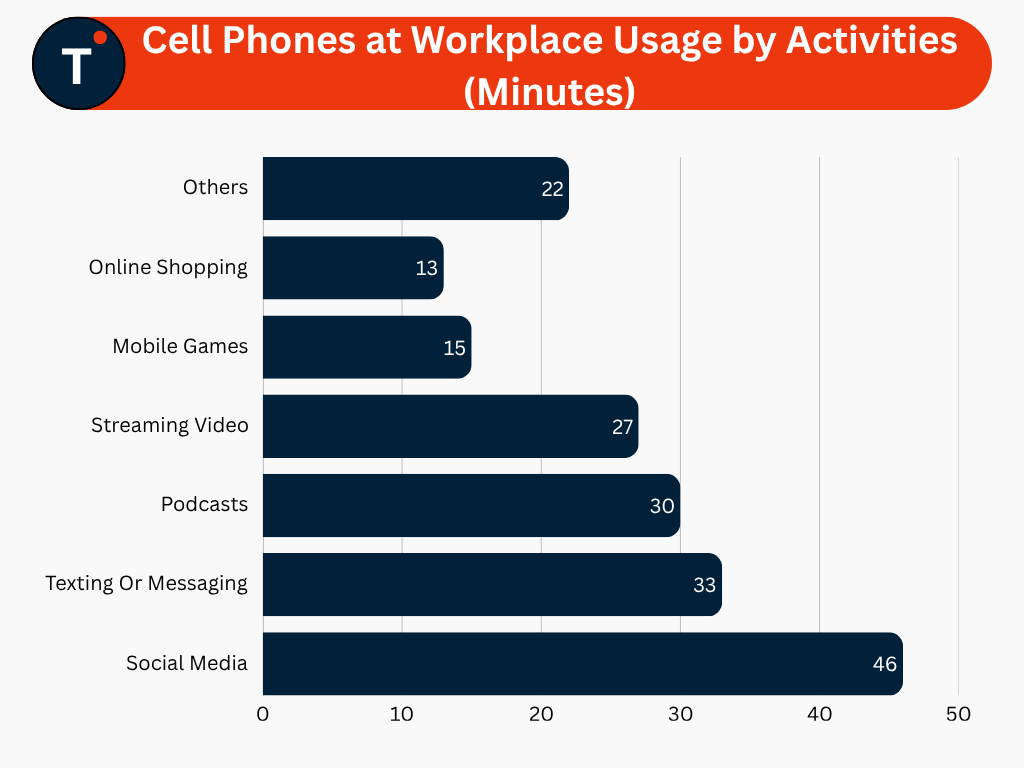
- Social media represents the largest share of workplace mobile phone usage, accounting for 46 minutes per day.
- Texting and messaging consume 33 minutes daily, making them the second most common mobile phone activity during work hours.
- Employees spend 30 minutes per day listening to podcasts on their mobile devices while at work.
- Video streaming accounts for 27 minutes of daily workplace mobile phone usage.
- Mobile gaming accounts for 15 minutes of daily smartphone usage during working hours.
- Online shopping represents 13 minutes of workplace mobile phone activity, making it the least time-consuming activity among the categories analyzed.
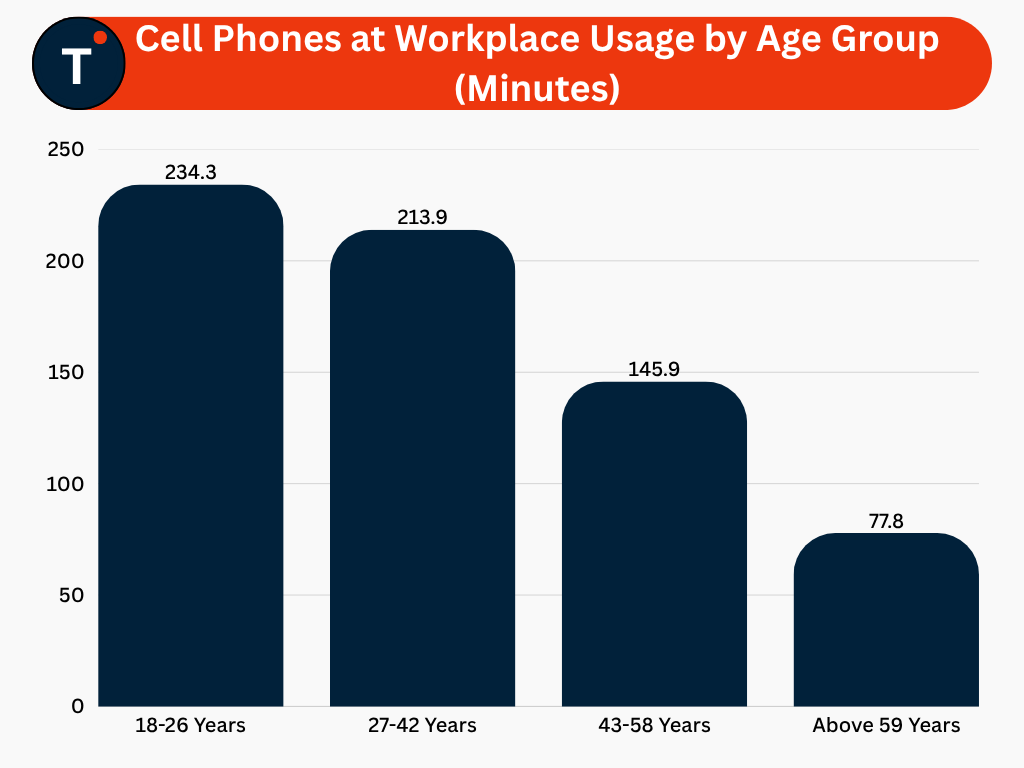
- Employees aged 18–26 years record the highest workplace mobile phone usage, spending an average of 234.3 minutes per day on their devices.
- The 27–42 years age group follows closely, with average daily workplace mobile phone usage reaching 213.9 minutes.
- Employees aged 43–58 years spend 145.9 minutes per day using mobile phones during work hours, reflecting a notable decline compared to younger age groups.
- Individuals above 59 years demonstrate the lowest workplace mobile phone usage, averaging 77.8 minutes per day.
Cell Phones at Workplace Usage by the U.S. States
| States | Minutes |
| Alabama | 243.8 |
| Arizona | 206.9 |
| Arkansas | 246.2 |
| California | 213.0 |
| Colorado | 188.5 |
| Connecticut | 160.4 |
| Delaware | 191.4 |
| Florida | 221.5 |
| Georgia | 242.0 |
| Hawaii | 205.6 |
| Idaho | 165.0 |
| Illinois | 186.4 |
| Indiana | 150.3 |
| Iowa | 185.8 |
| Kansas | 213.3 |
| Kentucky | 146.5 |
| Louisiana | 145.1 |
| Maine | 131.1 |
| Maryland | 189.8 |
| Massachusetts | 156.6 |
| Michigan | 148.4 |
| Minnesota | 163.7 |
| Mississippi | 173.0 |
| Missouri | 232.0 |
| Montana | 199.3 |
| Nebraska | 208.9 |
| Nevada | 200.1 |
| New Hampshire | 155.4 |
| New Jersey | 190.4 |
| New Mexico | 153.8 |
| New York | 238.5 |
| North Carolina | 146.4 |
| North Dakota | 194.3 |
| Ohio | 216.0 |
| Oklahoma | 152.9 |
| Oregon | 208.5 |
| Pennsylvania | 169.3 |
| Rhode Island | 172.2 |
| South Carolina | 145.2 |
| South Dakota | 151.4 |
| Tennessee | 215.6 |
| Texas | 280.3 |
| Utah | 182.9 |
| Vermont | 152.4 |
| Virginia | 265.7 |
| Washington | 144.3 |
| West Virginia | 161.8 |
| Wisconsin | 125.6 |
Employee Strategies to Combat Workplace Distractions
- Listening to music is the most widely adopted strategy for maintaining focus, with 46% of employees utilizing it to minimize workplace distractions.
- Working from home serves as an effective distraction-management approach for 36% of employees, providing a more controlled and flexible work environment.
- 22% of employees reduce distractions by keeping their mobile phones out of reach during working hours.
- Noise-cancelling headphones are used by 10% of employees to improve concentration and limit exposure to external interruptions.
- 8% of employees choose to work in meeting rooms or isolated spaces to create a distraction-free environment.
- 6% of employees manage workplace distractions by stepping outside or seeking quieter surroundings to enhance focus and productivity.
Cell Phone Governance in Modern Workplaces
- 74% of employers have implemented workplace cell phone policies to reduce distractions and enhance employee productivity.
- 45% of organizations permit personal mobile phone usage during designated break periods, balancing workplace productivity objectives with employee well-being.
- Employees operating under lenient mobile phone policies spend an average of 202 minutes per day on their devices, the highest among policy categories.
- Moderate workplace phone policies are associated with average daily mobile phone usage of 163 minutes.
- Employees in organizations with strict mobile phone policies spend an average of 183 minutes per day on their devices.
- 58% of employees use personal mobile devices to access websites that are restricted on company networks, highlighting the continued reliance on smartphones for unrestricted internet access.
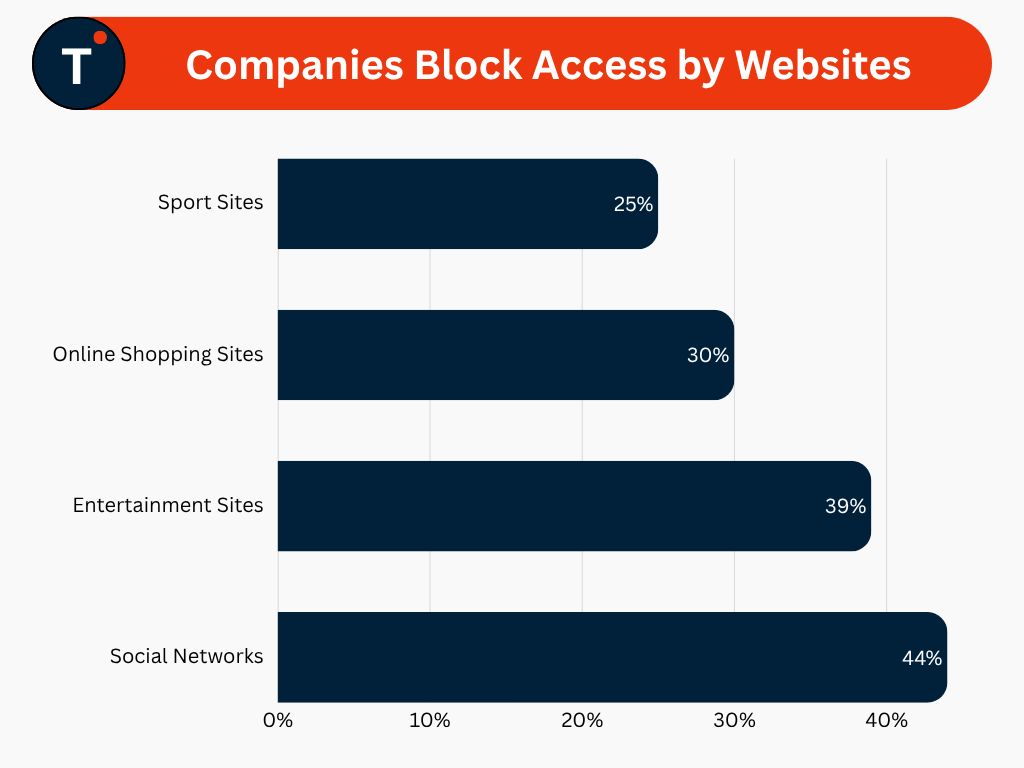
- Social networking platforms are the most frequently restricted websites in workplaces, with 43.6% of organizations limiting employee access.
- Entertainment websites are blocked by 38.9% of companies to minimize distractions and maintain workplace productivity.
- Online shopping websites are restricted by 30.0% of organizations, reducing non-work-related browsing during business hours.
- Sports-related websites are blocked by 24.6% of companies, representing the least restricted category among the website types analyzed.
Workplace Accidents Linked to Mobile Phone Distractions
- 14% of workplaces have experienced at least one accident attributed to employee distraction caused by mobile phone usage.
- Industrial environments face a higher risk of distraction-related incidents, with more than 25% reporting accidents linked to mobile phone distractions.
- Office environments report a lower incidence of distraction-related accidents, with 11% of workplaces experiencing such events.
- Digital distraction incidents have severe consequences, with 50% of reported accidents resulting in injury or fatality.
- Property damage is a common outcome of distraction-related incidents, affecting 75% of accidents in industrial settings and 59% of workplace incidents overall.
- South Carolina recorded 43,700 occupational injuries and illnesses across all industries in 2018, along with 98 workplace fatalities.
- Among 12,420 private industry injuries reported in the state, falls, slips, and trips accounted for 4,120 incidents, representing the most common injury category.
- Incidents involving contact with trucks, carts, dollies, hand trucks, and similar equipment resulted in 2,220 injuries.
- Machinery-related accidents accounted for 720 workplace injuries.
- Roadway motor vehicle accidents contributed to 630 occupational injuries.
- Workplace incidents involving contact with objects or equipment resulted in 450 reported injuries.
American Phone Usage & Screen Time Statistics
- Americans spend an average of 5 hours and 16 minutes per day on their smartphones, highlighting the growing role of mobile devices in daily life.
- Gen Z records the highest screen time among all generations, averaging 6 hours and 27 minutes of smartphone usage per day.
- Millennials spend an average of 5 hours and 28 minutes per day on their mobile devices, ranking second in overall screen time.
- Gen X users spend 4 hours and 48 minutes per day on smartphones, demonstrating substantial engagement with mobile technology.
- Baby Boomers report the lowest smartphone usage, averaging 4 hours and 19 minutes per day.
- Social media platforms are identified as the most addictive category of mobile applications, cited by 79% of users.
- Messaging applications rank second, with 38% of users identifying them as a primary source of mobile engagement.
- Mobile gaming applications are considered addictive by 35% of users, reflecting strong engagement with interactive entertainment.
- Email applications are identified as addictive by 28% of users, driven by the need for continuous communication and information access.
- Streaming services account for 25% of perceived mobile app addiction, highlighting the growing popularity of on-demand digital content.
- 53% of Americans intend to reduce their smartphone usage in 2025, reflecting growing awareness of digital well-being and screen time management.
- The share of Americans seeking to limit phone usage increased by 33% compared to 2023.
- Gen Z demonstrates the strongest interest in reducing smartphone usage, with 66% expressing a desire to cut down on screen time.
- 59% of Millennials plan to reduce mobile phone usage, highlighting increasing concerns about digital dependence among younger adults.
- 51% of Gen X individuals intend to spend less time on their smartphones.
- Baby Boomers show the lowest inclination to reduce smartphone usage, with 35% expressing plans to limit screen time.
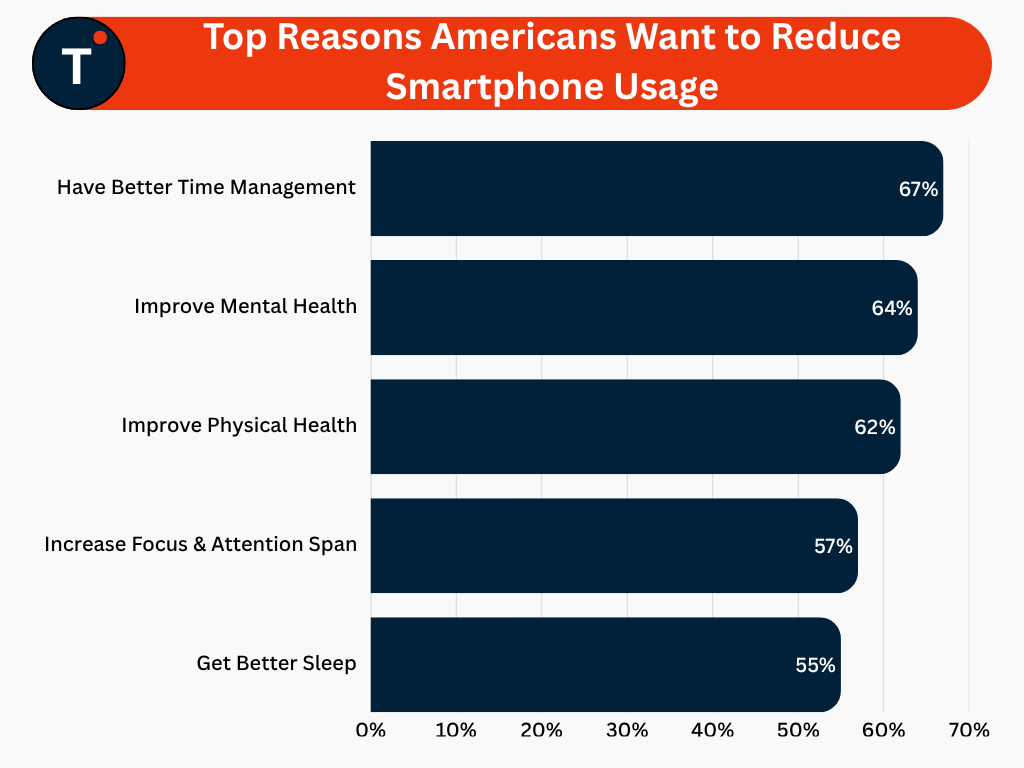
- Better time management is the leading reason for reducing smartphone usage, cited by 67% of Americans.
- Improving mental health motivates 64% of Americans to limit daily smartphone use.
- 62% of Americans seek to reduce smartphone usage to improve physical health and overall well-being.
- Increasing focus and attention span is a key objective for 57% of individuals aiming to lower screen time.
- Better sleep quality drives 55% of Americans to cut back on smartphone usage.
- 28% of individuals do not perceive smartphone addiction as a negative behavior, indicating broad acceptance of mobile device dependence.
- 47% of smartphone-dependent users utilize their devices to enhance mood and emotional well-being.
- 72% of Gen Z individuals believe their mental health would improve if mobile applications were less addictive.
- 69% of Gen Z indicate that reducing smartphone usage would have a positive impact on their social lives.
Conclusion
- Smartphones have become deeply integrated into workplace environments, serving as essential tools for communication, collaboration, and information access while also contributing to employee distraction and productivity challenges.
- Workplace mobile phone usage is highest among younger generations and communication-intensive industries, reflecting increasing dependence on digital connectivity across professional settings.
- Social media, messaging applications, and entertainment platforms account for a significant share of mobile engagement, driving both screen time and perceived smartphone dependency.
- Organizations continue to implement mobile phone policies and website restrictions to balance productivity, employee well-being, and operational efficiency.
- Excessive smartphone usage is increasingly associated with reduced focus, lower productivity, workplace safety risks, and potential impacts on mental and physical well-being.
- Growing awareness of these challenges is prompting individuals to adopt distraction-management strategies and reduce smartphone usage to improve time management, focus, sleep quality, and overall health.
Add TriCityLocalNews as a Preferred Source on Google for instant updates!