








Paid holidays are a widely offered employee benefit that typically includes federally recognized holidays, as well as holidays of religious, state, or national significance. Organizations commonly provide compensation for these non-working days as part of their broader employee benefits and Paid Time Off (PTO) programs. By offering paid holidays, employers recognize employee contributions, support work-life balance, and enhance overall job satisfaction, making paid leave an important component of modern compensation packages.
Editor’s Picks
- In 2025, 81.0% of private industry employees in the U.S. had access to paid holidays, with an average entitlement of eight paid holiday days annually.
- 77% of civilian workers received paid vacation benefits in 2025, reflecting the widespread adoption of leave programs across industries.
- Paid vacation coverage among government employees stood at 61%, significantly lower than that of civilian workers.
- Time off can boost employee performance by 80% and improve reaction times by 40%, reinforcing its role in enhancing workforce productivity.
- 70% of employees report higher motivation and engagement after taking a vacation lasting one week or longer.
- U.S. employees leave 765 million vacation days unused each year, highlighting a substantial gap between leave availability and utilization.
- 85% of employees state that taking time off improves their overall happiness and well-being.
- 68% of employees experience anxiety when disconnected from work-related communications during vacations.
- 61% of employers offer PTO accrual programs based on employee tenure and hire date.
- 59% of employees feel uncomfortable requesting time off, indicating persistent workplace barriers to leave utilization.
- 57% of workers report reduced loyalty toward their employer following a poor leave experience.
- 43% of Millennials take time off primarily to rest, recover, and improve personal well-being.
- 23% of individuals did not take a single day off during the previous year.
- More than 95% of employees in management, business, and finance occupations have access to paid leave benefits.
- Most European countries mandate a minimum of 20 days of paid time off, reflecting strong employee leave protections.
General Statistics
- In the private sector, 88% of employees have access to at least one form of paid leave, including personal leave, sick leave, family leave, or vacation benefits.
- Access to paid leave remains limited among lower-income and part-time workers, with 47% of the lowest-income earners and 35% of part-time employees lacking access to any form of paid leave.
- 88% of business owners view paid time off (PTO) as a critical benefit for attracting and retaining talent while maintaining a competitive advantage.
- 79% of civilian workers receive holiday pay for federally recognized holidays.
- Civilian employees with dedicated sick leave plans receive an average of 8 paid sick days annually, regardless of tenure.
- Private industry employees receive an average of 7 paid sick days per year, with leave entitlement remaining consistent across years of service.
- Government employees receive an average of 11 paid sick days after 1 year of service, increasing to 12 days after 5 years of employment.
- Paid sick leave is a widely available government benefit, with 93% of government employees having access to paid sick leave programs.
- In 2025, paid sick leave coverage reached 82% among civilian workers and 80% among private-sector employees.
- In 2026, 33 U.S. states and the District of Columbia will observe Juneteenth as a paid holiday for most state government employees.
- 48% of organizations offer floating holidays, allowing employees to use paid leave for cultural, religious, or personal observances.
- Work-life balance remains a key workforce priority, with 53% of employees identifying it as a critical factor when choosing an employer.
- Employer-sponsored leave benefits are highly valued, with 76% of workers prioritizing paid vacation, 74% valuing paid sick leave, and 74% considering paid holidays important.
- 12.5% of employees believe that taking a vacation may signal lower commitment to their employer.
- 8% of employees express concerns about potential job loss while taking time off.
- 33% of employees feel pressured not to use their full PTO entitlement, while 9% report direct discouragement from employers.
- 49% of employees state that workload pressures prevent them from fully utilizing available time off despite organizational support.
- 37% of employees use paid time off primarily for rest and recovery rather than travel or personal errands.
- Generational differences in restorative leave usage are evident, with Millennials leading at 43%, followed by Gen X at 34%, Gen Z at 33%, and Baby Boomers at 20%.
Global Paid Leave and Holiday Policy Insights
- European employees are generally entitled to 20–30 paid leave days annually, supported by statutory labor regulations, whereas the United States has no federal mandate requiring employers to provide paid holidays, paid vacation, or paid sick leave. As a result, leave benefits are primarily determined through employer-defined PTO policies.
- 40% of Irish employees do not utilize their full annual paid leave entitlement, with leave underutilization being more prevalent among men than women.
- 25% of U.S. workers, representing nearly 40 million employees, do not receive any paid holiday benefits. The United States remains the only advanced economy without a legal requirement guaranteeing paid holidays for workers.
| Country | Mandated Paid Holidays | Public Holidays | Total Days Off |
| Spain | 25 days | 14 | 39 |
| France | 25 days | 11 | 36 |
| United Kingdom | 20 days | 8 | 28 |
| Germany | 20 days | 9–13 | 29–33 |
| Japan | 10 days | 16 | 26 |
| Canada | 10 days | 5–9 | 15–19 |
| Australia | 20 days | 8 | 28 |
| United States | 0 (no mandate) | 11 federal | 8 |
Paid Vacation Days by U.S. Region
| Regions | Average Vacation Days |
| North East | 11.4 |
| West | 9.4 |
| Midwest | 8.5 |
| South | 8.4 |
- The Northeast region records the highest average paid vacation entitlement, with employees receiving 11.4 vacation days annually, reflecting stronger leave benefits compared to other U.S. regions.
- The Western region offers an average of 9.4 vacation days per year, ranking second in terms of paid leave availability.
- The Midwest region provides an average of 8.5 vacation days annually, indicating a more moderate level of vacation benefits.
- The Southern region reports the lowest average vacation entitlement at 8.4 days per year, highlighting regional disparities in paid leave offerings.
Most Common Paid Holidays Offered by Employers
- 45% of employers provide employees with Christmas Eve as a paid holiday, making it one of the most commonly offered additional holiday benefits.
- 23% of employers offer New Year’s Eve as a paid holiday, extending leave benefits during the year-end holiday season.
- 13% of employers grant paid leave for the entire period between Christmas and New Year’s Day, providing employees with an extended holiday break.
- The six most widely observed paid holidays across organizations are New Year’s Day, Memorial Day, Independence Day, Labor Day, Thanksgiving, and Christmas, forming the core of employer-sponsored holiday benefit programs in the United States.
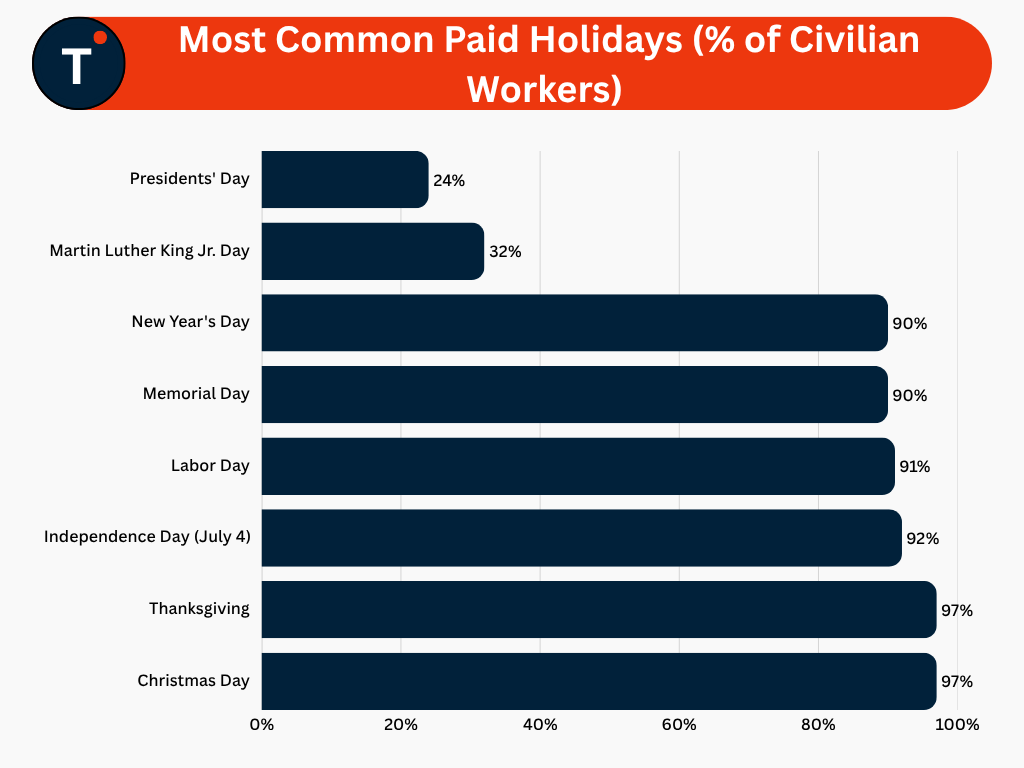
- Thanksgiving is the most widely offered paid holiday, with 97% of civilian workers receiving paid leave for the occasion.
- Christmas Day is provided as a paid holiday to 97% of civilian workers, reflecting its prominence within employer-sponsored holiday benefit programs.
- Independence Day (July 4) is recognized as a paid holiday by 92% of civilian workers, making it one of the most commonly observed national holidays.
- Labor Day is offered as a paid holiday to 91% of civilian workers, demonstrating broad adoption across industries.
- New Year’s Day is included in paid holiday programs for 90% of civilian workers, underscoring its importance within standard leave policies.
- Memorial Day is provided as a paid holiday to 90% of civilian workers, reflecting strong employer participation in holiday benefits.
- Martin Luther King Jr. Day is recognized as a paid holiday by 32% of civilian workers, indicating comparatively lower adoption among employers.
- Presidents’ Day is offered as a paid holiday to 24% of civilian workers, representing the lowest level of paid holiday coverage among the holidays assessed.
Planned per-person Food Spending for Independence Day Rises in 2026
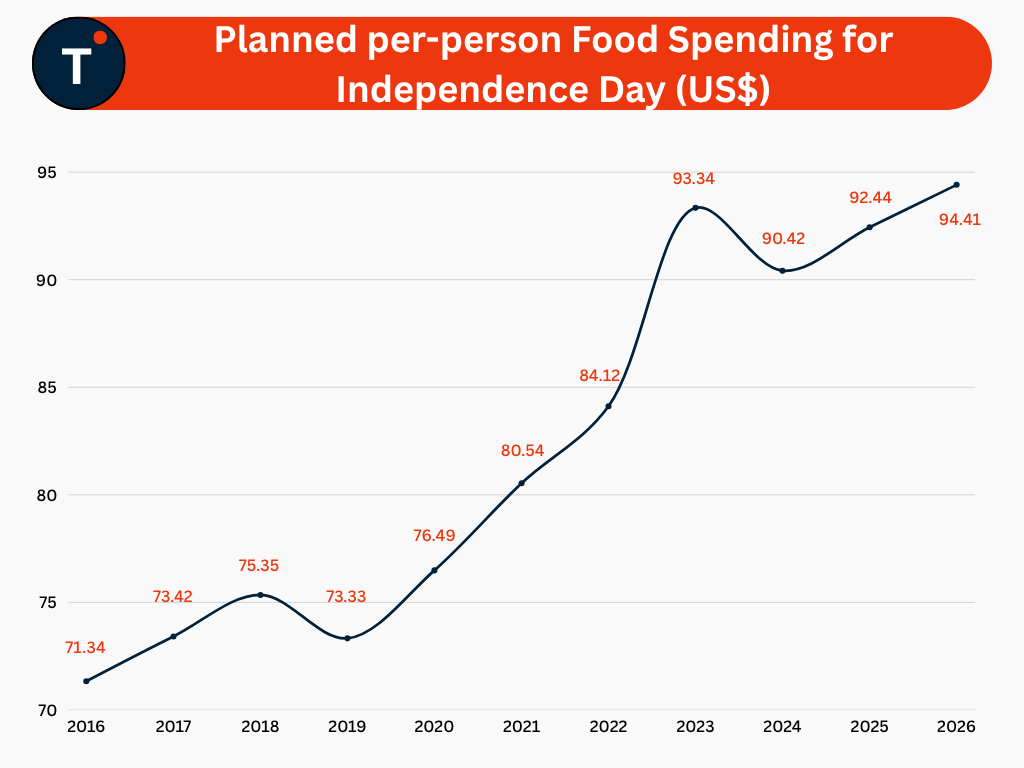
- Planned per-person food spending for Independence Day increased from US$71.34 in 2016 to US$94.41 in 2026.
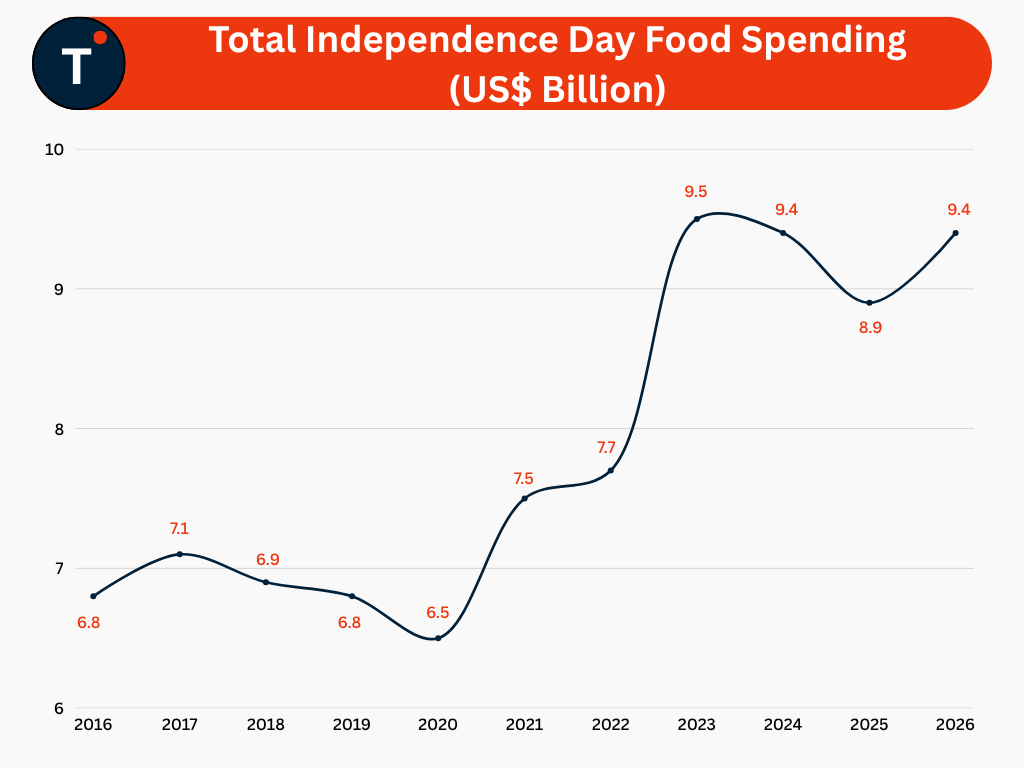
- Consumers are projected to spend US$9.4 billion on food for Independence Day celebrations in 2026, representing a 6% increase compared to the previous year.
- Despite continued inflationary pressures and elevated food prices, 87% of consumers plan to celebrate Independence Day, demonstrating the holiday’s strong cultural significance and resilience in consumer participation.
Office Holiday Party Statistics
- 85% of U.S. companies organize office holiday parties, underscoring the continued importance of workplace celebrations in employee engagement strategies.
- 63% of Americans attend at least one holiday party annually, highlighting strong participation in seasonal social events.
- 82% of employees plan to attend their company’s holiday party in 2025, up from 70% in 2024, indicating renewed interest in workplace gatherings.
- 51% of organizations are increasing their holiday party budgets in 2025, while 41% intend to maintain spending levels comparable to the previous year.
- Food and beverage budgets are projected to increase by 31% year-over-year, reflecting greater investment in employee event experiences.
- The average food and beverage expenditure per attendee stands at US$59.
- The average total event cost per attendee, including all associated expenses, reaches US$693.
- 93% of event planners identify food as the primary driver of social interaction during holiday celebrations.
- 77% of employees consider food the most anticipated aspect of office holiday events.
- 96% of employees look forward to workplace holiday celebrations, demonstrating their value in fostering positive employee experiences.
- 83% of employees believe holiday events strengthen coworker relationships and support workplace connectivity.
- 45% of employees report experiencing some level of stress related to office holiday parties, driven by concerns surrounding workplace conversations, interactions with management, and food-related preferences.
- 55% of employees view holiday celebrations as valuable opportunities for social interaction and team bonding, reinforcing their role in supporting employee retention, workplace culture, and engagement across hybrid and remote work environments.
Service Requirements for Paid Vacation Leave
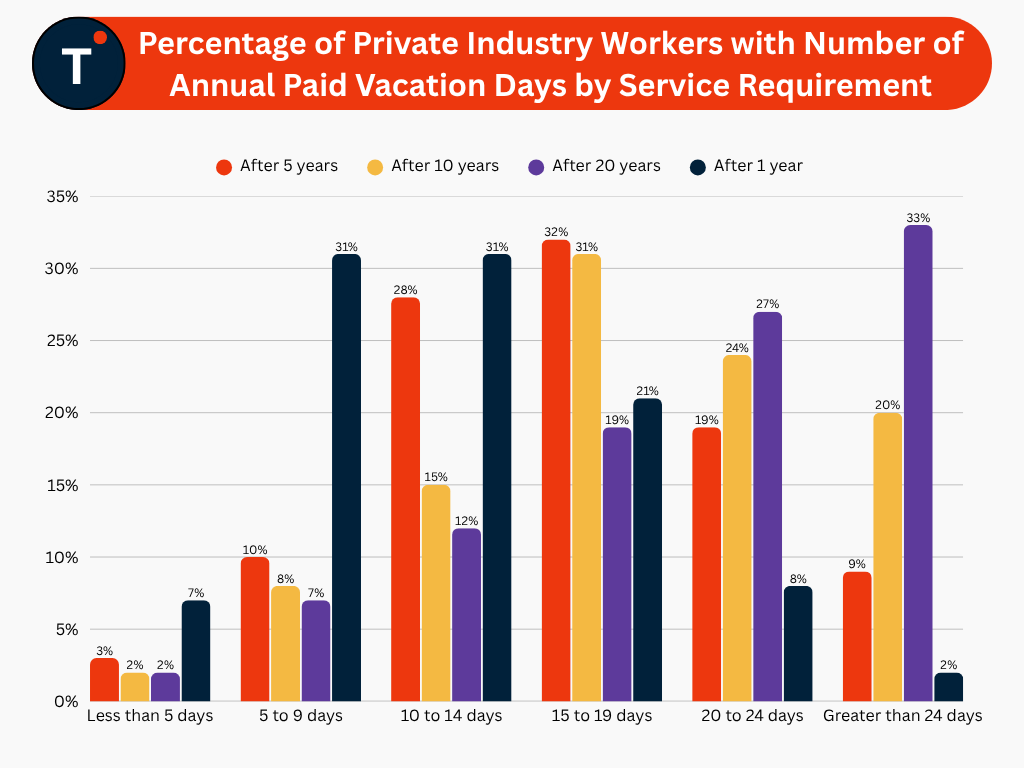
After 1 Year of Service:
- 31% of private industry workers receive 5–9 paid vacation days, representing the most common leave entitlement after 1 year of employment.
- 31% of workers are entitled to 10–14 paid vacation days, reflecting broad adoption of mid-range vacation benefits.
- 21% of workers receive 15–19 paid vacation days after 1 year of service.
- 8% of workers are offered 20–24 paid vacation days.
- 7% of workers receive fewer than 5 paid vacation days.
- 2% of workers have access to more than 24 paid vacation days.
After 5 Years of Service:
- 32% of private industry workers receive 15–19 paid vacation days, making it the most prevalent vacation entitlement after 5 years of service.
- 28% of workers are provided 10–14 paid vacation days.
- 19% of workers receive 20–24 paid vacation days.
- 10% of workers are entitled to 5–9 paid vacation days.
- 9% of workers receive more than 24 paid vacation days.
- 3% of workers receive fewer than 5 paid vacation days.
After 10 Years of Service:
- 31% of private industry workers receive 15–19 paid vacation days, representing the largest share of employees at this tenure level.
- 24% of workers are entitled to 20–24 paid vacation days.
- 20% of workers receive more than 24 paid vacation days.
- 15% of workers are offered 10–14 paid vacation days.
- 8% of workers receive 5–9 paid vacation days.
- 2% of workers have fewer than 5 paid vacation days.
After 20 Years of Service:
- 33% of private industry workers receive more than 24 paid vacation days, representing the most common leave entitlement among long-tenured employees.
- 27% of workers are entitled to 20–24 paid vacation days.
- 19% of workers receive 15–19 paid vacation days.
- 12% of workers are offered 10–14 paid vacation days.
- 7% of workers receive 5–9 paid vacation days.
- 2% of workers continue to receive fewer than 5 paid vacation days.
Percentage of Private Industry Workers with Access to Paid Vacation
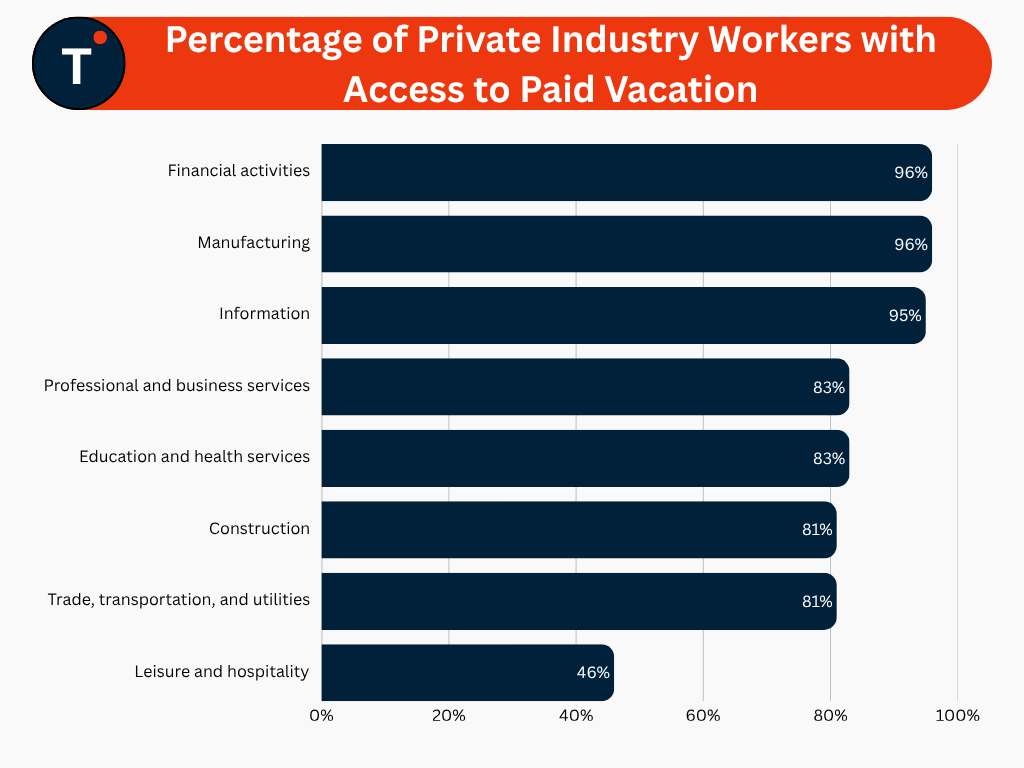
- Manufacturing records one of the highest levels of paid vacation access, with 96% of workers receiving paid vacation benefits.
- Financial Activities also demonstrates strong vacation benefit coverage, with 96% of employees having access to paid vacation leave.
- Information Services maintains a high level of paid vacation availability, with 95% of workers covered by paid vacation programs.
- Education and Health Services provides paid vacation benefits to 83% of employees, reflecting broad adoption across the sector.
- Professional and Business Services reports 83% employee access to paid vacation leave, aligning with overall private-sector benefit trends.
- Trade, Transportation, and Utilities offers paid vacation benefits to 81% of workers, indicating moderate coverage across the industry.
- Construction also records 81% paid vacation access, reflecting comparable leave benefits to other operational industries.
- Leisure and Hospitality exhibits the lowest level of paid vacation coverage, with only 46% of employees having access to paid vacation benefits.
Percentage of Workers with Access to Paid Vacation Leave by Establishment Size
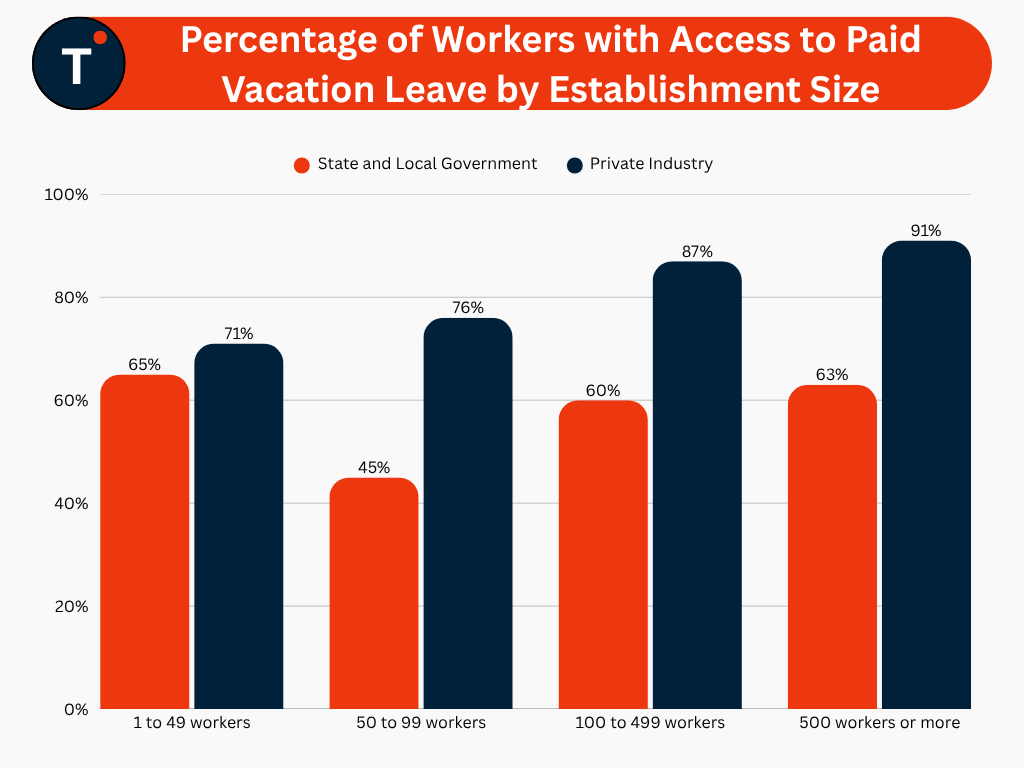
- Among organizations with 1–49 employees, 71% of private-sector workers have access to paid vacation leave, compared with 65% of state and local government employees.
- In organizations employing 50–99 workers, paid vacation coverage reaches 76% in the private sector, while coverage stands at 45% among state and local government employees.
- For organizations with 100–499 employees, access to paid vacation benefits increases to 87% in the private sector, compared with 60% in state and local government organizations.
- Among large employers with 500 or more employees, 91% of private-sector workers receive paid vacation benefits, versus 63% of state and local government employees.
Average Number of Sick and Vacation Days by Length of Service Requirement
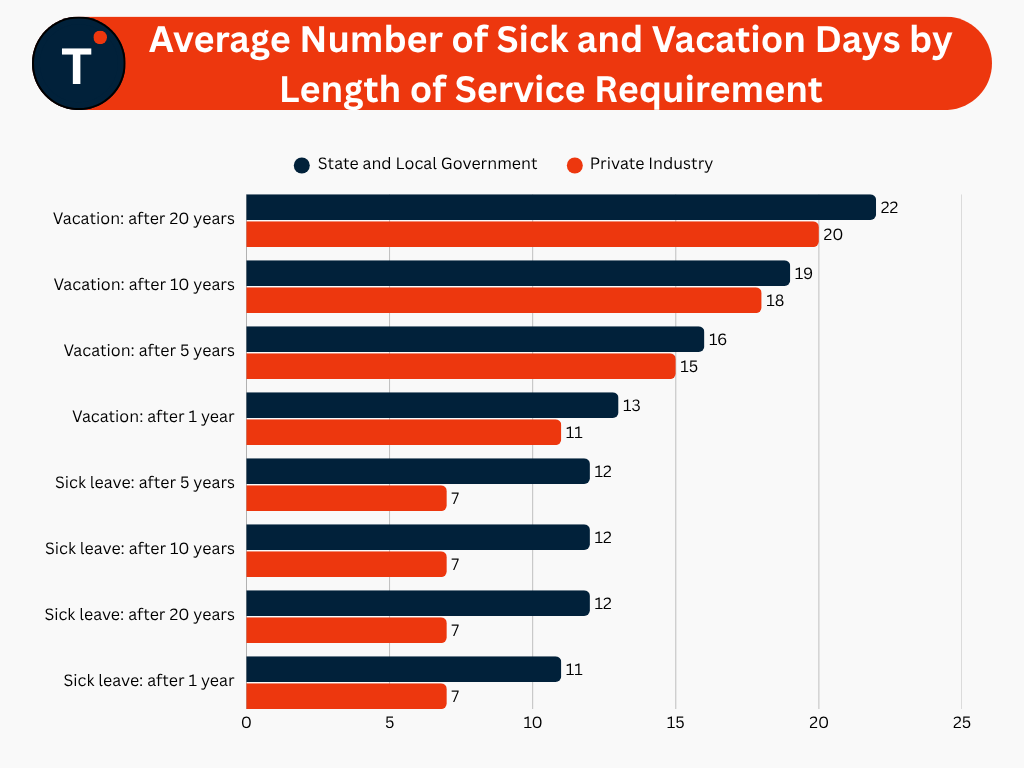
- After 1 year of service, private-sector employees receive an average of 11 vacation days and 7 sick days, while state and local government employees receive 13 vacation days and 11 sick days.
- After 5 years of service, average vacation entitlement increases to 15 days in the private sector and 16 days in state and local government organizations. Average sick leave stands at 7 days and 12 days, respectively.
- After 10 years of service, employees receive an average of 18 vacation days in the private sector and 19 vacation days in state and local government organizations. Sick leave benefits remain at 7 days and 12 days, respectively.
- After 20 years of service, average vacation entitlement reaches 20 days in the private sector and 22 days in state and local government organizations. Sick leave benefits total 7 days for private-sector employees and 12 days for state and local government employees.
Percentage of Private Industry Workers with Access to Consolidated Leave Plans
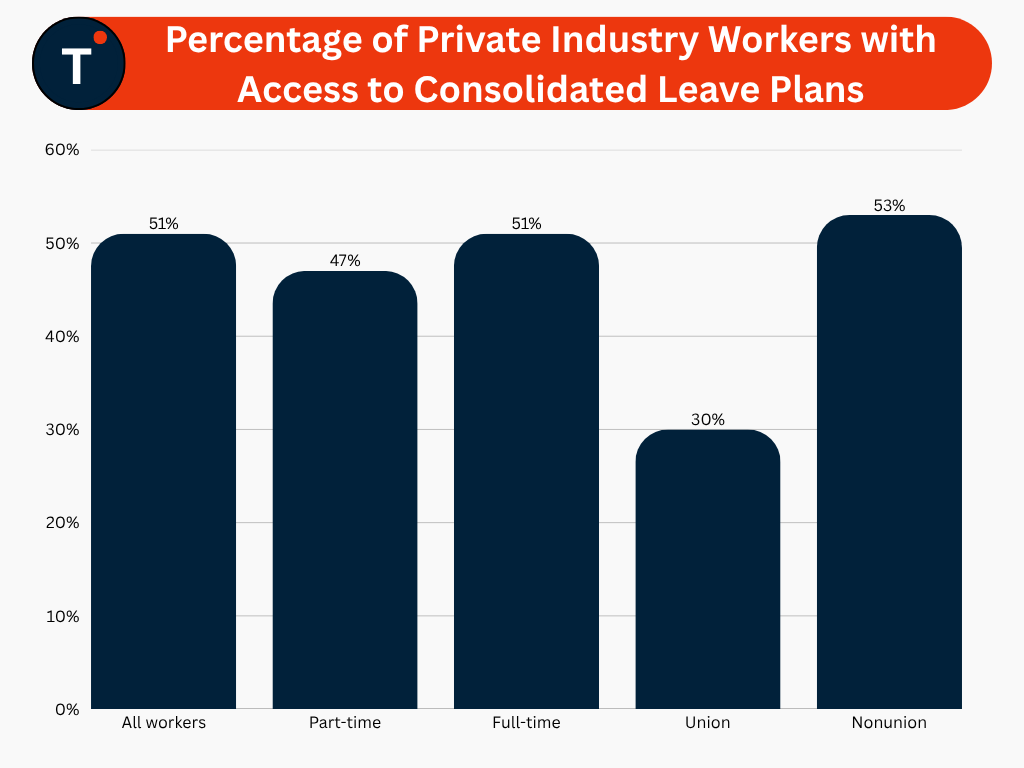
- 51% of private industry workers have access to consolidated leave plans that combine multiple leave benefits under a single policy framework.
- 47% of part-time employees are covered by consolidated leave plans, indicating lower access compared to the overall workforce.
- 51% of full-time employees have access to consolidated leave programs, aligning with the average coverage level across private industry workers.
- 30% of unionized workers are covered by consolidated leave plans, representing the lowest level of access among the employee groups analyzed.
- 53% of nonunion employees have access to consolidated leave programs, the highest coverage rate among the workforce segments assessed.
Factors Influencing Employee Confidence in Taking Time Off
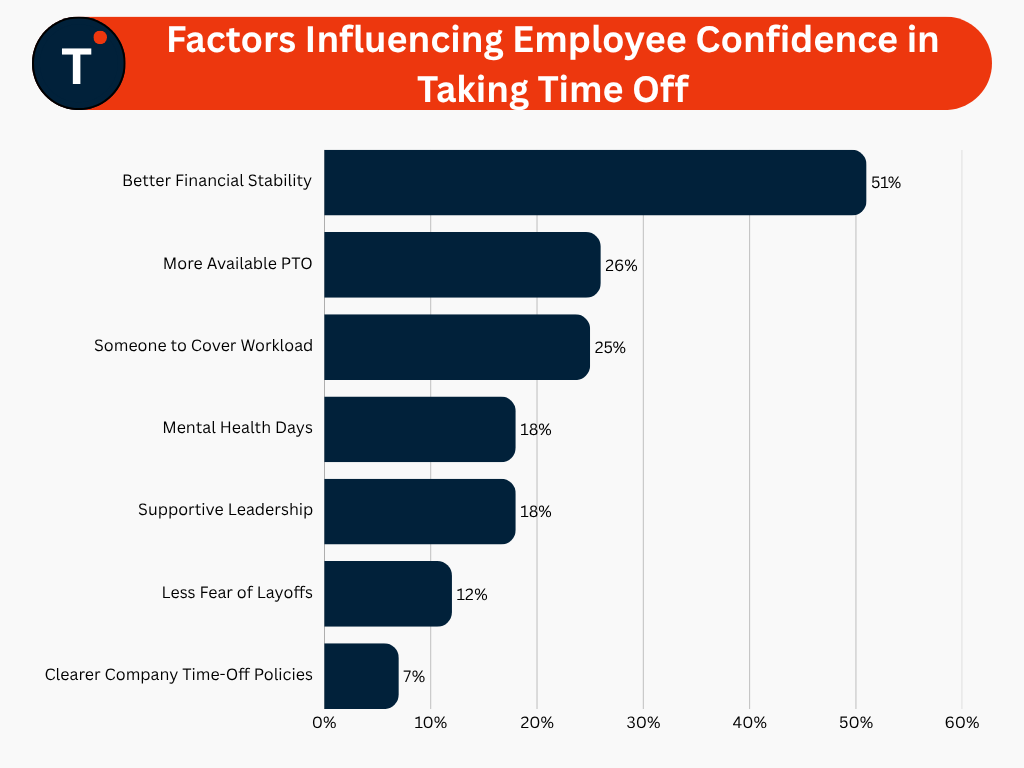
- 51% of workers indicate that greater financial stability would increase their confidence in requesting time off, making it the most significant factor influencing leave utilization.
- 26% of employees report that additional Paid Time Off (PTO) availability would encourage them to take leave more comfortably.
- 25% of workers state that having adequate workload coverage during their absence would improve their willingness to request time off.
- 18% of employees identify access to dedicated mental health days as a factor that would support greater confidence in utilizing leave benefits.
- 18% of workers cite supportive leadership as an important enabler of leave utilization and work-life balance.
- 12% of employees report that reduced concerns regarding layoffs and job security would make them more comfortable taking time off.
- 7% of workers indicate that clearer organizational leave policies would improve confidence in requesting and utilizing available time off.
Work-Related Concerns During Vacation
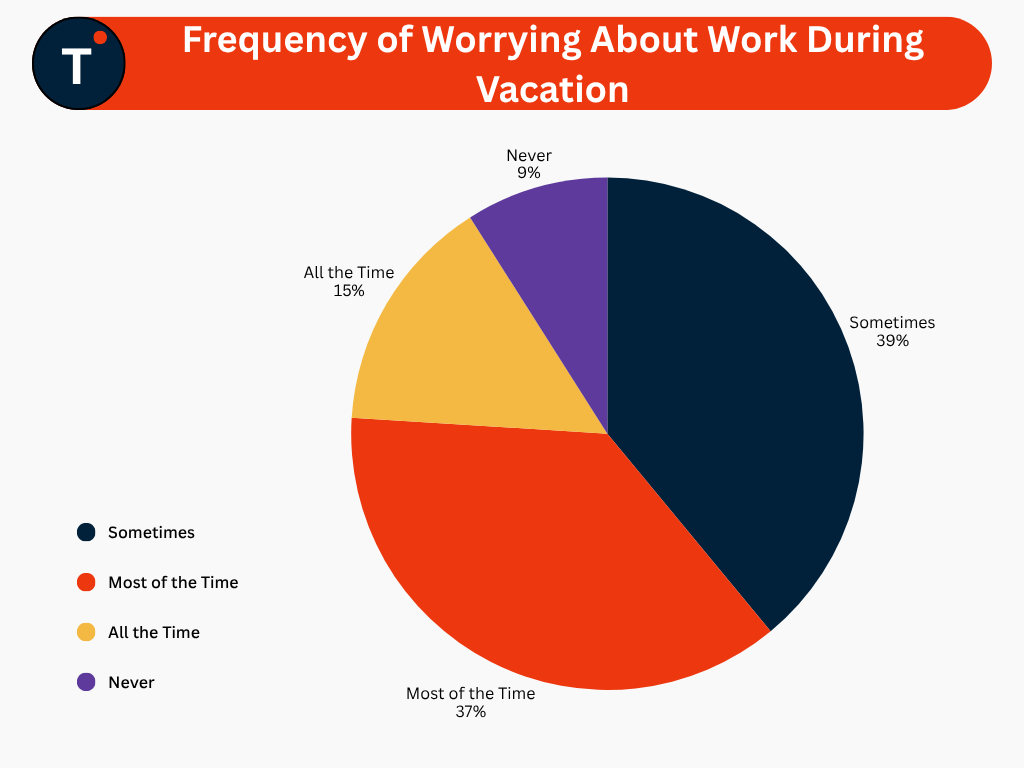
- 39% of Americans report worrying about work sometimes while on vacation, making it the most common response among surveyed individuals.
- 37% of Americans indicate that they worry about work most of the time during vacations, highlighting the persistent influence of work-related responsibilities on personal time.
- 15% of individuals report worrying about work all the time while on vacation, suggesting that a notable segment of the workforce remains continuously connected to work-related concerns.
- Only 9% of Americans state that they never worry about work during vacations, indicating that complete disengagement from work remains relatively uncommon.
Workplace Connectivity During Time Off
- 30% of employees continue to perform work-related tasks during their time off, while 8% remain consistently engaged with work even when on leave.
- 68% of individuals experience anxiety when unable to check work-related messages during vacations, highlighting the persistent influence of workplace communications on employee well-being.
- 66% of employees report difficulty mentally disconnecting from work while on leave, indicating ongoing challenges in achieving effective work-life separation.
- 44% of employees continue working during vacations due to a perceived need to maintain control over work-related responsibilities and outcomes.
- 35% of employees remain engaged with work during leave periods because of a strong commitment to and passion for their jobs.
- 34% of employees report working while on vacation because there is no suitable colleague available to manage their responsibilities in their absence.
- 15% of employees continue working during time off due to concerns about job security and the potential risk of losing their position.
- 13% of employees indicate that expectations from management or direct supervisors contribute to their decision to work while on vacation.
Conclusion
- Paid leave benefits remain a critical component of employee compensation strategies, supporting workforce well-being, engagement, productivity, and retention.
- Access to paid holidays, vacation leave, and sick leave varies significantly across industries, organization sizes, income groups, and employment types, highlighting disparities in benefit availability.
- Employees increasingly view paid time off as an essential workplace benefit, with work-life balance, mental well-being, and flexibility emerging as key priorities in employment decisions.
- Despite widespread availability of leave benefits, utilization challenges persist due to workload pressures, financial concerns, workplace expectations, and difficulties disconnecting from work.
- Employee participation in holidays, vacations, and workplace celebrations continues to demonstrate the importance of time away from work in fostering satisfaction, social connection, and organizational commitment.
- The growing prevalence of work-related anxiety during leave periods underscores the need for organizations to strengthen policies and workplace cultures that encourage employees to fully utilize available time off.
- Organizations that offer comprehensive leave programs and actively support leave utilization are better positioned to enhance employee experience, improve retention, and maintain a more engaged and productive workforce.
Add TriCityLocalNews as a Preferred Source on Google for instant updates!