The lingerie market continues to evolve, driven by changing consumer preferences, product innovation, and shifting lifestyle trends. Manufacturers are increasingly focusing on enhancing comfort, functionality, inclusivity, and sustainability while expanding their digital presence to strengthen consumer engagement and improve accessibility across global markets.
Growing consumer awareness of the health and comfort benefits associated with well-fitting lingerie, combined with the increasing purchasing power and economic independence of women, continues to support market growth. In addition, rising demand for premium, personalized, and body-inclusive lingerie collections is encouraging brands to invest in innovative materials, advanced fit technologies, and diverse product offerings.
Editor’s Picks
The average profit margin in the lingerie industry ranges from 20% to 25%, reflecting the sector’s healthy retail economics.
70% to 80% of women prioritize comfort over appearance when purchasing lingerie, making comfort the leading purchase consideration.
Mobile devices generate 65% of traffic to lingerie e-commerce websites, highlighting the growing role of mobile commerce in online lingerie sales.
40% to 45% of consumers evaluate sustainability credentials before purchasing lingerie, reflecting increasing demand for environmentally responsible products.
Men account for 26.7% of lingerie purchases, demonstrating their significant contribution to the overall market.
59% of lingerie brands incorporate recycled materials into at least a portion of their product collections, reflecting the industry’s growing focus on sustainable manufacturing.
64% of millennial women purchased lingerie within the previous six months, highlighting strong purchasing frequency among this consumer segment.
40% of women wear sports bras for everyday, non-sport activities, reflecting growing demand for comfort-oriented lingerie.
The Victoria’s Secret “Red Hot Fantasy Bra” remains the world’s most expensive bra, valued at US$15 million, featuring 1,300 precious gemstones.
The average woman spends approximately US$3,400 on bras over her lifetime, reflecting substantial long-term consumer expenditure on lingerie.
General Statistics
80% of women wear an incorrect bra size, with 70% wearing bras that are too small and 10% wearing bras that are too large.
Gen Z consumers are 30% more likely to purchase gender-fluid or unisex intimate apparel than older demographic groups.
Men account for 80% of lingerie gift card purchases, highlighting their significant role in gift-oriented lingerie sales.
Lingerie represents 17% of all women’s apparel sales, underscoring its importance within the women’s fashion industry.
The global lingerie industry is nine times larger than the men’s underwear market, reflecting the broader product range and stronger consumer demand.
Instagram influences 70% of lingerie purchasing decisions, demonstrating the platform’s significant impact on consumer buying behavior.
The average lifespan of a bra ranges from 6 to 12 months, equivalent to 100–130 wears under regular usage.
24% of women purchase Christmas-themed lingerie, while 42% consider festive lingerie suitable for seasonal occasions.
Online searches for red lingerie increase by 73% during the Christmas season and remain 12% higher than February levels, reflecting strong seasonal demand.
76% of lingerie brands prohibit the use of animal-derived materials, including silk and leather, within their product portfolios.
33% of lingerie brands utilize organic or certified materials across their collections, while 29% incorporate these materials into selected product lines.
Bikini panties are the most preferred style, selected by 37% of women, followed by full briefs (23%), G-strings (19%), and other styles—including hi-cut, French cut, and hipsters (10%). 7% of women report not wearing underwear.
The average bra size in the United States is 34DD.
The bra band provides 80% of overall support, while shoulder straps contribute the remaining 20%.
A single underwired bra consists of approximately 35 individual components, requires up to 60 seams, and may involve the expertise of 10 skilled seamstresses during production.
A total of 306,196 breast augmentation procedures were performed in the United States in 2024, according to data from the American Society of Plastic Surgeons.
Global Lingerie Market Insights
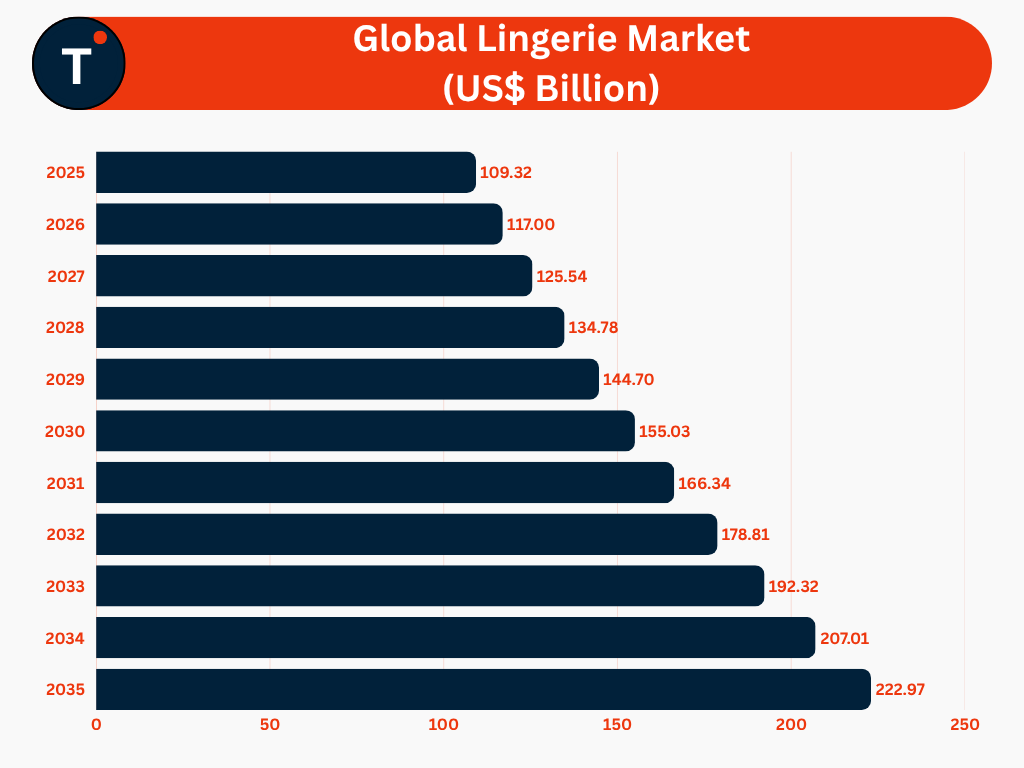
The global lingerie market was valued at US$109.32 billion in 2025.
Global lingerie sales are projected to reach US$117.00 billion in 2026, reflecting continued market expansion.
The global lingerie market is forecast to grow at a CAGR of 7.4% during the 2026–2035 period.
The global lingerie market is expected to attain a value of US$222.97 billion by 2035.
Global Lingerie Market by Geography
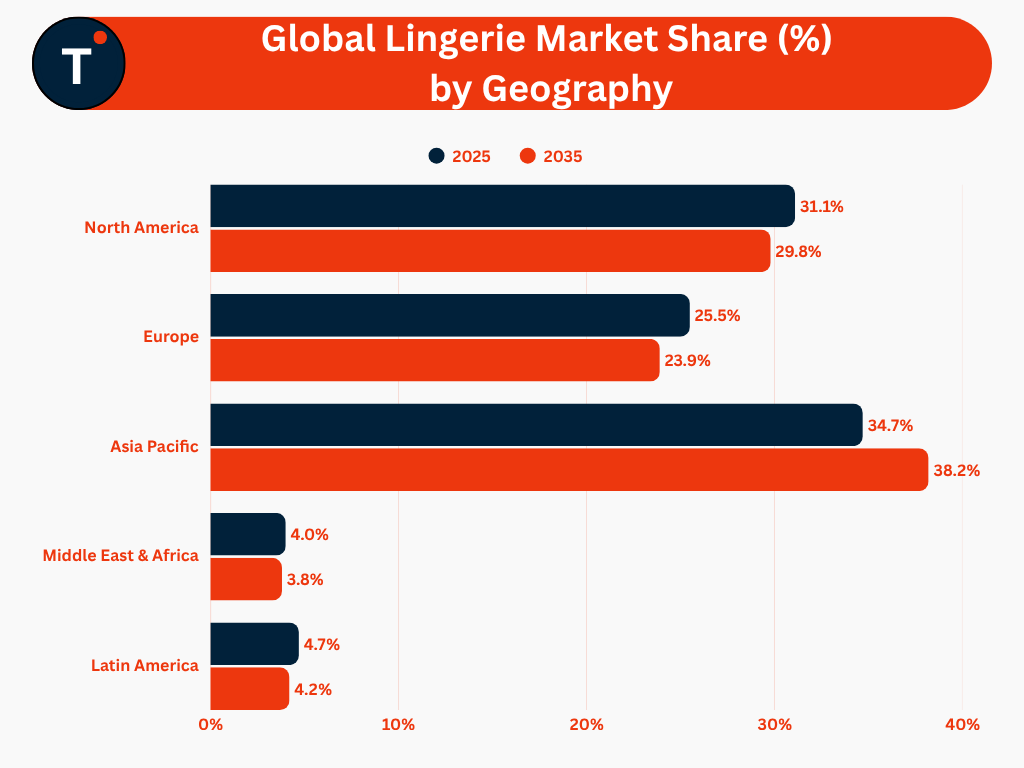
Asia Pacific dominated the global lingerie market, accounting for 34.7% of total revenue in 2025.
The Asia Pacific lingerie market was valued at US$37.97 billion in 2025 and is projected to reach US$85.28 billion by 2035, expanding at a CAGR of 8.6%.
North America accounted for 31.1% of the global lingerie market in 2025, making it the second-largest regional market.
The North America lingerie market generated US$34.03 billion in revenue in 2025 and is forecast to reach US$66.48 billion by 2035, registering a CAGR of 6.9%.
Europe represented 25.5% of the global lingerie market in 2025, ranking as the third-largest regional market.
The Europe lingerie market was valued at US$27.86 billion in 2025 and is expected to reach US$53.32 billion by 2035, growing at a CAGR of 6.7%.
The Middle East & Africa lingerie market was valued at US$4.32 billion in 2025 and is projected to reach US$8.54 billion by 2035, reflecting a CAGR of 7.1%.
The Latin America lingerie market generated US$5.13 billion in revenue in 2025 and is anticipated to reach US$9.36 billion by 2035, expanding at a CAGR of 6.2%.
The US Lingerie Market Insights
The United States accounted for 25.2% of the global lingerie market in 2025, reinforcing its position as one of the largest country-level markets.
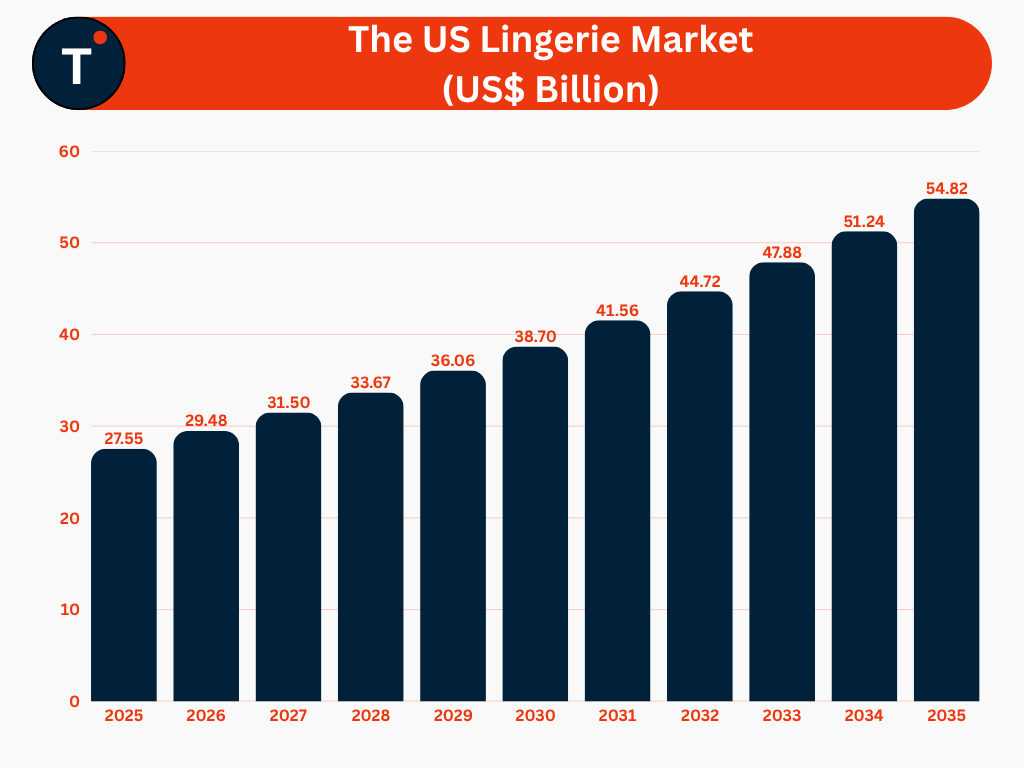
The U.S. lingerie market was valued at US$27.55 billion in 2025.
The U.S. lingerie market is projected to reach US$29.48 billion in 2026, reflecting continued growth in consumer spending on intimate apparel.
The U.S. lingerie market is expected to expand at a CAGR of 7.1% during the 2026–2035 forecast period.
The U.S. lingerie market is forecast to attain a value of US$54.82 billion by 2035.
Global Lingerie Market by Product Type
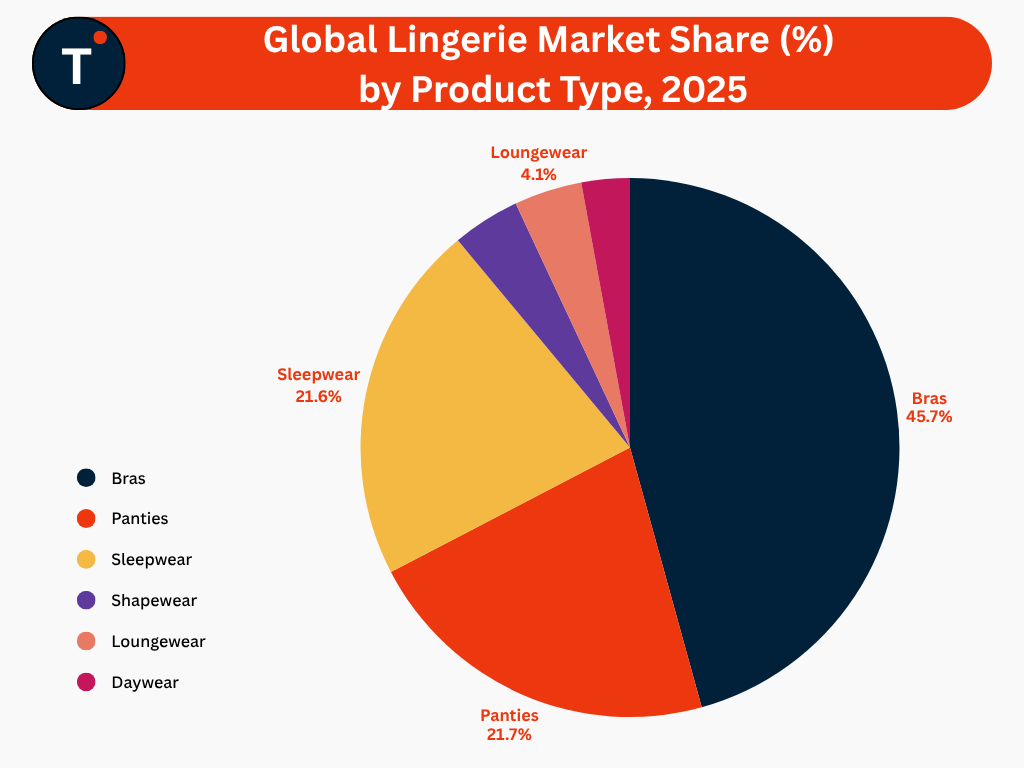
Bras dominated the global lingerie market, accounting for 45.7% of total revenue in 2025.
The bras segment was valued at US$49.97 billion in 2025 and is projected to reach US$97.98 billion by 2035, expanding at a CAGR of 7.0%.
Panties accounted for 21.7% of the global lingerie market in 2025, making them the second-largest product category.
The panties segment generated US$23.68 billion in revenue in 2025 and is forecast to reach US$45.56 billion by 2035, growing at a CAGR of 6.8%.
Sleepwear represented 21.6% of the global lingerie market in 2025.
The sleepwear segment was valued at US$23.62 billion in 2025 and is anticipated to reach US$52.79 billion by 2035, registering a CAGR of 8.4%.
Shapewear is projected to be the fastest-growing product category, expanding at a CAGR of 9.1% during the forecast period.
The shapewear segment accounted for 4.1% of the market in 2025, generating US$4.44 billion in revenue and is expected to reach US$10.48 billion by 2035.
Loungewear represented 4.1% of the global lingerie market in 2025.
The loungewear segment was valued at US$4.45 billion in 2025 and is projected to reach US$10.27 billion by 2035, growing at a CAGR of 8.8%.
Daywear accounted for 2.9% of the global lingerie market in 2025.
The daywear segment generated US$3.17 billion in revenue in 2025 and is forecast to reach US$5.87 billion by 2035, expanding at a CAGR of 6.4%.
Global Lingerie Market by Material Type
Material Type
2025 (US$ Bn)
2030 (US$ Bn)
2035 (US$ Bn)
Cotton
52.64
73.46
100.48
Silk and Satin
38.83
55.84
84.82
Synthetic
17.86
25.74
37.68
Cotton dominated the global lingerie market, accounting for 48.1% of total revenue in 2025.
The cotton lingerie segment was valued at US$52.64 billion in 2025 and is projected to reach US$100.48 billion by 2035, expanding at a CAGR of 6.6%.
Silk and satin lingerie accounted for 35.5% of the global lingerie market in 2025, making it the second-largest material segment.
The silk and satin lingerie segment is projected to register the fastest growth, increasing from US$38.83 billion in 2025 to US$84.82 billion by 2035, at a CAGR of 8.3%.
Synthetic materials represented 16.3% of the global lingerie market in 2025.
The synthetic lingerie segment generated US$17.86 billion in revenue in 2025 and is forecast to reach US$37.68 billion by 2035, growing at a CAGR of 7.8%.
Global Lingerie Market by Age Group
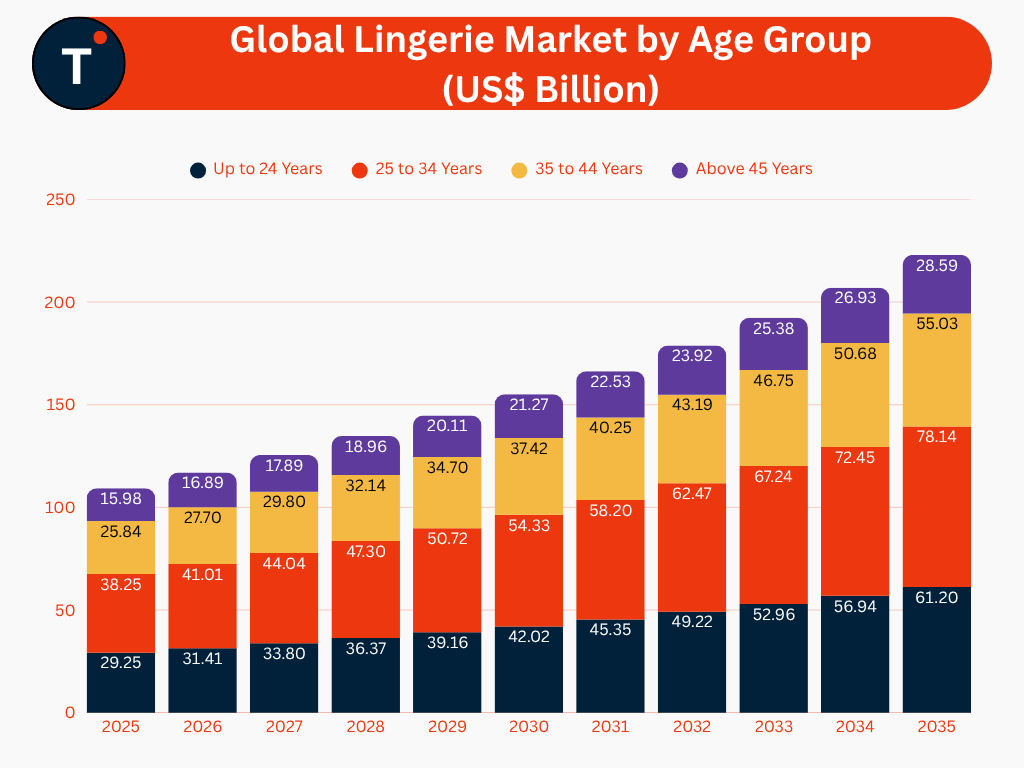
The 25–34 years age group dominated the global lingerie market, accounting for 35.0% of total revenue in 2025.
The 25–34 years segment generated US$38.25 billion in revenue in 2025 and is projected to reach US$78.14 billion by 2035, expanding at a CAGR of 7.4%.
Consumers aged up to 24 years accounted for 26.8% of the global lingerie market in 2025, making them the second-largest age group.
The up to 24 years segment was valued at US$29.25 billion in 2025 and is forecast to reach US$61.20 billion by 2035, growing at a CAGR of 7.7%.
The 35–44 years age group is projected to register the fastest growth, expanding at a CAGR of 7.9% during the forecast period.
The 35–44 years segment is expected to increase from US$25.84 billion in 2025 to US$55.03 billion by 2035.
Consumers aged above 45 years accounted for 14.6% of the global lingerie market in 2025.
The above 45 years segment generated US$15.98 billion in revenue in 2025 and is projected to reach US$28.59 billion by 2035, registering a CAGR of 6.0%.
Global Lingerie Market by Distribution Channel
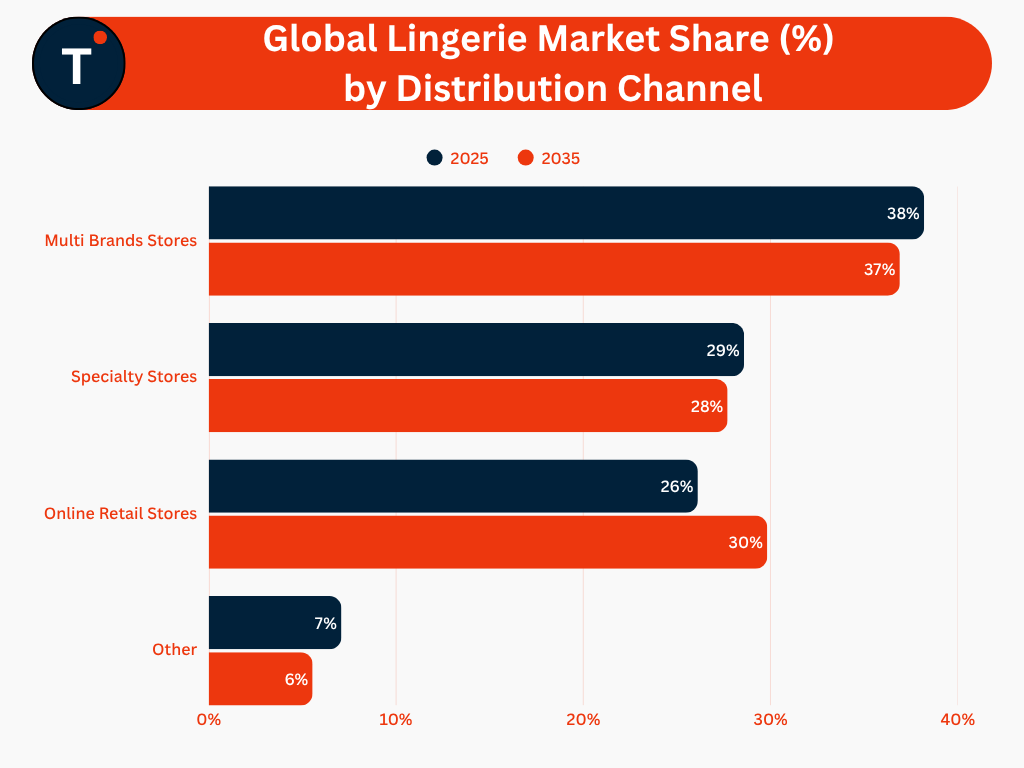
Multi-brand stores dominated the global lingerie market, accounting for 38.2% of total revenue in 2025.
Revenue generated through multi-brand stores reached US$41.77 billion in 2025 and is projected to increase to US$82.29 billion by 2035, expanding at a CAGR of 7.0%.
Specialty stores accounted for 28.6% of the global lingerie market in 2025, making them the second-largest distribution channel.
Lingerie sales through specialty stores were valued at US$31.26 billion in 2025 and are forecast to reach US$61.80 billion by 2035, growing at a CAGR of 7.1%.
Online retail stores are projected to be the fastest-growing distribution channel, registering a CAGR of 9.0% during the forecast period.
The online retail channel is expected to account for 29.8% of the global lingerie market by 2035.
Revenue generated through online retail stores is projected to increase from US$28.55 billion in 2025 to US$66.52 billion by 2035.
The others distribution channel generated US$7.74 billion in revenue in 2025 and is expected to reach US$12.36 billion by 2035, expanding at a CAGR of 4.8%.
Sports Bra Statistics
The global sports bras market was valued at US$12.27 billion in 2024 and is projected to reach US$36.74 billion by 2033, expanding at a CAGR of 12.96%.
54% of female consumers in the United States purchase sports bras for both athletic and casual wear, while 61% of purchases are completed through digital platforms.
The crossover use of sports bras for workout and everyday wear has increased by 46%, particularly across urban markets.
Women aged 18–39 years represent the primary consumer group, supported by a 52% increase in female gym memberships and a 38% rise in yoga participation.
41% of sports bra brands incorporate moisture-wicking, breathable, and anti-odor fabrics, while consumer preference for adjustable fit features has increased by 32%.
Demand for inclusive sizing has increased by 34%, making extended size ranges a key competitive differentiator among manufacturers.
E-commerce dominates sports bra distribution with a 51% market share, while mobile app purchases have increased by 44%.
29% of consumers prefer sports bras made from sustainable materials, reflecting growing demand for environmentally responsible activewear.
47% of consumers are willing to pay a premium for brands that align with their personal values, including sustainability and ethical manufacturing.
Consumer preference for wire-free and seamless sports bra designs has increased by 37%, driven by growing demand for comfort and versatility.
Demand for customizable fit features has increased by 32%, highlighting the importance of personalized comfort and support.
Sports bras can reduce breast movement by up to 74%, improving comfort and support during physical activities.
Purchase intent for activewear has increased by 35%, contributing to sustained demand for sports bras within the global apparel market.
Sports Bra Buyer Decision Framework
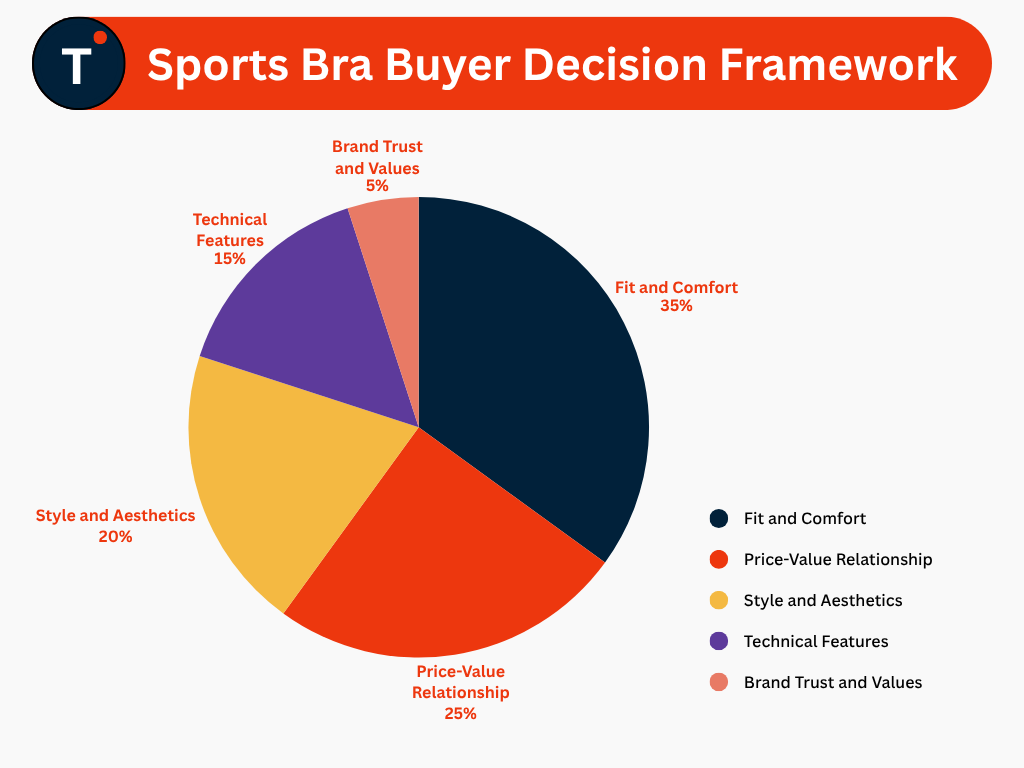
Fit and comfort are the most influential purchasing factors, accounting for 35% of consumer buying decisions.
Price-to-value relationship represents 25% of purchase consideration, highlighting consumers’ focus on balancing product quality with affordability.
Style and aesthetics contribute 20% to purchasing decisions, reflecting the importance of design and visual appeal in product selection.
Technical features account for 15% of consumer preference, including attributes such as moisture management, support, breathability, and performance-enhancing fabrics.
Brand trust and values represent 5% of purchasing decisions, indicating that brand reputation and corporate values play a supporting role compared with product-specific attributes.
Average Bra Size by Age Group
Age Group
Average Band Size
Average Cup Size
Teens (13-19)
32-34
A-B
20s
32-36
B-D
30s
36-38
C-D
40s and Beyond
36-40
D-DD
Teenagers (13–19 years) typically wear bra band sizes ranging from 32–34, with average cup sizes between A and B.
Women in their 20s generally wear bra band sizes of 32–36, while average cup sizes range from B to D.
Women in their 30s commonly wear bra band sizes between 36–38, with average cup sizes ranging from C to D.
Women aged 40 years and above typically wear bra band sizes of 36–40, while average cup sizes generally range from D to DD, reflecting the largest average sizing among the age groups analyzed.
Popular Lingerie Color Trends
Print-patterned lingerie is projected to record the strongest growth in popularity, with a 235% increase compared to the previous year, making it the fastest-growing style trend.
Purple lingerie is expected to experience the second-highest increase in demand, rising by 96%, reflecting growing consumer interest in bold and vibrant color choices.
Nude-colored lingerie is projected to grow by 17%, supported by continued demand for versatile and everyday essentials.
Yellow lingerie is anticipated to register a 16% increase in popularity, indicating rising consumer preference for brighter color options.
Green lingerie is expected to witness a 15% increase in demand, demonstrating steady growth among emerging color trends.
Bra Purchase Decision Factors
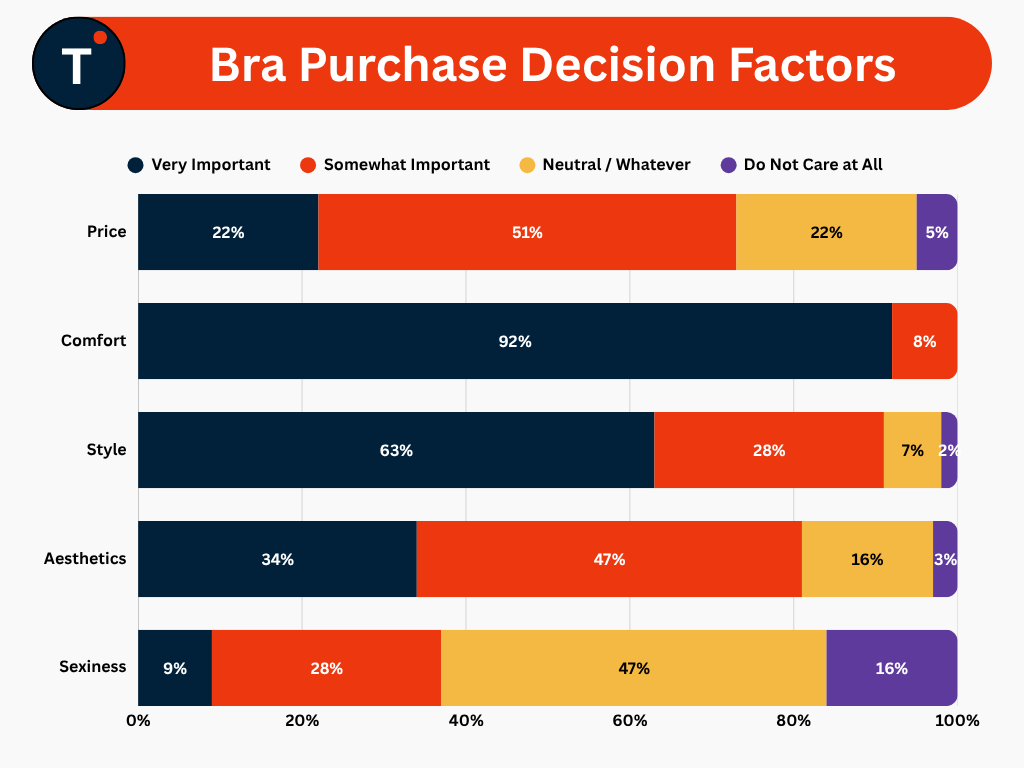
Comfort is the most important attribute when purchasing a bra, with 92% of consumers considering it “Very Important” and 8% rating it as “Somewhat Important”, indicating universal emphasis on fit and comfort.
Style is another key purchasing consideration, with 63% of consumers rating it as “Very Important”, 28% as “Somewhat Important”, 7% expressing no strong preference, and 2% indicating it is not important.
Aesthetics also plays a significant role in purchasing decisions, as 34% of consumers consider it “Very Important”, 47% rate it as “Somewhat Important”, 16% are neutral, and 3% do not consider it important.
Price remains an influential purchasing factor, with 22% of consumers rating it as “Very Important”, 51% as “Somewhat Important”, 22% expressing neutrality, and 5% indicating that price is not an important consideration.
Sexiness is the least influential purchasing attribute, with 9% of consumers considering it “Very Important”, 28% rating it as “Somewhat Important”, 47% expressing neutrality, and 16% indicating that it is not important.
Underwire Bra Usage Frequency
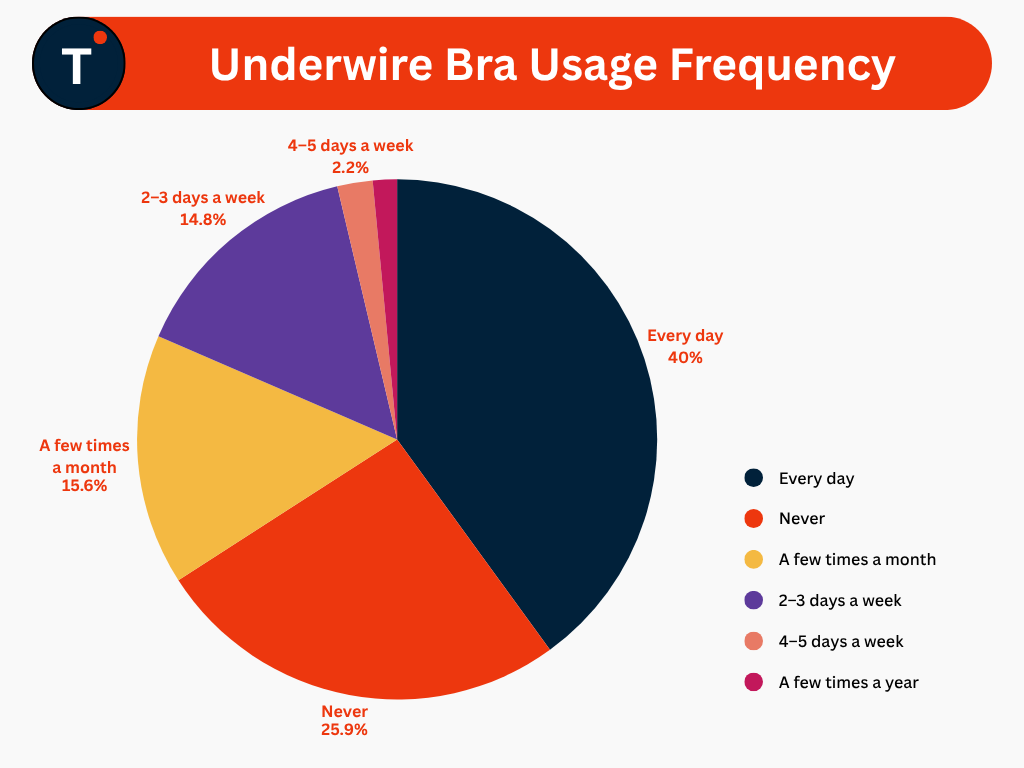
40.0% of consumers wear an underwire bra every day, making it the most common usage pattern.
25.9% of consumers report never wearing an underwire bra, indicating a substantial preference for wire-free alternatives.
15.6% of consumers wear an underwire bra a few times each month, reflecting occasional usage.
14.8% of consumers wear an underwire bra 2–3 days per week, making it the fourth most common wearing frequency.
2.2% of consumers wear an underwire bra 4–5 days per week, representing a relatively small user segment.
1.5% of consumers wear an underwire bra only a few times per year, making it the least common usage pattern.
Bra Changing Frequency Statistics
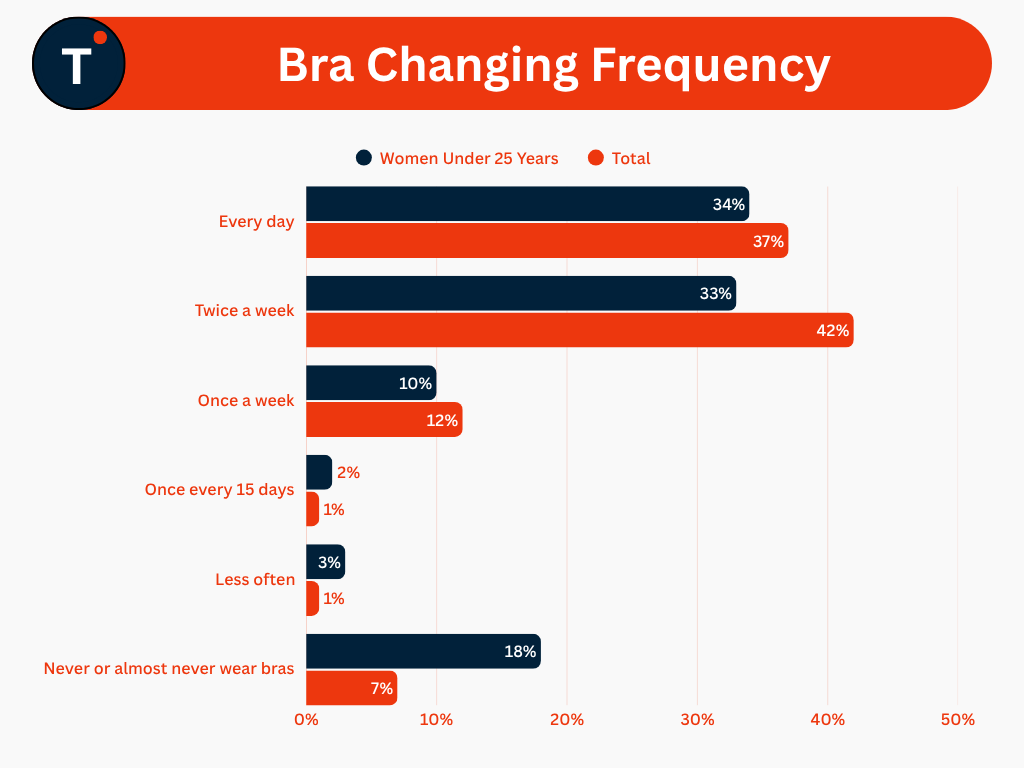
Changing bras twice a week is the most common practice among the overall population, reported by 42% of respondents, compared with 33% of women under 25 years of age.
37% of the overall population change their bras every day, while 34% of women under 25 years follow the same routine.
Changing bras once a week is reported by 12% of respondents overall, compared with 10% among women under 25 years.
2% of women under 25 years change their bras once every 15 days, compared with 1% of respondents overall.
3% of women under 25 years report changing their bras less often, while the corresponding figure for the overall population is 1%.
18% of women under 25 years report never or almost never wearing bras, significantly higher than the 7% reported across the overall population.
Top Lingerie Companies Market Share
Top Lingerie Companies
Market Share in 2025
Gap
15.2%
Zivame
11.2%
Marks & Spencer
10.8%
Victoria’s Secret
10.4%
Calvin Klein
5.8%
Ralph Lauren
5.7%
Amante, MAS Brands
2.1%
Triumph
1.4%
Maidenform
0.6%
Lily of France
0.6%
Jockey
0.4%
Others
36.4%
Gap led the global lingerie market in 2025, capturing a 15.2% market share, making it the largest player among the analyzed companies.
Zivame ranked second with an 11.2% market share, reflecting its strong presence in the lingerie industry.
Marks & Spencer accounted for 10.8% of the global lingerie market, maintaining a competitive position among leading brands.
Victoria’s Secret held a 10.4% market share in 2025, reinforcing its position as one of the world’s leading lingerie brands.
Calvin Klein captured 5.8% of the global lingerie market, supported by its strong brand recognition and premium product portfolio.
Ralph Lauren represented 5.7% of the market, maintaining a notable presence in the premium lingerie segment.
Amante (MAS Brands) accounted for 2.1% of the global lingerie market, reflecting its growing regional footprint.
Triumph held a 1.4% market share, remaining a recognized player in the global lingerie industry.
Maidenform accounted for 0.6% of the market, contributing to the competitive landscape.
Lily of France also represented 0.6% of the global lingerie market, maintaining a niche market presence.
Jockey captured 0.4% of the market, representing a smaller share among the leading lingerie brands.
Other manufacturers collectively accounted for 36.4% of the global lingerie market, highlighting the fragmented nature of the industry and the presence of numerous regional and niche brands.
Recent Industry Developments
In July 2026, Crown Brands Group completed the acquisition of Cosabella from CALIDA GROUP, strengthening its position in the premium and luxury lingerie segment.
In July 2026, Victoria’s Secret PINK introduced the Marshmallow bra collection, expanding its core bra portfolio with a new comfort-focused product line.
In April 2026, Wacoal International Corporation (WIC) announced the acquisition of Glamorise Foundations, Inc., a U.S.-based women’s innerwear company specializing in design, product development, and e-commerce sales, to enhance its global market presence.
In April 2026, Victoria’s Secret launched its global “The Season of Strapless” campaign, introducing the Invisible by Victoria Strapless Collection and Bombshell Bronze Eau de Parfum, while reinforcing its leadership in the strapless lingerie category.
In April 2026, Marks & Spencer launched the BODY lingerie collection, its most comprehensive lingerie introduction to date, featuring a 300-piece range of bras, briefs, shapewear, and everyday essentials designed with advanced fabrics and comfort-focused engineering.
In January 2026, Sydney Sweeney launched her lingerie brand, Syrn, expanding the presence of celebrity-backed brands within the global lingerie industry.
In December 2025, Gildan Activewear Inc. completed its acquisition of HanesBrands Inc., creating a larger global apparel company with an expanded portfolio across innerwear and activewear categories.
In July 2025, Victoria’s Secret expanded its Body by Victoria collection with the launch of the FlexFactor Lightly Lined Plunge Demi Bra, featuring wireless support technology designed to deliver enhanced comfort and everyday wearability.
Conclusion
The global lingerie market is expected to witness sustained growth, supported by increasing consumer spending on intimate apparel, rising demand for comfort-focused products, and continuous innovation in materials, design, and functionality.
Asia Pacific remains the largest regional market, while the United States continues to be a major contributor to global revenue, driven by high consumer awareness, premium product adoption, and strong e-commerce penetration.
The United States continues to represent one of the largest and most influential lingerie markets globally, supported by high consumer spending, strong brand presence, and increasing demand for premium, comfort-focused intimate apparel.
U.S. consumers are increasingly prioritizing comfort, fit, and functionality over aesthetics, driving demand for wireless bras, sports bras, shapewear, and everyday essentials featuring innovative fabrics and ergonomic designs.
E-commerce and mobile commerce are reshaping the U.S. lingerie retail landscape, with digital platforms becoming the preferred purchasing channel and enabling brands to strengthen direct-to-consumer engagement.
Sustainability, inclusivity, and personalization have emerged as key purchasing drivers in the U.S. market, encouraging manufacturers to expand size ranges, incorporate recycled materials, and develop products that cater to diverse consumer preferences.
The U.S. market remains highly competitive, with established brands such as Victoria’s Secret, Calvin Klein, Gap, and emerging digital-first companies continuing to invest in product innovation, strategic acquisitions, and marketing initiatives to strengthen their market positions.
The growing adoption of sports bras for both athletic and everyday wear, coupled with rising health and wellness awareness, is creating new growth opportunities across multiple lingerie categories in the United States.
Add TriCityLocalNews as a Preferred Source on Google for instant updates!
Jeff Goldman is a veteran technology journalist with over 15 years of experience covering the intersection of enterprise IT and digital innovation. He holds a B.A. in Computer Science, from Harvard University. Since 2010, Jeff has been a dedicated contributor to leading technology publications, breaking down complex industry shifts into actionable insights. His reporting primarily focuses on cybersecurity, enterprise networking, cloud storage, and emerging mobile technologies. Armed with a deep technical background, Jeff specializes in making highly specialized IT concepts accessible to both industry professionals and tech enthusiasts alike.