
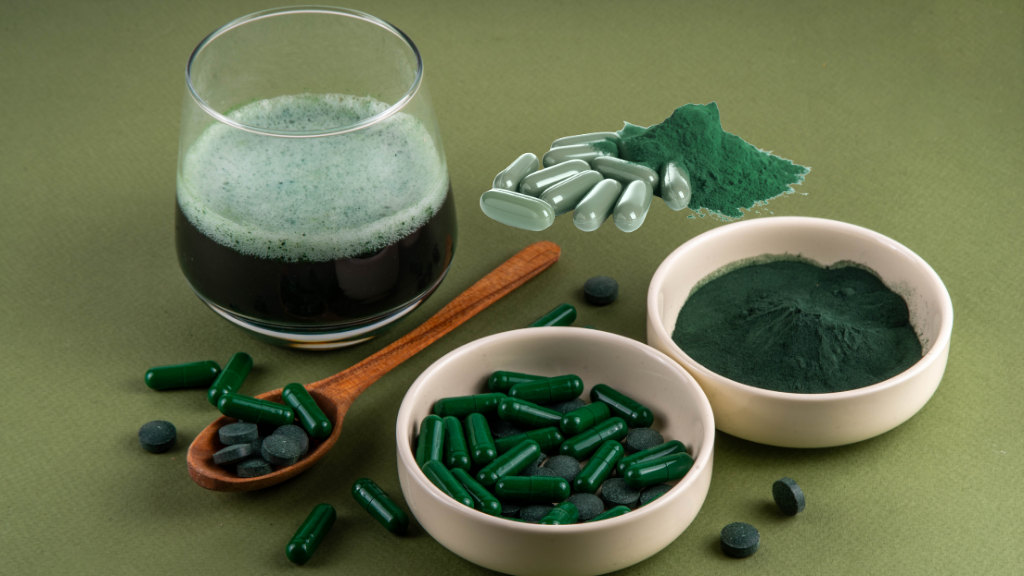







Spirulina is a blue-green microalgae recognized for its high content of protein, minerals, vitamins, and antioxidants. Growing concerns over protein deficiency, particularly among younger populations, are increasing interest in nutrient-dense food sources. The U.S. Food and Drug Administration (FDA) recognizes spirulina as a “superfood,” highlighting its nutritional relevance. Spirulina is also associated with potential benefits related to immunity, metabolism, weight management, and dietary iron intake. Its nutritional profile supports its potential as a promising nutraceutical product for the future food industry.
Editor’s Picks
- The global spirulina market volume was valued at 63.79 kilotons in 2025 and is projected to reach 143.08 kilotons by 2035, registering a CAGR of 8.4%.
- The global spirulina market revenue was valued at US$ 1,394.95 million in 2025 and is anticipated to reach US$ 3,479.00 million by 2035, expanding at a CAGR of 9.6%.
- The US accounted for 43.7% of global spirulina consumption in 2025, making it a major consuming country.
- The US spirulina market is projected to reach US$ 1,444.40 million by 2035, up from US$ 610.13 million in 2025, representing a CAGR of 9%.
- Northeast Asia accounts for more than 70% of global spirulina production.
- China alone has more than 50 medium-to-large commercial farms and over 550 smaller producers, generating an estimated 55,000 tonnes of spirulina annually.
- In India, Tamil Nadu, Karnataka, and Andhra Pradesh are leading spirulina-producing states, with annual production of 1,500 metric tons, 400 metric tons, and 300 metric tons, respectively. Total production reaches 2,000–2,500 metric tons, supported by rising demand for nutritional supplements and eco-friendly farming practices, with annual growth expected at 15–20%.
- Spirulina contains 18,000 units of beta-carotene per 100g, compared with 1,670 units per 100g in drumstick leaves, highlighting its high beta-carotene concentration.
- Beta-carotene accounts for 80% of the carotenoids in spirulina, while each kilogram of dry spirulina contains 700–1,700 mg of beta-carotene.
- A single spoon of spirulina provides about 20 calories, including 1.7g of carbohydrates and fiber.
- Spirulina contains 55–70% protein by dry weight, highlighting its high protein density.
General Statistics
- The number of Spirulina-related publications increased 11.3 times between 2002 and 2022, while the average number of citations per year increased 32.3 times over the same period.
- China accounted for 15.1% of global Spirulina academic production, followed by India at 11.6%, the USA at 8.2%, Brazil at 8.0%, and Egypt at 6.5%.
- Spirulina reaches its maximum growth rate under light wavelengths of 620–680 nm, leading many producers to use energy-intensive cultivation systems to optimize production.
- Spirulina grows effectively in alkaline water with a pH of 8–11 and temperatures ranging from 30°C to 40°C.
- Under optimal conditions, Spirulina can double its biomass every 2–3 days, with a typical harvest cycle of 7–14 days.
- Spirulina is commonly consumed at 2–10 grams per day in powder or capsule form.
- Daily doses of 4–10 grams appear more effective for improving lipid profiles and may also help reduce fatigue during endurance exercise.
- A daily dose of 2 grams may help reduce symptoms associated with allergic rhinitis.
- For adults, vitamin A requirements are estimated at less than 1 mg per day, which can be met through 1–2 grams of Spirulina based on its vitamin A content.
- Spirulina powder contains 50–190 mg/kg of vitamin E, a nutrient associated with antioxidant and skin-health properties.
- On February 6, 2026, the U.S. Food and Drug Administration (FDA) issued final orders approving the use of beetroot red and expanding the approved uses of spirulina extract as color additives in human foods.
Nutritional Composition of Spirulina Powder per 100g
General Components
- Calories: Spirulina powder provides 378 kcal per 100g.
- Protein: Spirulina contains 67.5g of protein, highlighting its high protein density.
- Fat: The fat content stands at 6.9g.
- Carbohydrates: Spirulina provides 8.4g of carbohydrates.
- Dietary Fiber: The dietary fiber content is 6.1g.
Vitamins
- Vitamin A: Spirulina contains 21,100 µg of vitamin A (retinol equivalent).
- Vitamin B1: The vitamin B1 content is 3.39mg.
- Vitamin B2: Spirulina provides 3.82mg of vitamin B2.
- Vitamin B6: The vitamin B6 content stands at 0.99mg.
- Niacin Equivalent: Spirulina contains 33.0mg of niacin equivalent.
- Folic Acid: The folic acid content is 0.11mg.
- Pantothenic Acid: Spirulina provides 1.58mg of pantothenic acid.
- Biotin: The biotin content stands at 23.6 µg.
- Vitamin E: Spirulina contains 12.3mg of vitamin E.
- Vitamin K1: The vitamin K1 content is 1,200 µg.
- Vitamin K2: Spirulina provides 50 µg of vitamin K2.
Fatty Acids
- Gamma-Linolenic Acid: Spirulina contains 1.42g of gamma-linolenic acid.
- Linoleic Acid: The linoleic acid content stands at 1.20g.
Minerals
- Calcium: Spirulina provides 194mg of calcium.
- Phosphorus: The phosphorus content is 963mg.
- Iron: Spirulina contains 49.4mg of iron.
- Sodium: The sodium content stands at 670mg.
- Potassium: Spirulina provides 1.74g of potassium.
- Magnesium: The magnesium content is 292mg.
- Zinc: Spirulina contains 1.83mg of zinc.
Other Bioactive Compounds
- Chlorophyll a: Spirulina contains 1,160mg of chlorophyll a.
- Phycocyanin: The phycocyanin content stands at 8,200mg.
- Zeaxanthin: Spirulina provides 122mg of zeaxanthin.
- Inositol: The inositol content is 76mg.
Comparison of Spirulina Protein Content to Selected Foods
| Product | Protein Content [%] |
| Spirulina | 55.00–70.00 |
| Beef | 17.40–22.00 |
| Chicken | 19.00–24.00 |
| Fish | 19.20–22.00 |
| Parmesan Cheese | 36 |
| Skimmed Milk Powder | 36.00–37.00 |
| Peanuts | 25.80–26.00 |
| Wheat | 11.88–13.20 |
| Rice | 7.76–10.30 |
| Sunflower Seeds | 20.78 |
| Pumpkin Seeds | 30.23 |
| Soybeans | 35.35–40.30 |
How Big is the Spirulina Market?
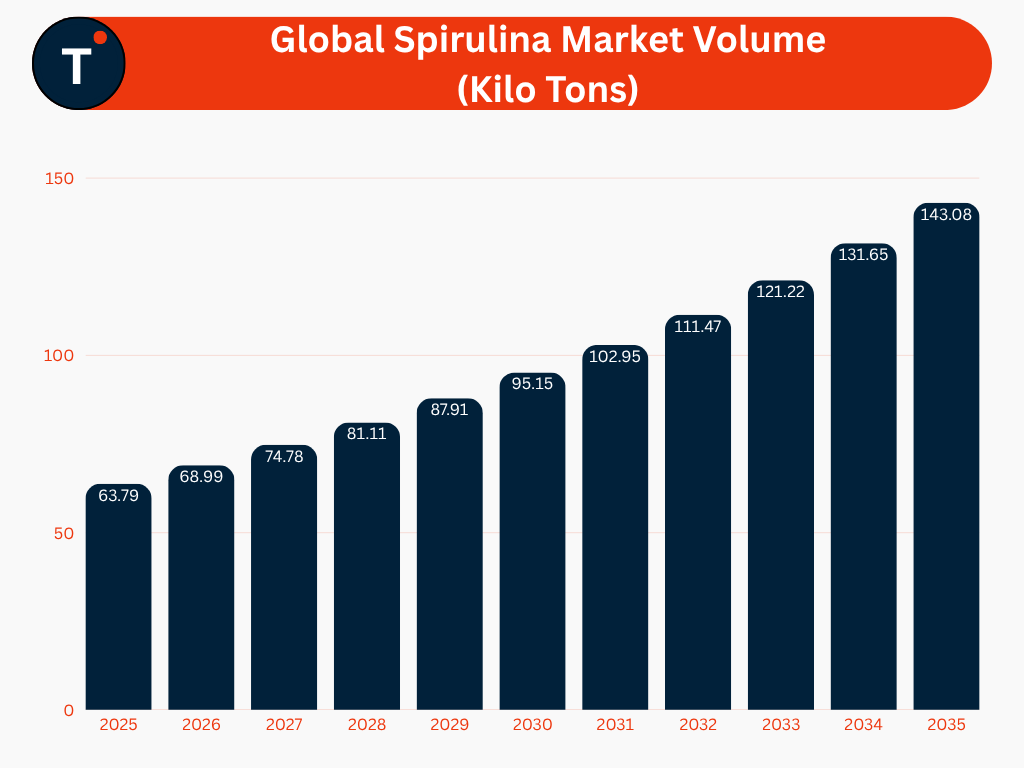
- In 2025, global spirulina consumption stood at 63.79 kilotons.
- Global spirulina consumption is projected to reach 68.99 kilotons in 2026.
- The global spirulina market volume is projected to grow at a CAGR of 8.4% from 2026 to 2035.
- By 2035, global spirulina consumption is projected to reach 143.08 kilotons.
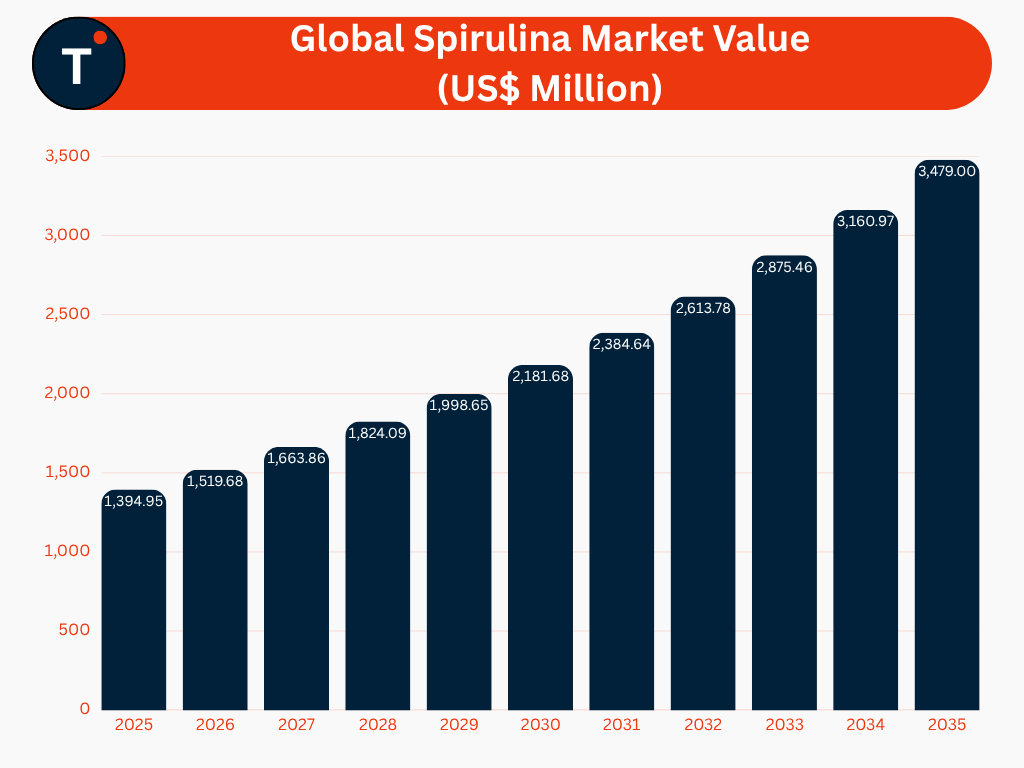
- In terms of value, the global spirulina market was valued at US$ 1,394.95 million in 2025.
- The global spirulina market is projected to reach US$ 1,519.68 million in 2026.
- The global spirulina market is anticipated to grow at a CAGR of 9.6% from 2026 to 2035.
- At a CAGR of 9.6%, the global spirulina market is projected to reach US$ 3,479.00 million by 2035.
What is the Regional Outlook for the Global Spirulina Market?
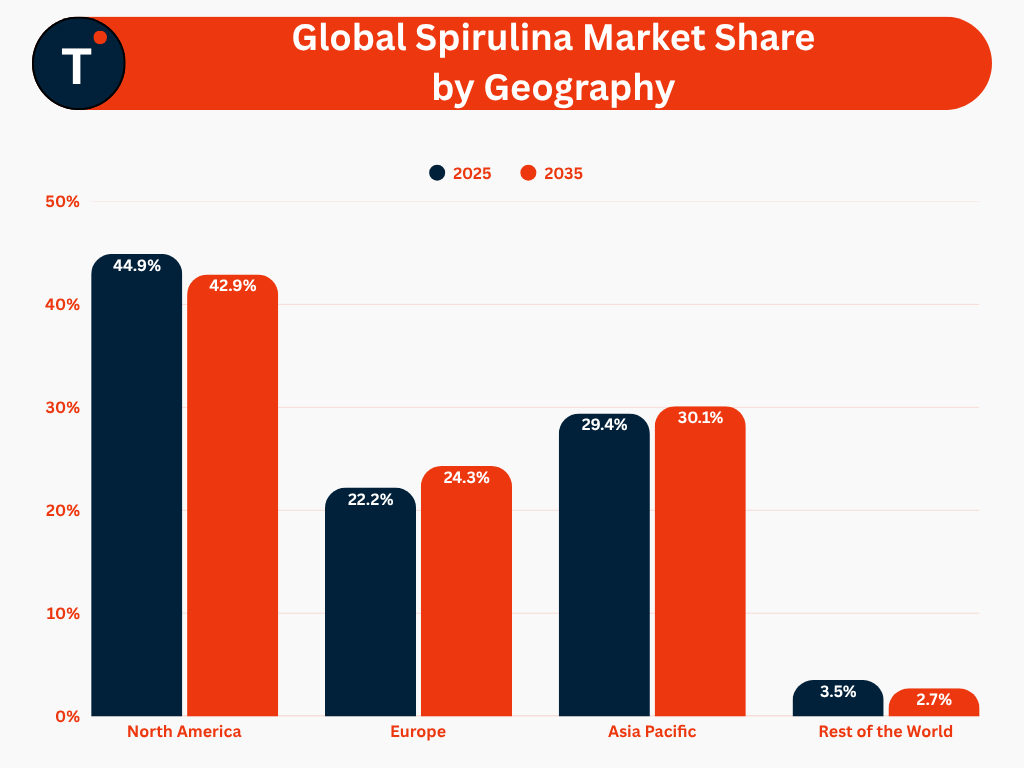
- North America was the leading region in the global spirulina market, accounting for 44.9% of the market share in 2025.
- The North America spirulina market was valued at US$ 626.32 million in 2025 and is projected to reach US$ 1,492.46 million by 2035, expanding at a CAGR of 9.1%.
- Asia Pacific ranked as the second-largest region, accounting for 29.4% of the global market share in 2025.
- The Asia Pacific spirulina market was valued at US$ 410.38 million in 2025 and is projected to expand at a CAGR of 9.9%, reaching US$ 1,048.45 million by 2035.
- Europe is projected to be the fastest-growing region in the global spirulina market, with a CAGR of 10.7% from 2026 to 2035.
- The Europe spirulina market accounted for 22.2% of the global market share in 2025 and was valued at US$ 309.09 million. The market is projected to reach US$ 844.74 million by 2035.
Which Country is the Major Consumer of Spirulina?
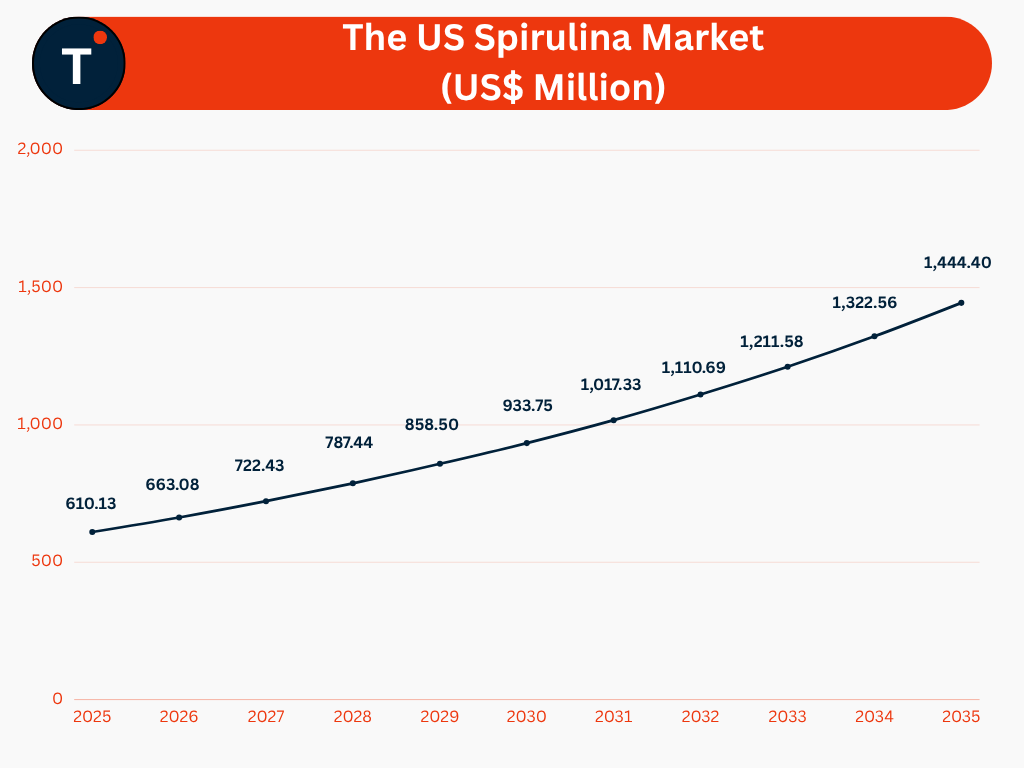
- The US spirulina market was valued at US$ 610.13 million in 2025.
- In 2026, the market value is projected to reach US$ 663.08 million.
- From 2026 to 2035, spirulina demand in the US is projected to grow at a CAGR of 9%.
- By 2035, the US market value is projected to reach US$ 1,444.40 million.
Spirulina Platensis Vs Spirulina Maxima
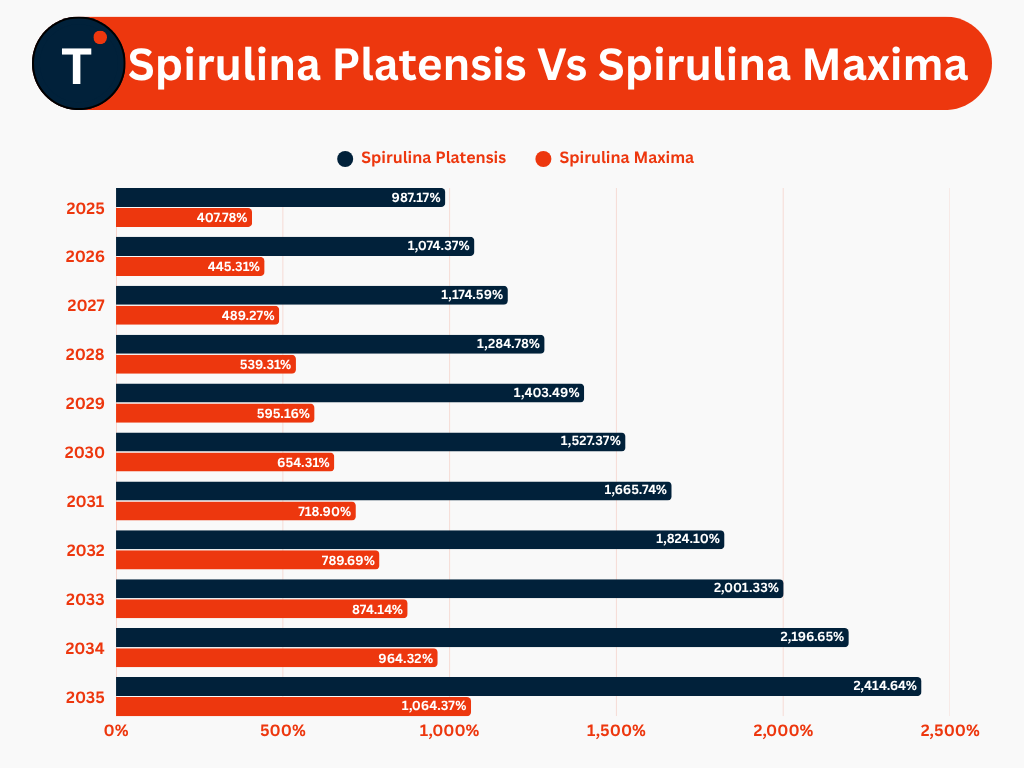
- Spirulina Platensis dominated the market with a 70.8% share in 2025.
- The Spirulina Platensis segment was valued at US$ 987.17 million in 2025 and is projected to reach US$ 2,414.64 million by 2035, expanding at a CAGR of 9.4%.
- Spirulina Maxima is projected to account for a 30.6% market share by 2035.
- The Spirulina Maxima segment is projected to be the fastest-growing, with a CAGR of 10.2%, reaching US$ 1,064.37 million by 2035 from US$ 407.78 million in 2025.
How is Spirulina Used Across Major Applications?
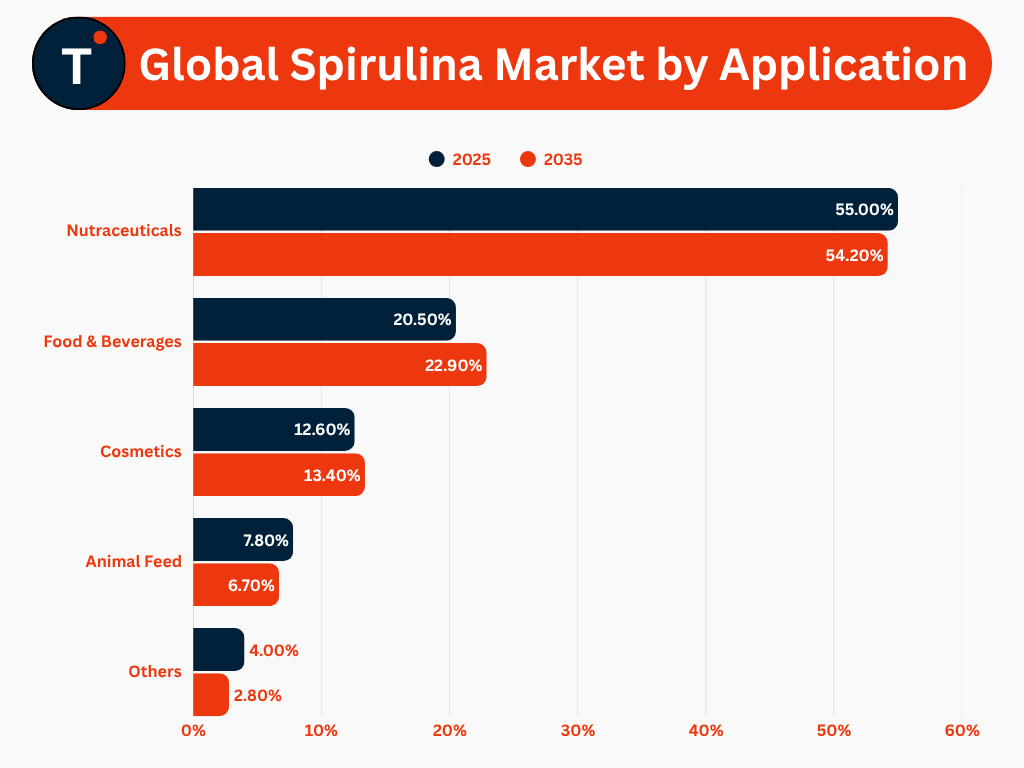
- Nutraceuticals dominated the spirulina market with a 55% share in 2025.
- The spirulina market for nutraceutical applications was valued at US$ 767.29 million in 2025 and is projected to reach US$ 1,885.43 million by 2035, expanding at a CAGR of 9.4%.
- Food & Beverages represented the second-largest application, accounting for 20.5% of the market in 2025.
- The spirulina market for Food & Beverages applications is anticipated to reach US$ 796.01 million by 2035, from US$ 286.01 million in 2025, at a CAGR of 10.9%.
- Cosmetics accounted for 12.6% of the spirulina market in 2025.
- The spirulina market for cosmetics applications was valued at US$ 175.81 million in 2025 and is expected to reach US$ 467.46 million by 2035, registering a CAGR of 10.4%.
- The spirulina market for animal feed applications was valued at US$ 109.37 million in 2025 and is estimated to reach US$ 232.59 million by 2035, growing at a CAGR of 7.9%.
What is the FOB Price of Spirulina in US$/Kg?
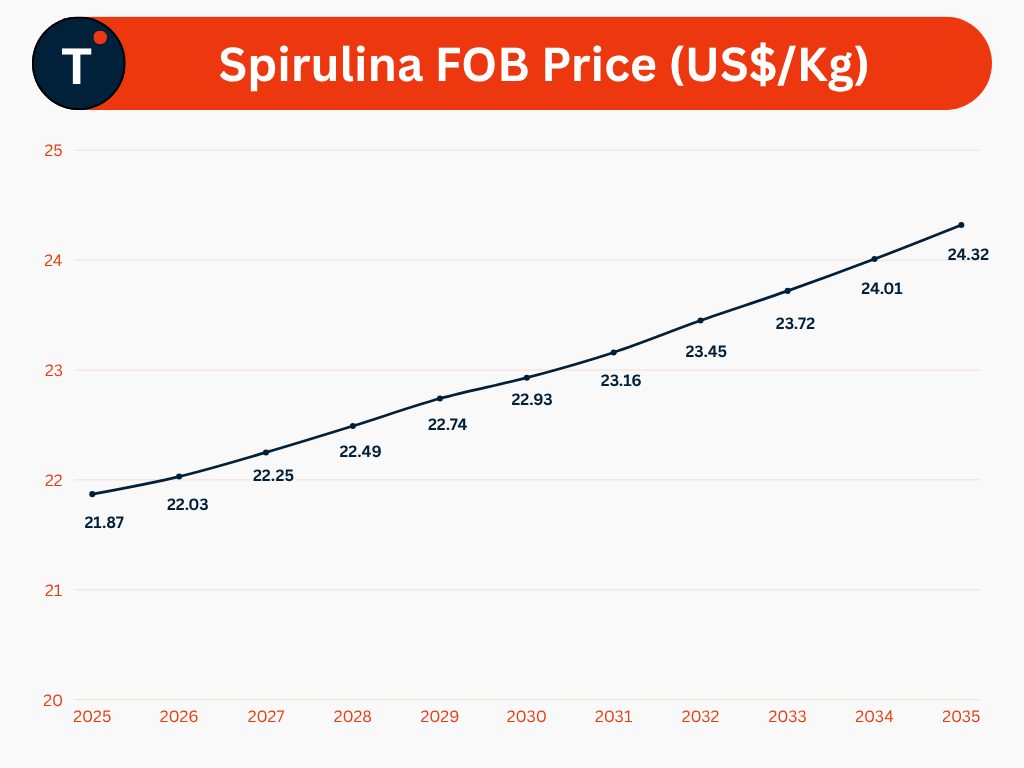
- The FOB price of spirulina stood at US$ 21.87/kg in 2025.
- The FOB price of spirulina is projected to reach US$ 22.03/kg in 2026.
- By 2035, the FOB price of spirulina is projected to reach US$ 24.32/kg.
Recent Developments
- In August 2026, Mars, the company behind M&M’s, Skittles, and Starburst, introduced candy products without artificial dyes. The company developed new color formulations using ingredients such as beet juice for red, turmeric for yellow, a combination of turmeric, beet juice, and spirulina for green, and beta-carotene and carotenals for orange.
- In August 2026, AG1 announced the launch of AG1 Essentials Gummies, a gummy product delivering 50 nutrients across vitamins and minerals, antioxidants, fiber, greens, and whole-food-sourced ingredients. The formulation includes B vitamins, vitamin D, choline, magnesium, vitamin C, and spirulina, among other ingredients, and is positioned to address common nutrient gaps while supporting energy and immune health.
- In May 2026, Vita Actives and Arborea announced a strategic collaboration to commercialize BioSolar Spirulina for food, nutraceutical, and functional nutrition brands worldwide. Produced in Europe using Arborea’s closed BioSolar Leaf platform, the ingredient is cultivated from carbon dioxide and natural sunlight. Vita Actives and Arborea planned to showcase BioSolar Spirulina at Vitafoods Europe 2026 at Stand 3C24.
- In May 2026, CHITOSE and JAXA launched an experiment at the International Space Station (ISS) to validate efficient spirulina cultivation in space.
- In November 2025, Nutri&Co introduced a limited-edition French organic spirulina cultivated in Provence, emphasizing local sourcing and nutritional purity in response to growing demand for traceable supplements.
Conclusion
- The spirulina market is positioned for sustained expansion as growing interest in plant-based nutrition, protein-rich foods, functional ingredients, and nutraceutical products strengthens demand.
- Spirulina’s high protein content and broad nutritional profile, including vitamins, minerals, antioxidants, and bioactive compounds, continue to support its adoption across health and wellness applications.
- Nutraceuticals remain a key demand area, while expanding use in food and beverages, cosmetics, functional nutrition, and animal feed is creating additional opportunities for market development.
- Increasing emphasis on sustainable food production and resource-efficient cultivation is encouraging innovation in spirulina farming, including closed cultivation systems and carbon-utilizing production technologies.
- Product innovation is broadening spirulina’s commercial presence, with its incorporation into supplements, gummies, functional foods, natural food colors, and other consumer products.
Add TriCityLocalNews as a Preferred Source on Google for instant updates!