








Cloud computing enables the delivery of computing resources, including servers, storage, databases, networking, software, analytics, and intelligence, through internet-based platforms. The technology provides on-demand access to scalable and flexible computing infrastructure, allowing organizations to accelerate innovation, enhance operational efficiency, optimize resource utilization, and achieve cost savings through economies of scale.
Editor’s Pick
- 95% of enterprises currently utilize at least one form of cloud service to support business operations, highlighting the widespread adoption of cloud computing across industries.
- 48% of organizations store highly sensitive business data on cloud platforms, reflecting growing confidence in cloud-based security and data management capabilities.
- Cloud-stored data is projected to exceed 100 zettabytes by 2025, equivalent to 1 trillion gigabytes, underscoring the accelerating growth of global data generation and cloud storage demand.
- 70% of small and medium-sized enterprises (SMEs) have adopted at least one cloud-based solution, demonstrating strong cloud penetration among smaller organizations.
- 94% of organizations report improved security following cloud migration, attributing enhancements to advanced security controls, monitoring capabilities, and data protection measures provided by cloud service providers.
- Despite increasing confidence in cloud security, 93% of enterprises remain concerned about potential data breaches and loss of control over sensitive information, highlighting ongoing challenges related to cybersecurity and governance.
- Enterprises utilize an average of 2.6 public cloud platforms and 2.9 private cloud environments, reflecting the growing complexity of modern cloud infrastructures.
- The primary factors driving multi-cloud adoption include vendor lock-in avoidance (84%), cost optimization (82%), and improved reliability and resilience (78%).
- Within the financial services sector, 95% of organizations have adopted multi-cloud strategies, with enterprises utilizing an average of 3.7 cloud service providers to support business-critical operations.
- The healthcare sector continues to expand cloud adoption, with 88% of organizations implementing hybrid cloud environments and 76% maintaining private cloud deployments to address data sovereignty and regulatory compliance requirements.
- The combined market share of Amazon Web Services, Microsoft Azure, and Google Cloud reached 63%, highlighting the dominance of the leading hyperscale cloud providers within the global cloud computing industry.
General Statistics
- 96% of organizations plan to increase their adoption of container technologies, highlighting the growing importance of containerized applications in modern cloud environments.
- 87% of enterprises intend to expand artificial intelligence (AI) and machine learning (ML) workloads within cloud environments, reflecting the increasing role of cloud infrastructure in supporting advanced analytics and intelligent applications.
- 76% of organizations are planning to implement edge computing solutions integrated with existing cloud infrastructures, demonstrating the growing convergence of edge and cloud technologies.
- 52.74% of enterprises across the European Union utilized paid cloud computing services in 2025, primarily for email services, office software applications, and file storage.
- The proportion of EU enterprises using paid cloud services increased by 7.42 percentage points between 2023 and 2025, indicating continued growth in cloud adoption across the region.
- According to the Cloud Native Computing Foundation (CNCF), 89% of financial institutions have adopted cloud-native technologies, achieving 73% faster transaction processing, 91% improved security compliance, and 66% savings in infrastructure management costs while maintaining 99.999% service availability.
- Healthcare organizations utilizing cloud-based solutions have achieved 84% improvements in patient data accessibility and 77% enhancements in diagnostic accuracy through AI and machine learning applications. However, these organizations incur 2.1 times higher compliance costs due to stringent regulatory and data protection requirements.
- Smart manufacturing initiatives powered by cloud-native technologies have delivered 69% improvements in operational efficiency and 83% greater predictive maintenance accuracy. Industry 4.0 implementations have also reduced operational downtime by 71% through cloud-enabled monitoring and control systems.
- Integration of artificial intelligence and machine learning capabilities within cloud platforms is projected to increase by 312% by 2025, highlighting the accelerating adoption of intelligent cloud services.
- Green computing initiatives are expected to reduce cloud infrastructure energy consumption by 35% through enhanced operational efficiency and resource optimization.
- AI-driven cooling systems have reduced data center energy consumption by 35%, while intelligent resource allocation technologies have improved server utilization by 67%.
- Industry-wide green cloud computing initiatives are projected to reduce carbon emissions by 59% by 2028, supporting global sustainability and environmental objectives.
- Edge computing adoption is expected to increase by 89%, driven by the expansion of 5G networks and the growing demand for distributed cloud architectures.
- AI-powered automation in cloud resource management has reduced human intervention in routine operational tasks by 58%, enabling IT teams to focus on strategic and value-added initiatives.
- Organizations that effectively implement advanced cloud adoption strategies have achieved up to 30% reductions in operational costs and 15%–25% improvements in productivity, demonstrating the measurable business value of cloud transformation initiatives.
Global Cloud Computing Market Overview
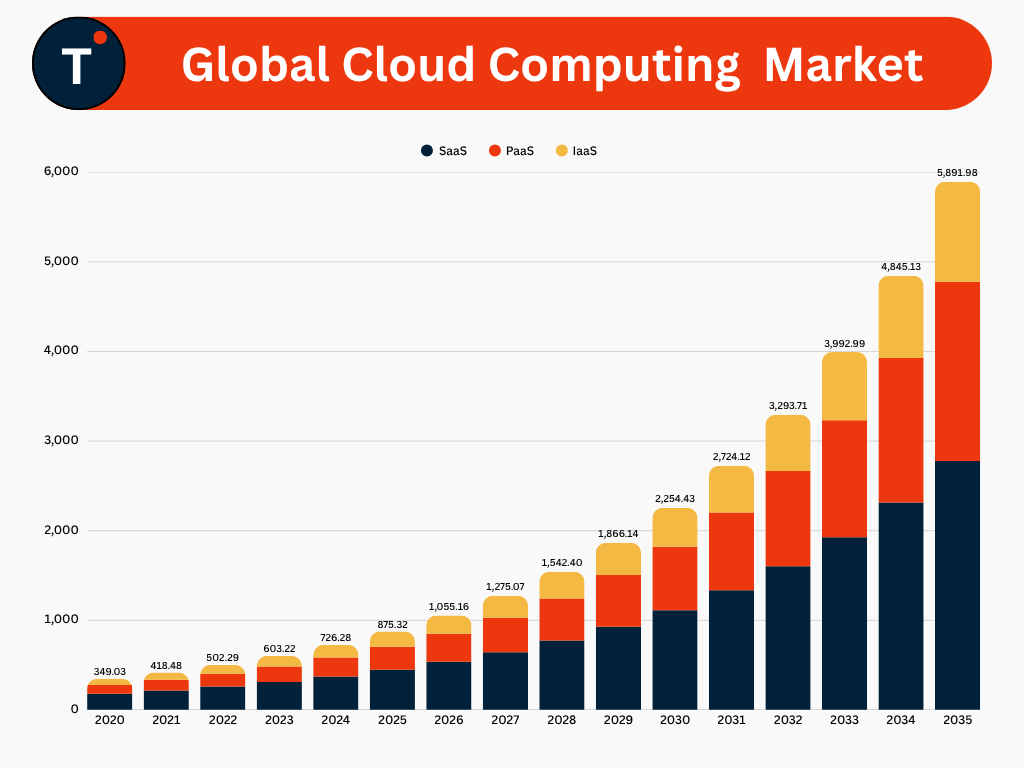
- The global cloud computing market was valued at US$ 875.31 billion in 2025.
- The market is projected to grow at a CAGR of 21.1% during the forecast period.
- Global cloud computing market revenue is expected to increase from US$ 875.31 billion in 2025 to US$ 5,891.97 billion by 2035.
Service Models Highlights
Software as a Service (SaaS):
- Software as a Service (SaaS) emerged as the largest service model in the global cloud computing market, accounting for 51.4% of total market revenue in 2025.
- The SaaS segment was valued at US$ 449.50 billion in 2025 and is projected to reach US$ 2,778.86 billion by 2035, expanding at a CAGR of 20.0%.
- Organizations adopting SaaS solutions have achieved an average 35% reduction in software deployment costs compared to traditional on-premise software models.
- The healthcare industry has reported a 76% improvement in patient data accessibility and a 42% reduction in administrative expenses through SaaS implementation.
- Financial services organizations have experienced 63% faster product launches and a 58% reduction in compliance-related costs following SaaS adoption.
- Manufacturing enterprises have achieved a 45% improvement in supply chain visibility and a 39% reduction in inventory management costs through SaaS-enabled operations.
- Organizations utilizing SaaS platforms have reported a 67% improvement in employee collaboration efficiency and a 51% reduction in IT support requirements.
- Automated software updates and patch management capabilities have contributed to a 73% reduction in security vulnerabilities.
- Centralized configuration management systems have improved deployment consistency by 84%, enhancing operational reliability and governance.
Platform as a Service (PaaS)
- Platform as a Service (PaaS) accounted for 29.3% of the global cloud computing market in 2025.
- The PaaS segment is expected to grow from US$ 256.20 billion in 2025 to US$ 1,998.39 billion by 2035, registering a CAGR of 22.9%.
- Organizations leveraging PaaS solutions have reported a 71% reduction in application deployment time, accelerating software development cycles.
- PaaS adoption has contributed to a 43% decrease in application development costs, improving resource utilization and development efficiency.
- 89% of enterprises utilize PaaS platforms for at least one major application development initiative, reflecting widespread enterprise adoption.
- Containerization adoption within PaaS environments has reached 86% among enterprise users, supporting greater application portability and scalability.
- Database services offered through PaaS platforms have demonstrated 99.999% availability, while supporting up to 500,000 concurrent connections and processing more than 1 million transactions per second.
Infrastructure as a Service (IaaS)
- Infrastructure as a Service (IaaS) represented 19.4% of the global cloud computing market revenue in 2025.
- The IaaS segment was valued at US$ 169.62 billion in 2025 and is projected to reach US$ 1,114.73 billion by 2035, expanding at a CAGR of 20.7%.
- IaaS solutions have become a critical component of enterprise digital transformation strategies, delivering an average return on investment (ROI) of 156% within 18 months of deployment.
- Enterprise workloads operating within IaaS environments have achieved 99.99% availability, ensuring high levels of reliability and business continuity.
- Industry data indicates that cloud storage costs have declined by 25% year-over-year, while storage performance has improved by 37%.
- Network infrastructure capabilities have advanced significantly, with leading cloud providers offering connectivity speeds of up to 400 Gbps, representing a fourfold increase compared to previous-generation infrastructure.
Regional Analysis
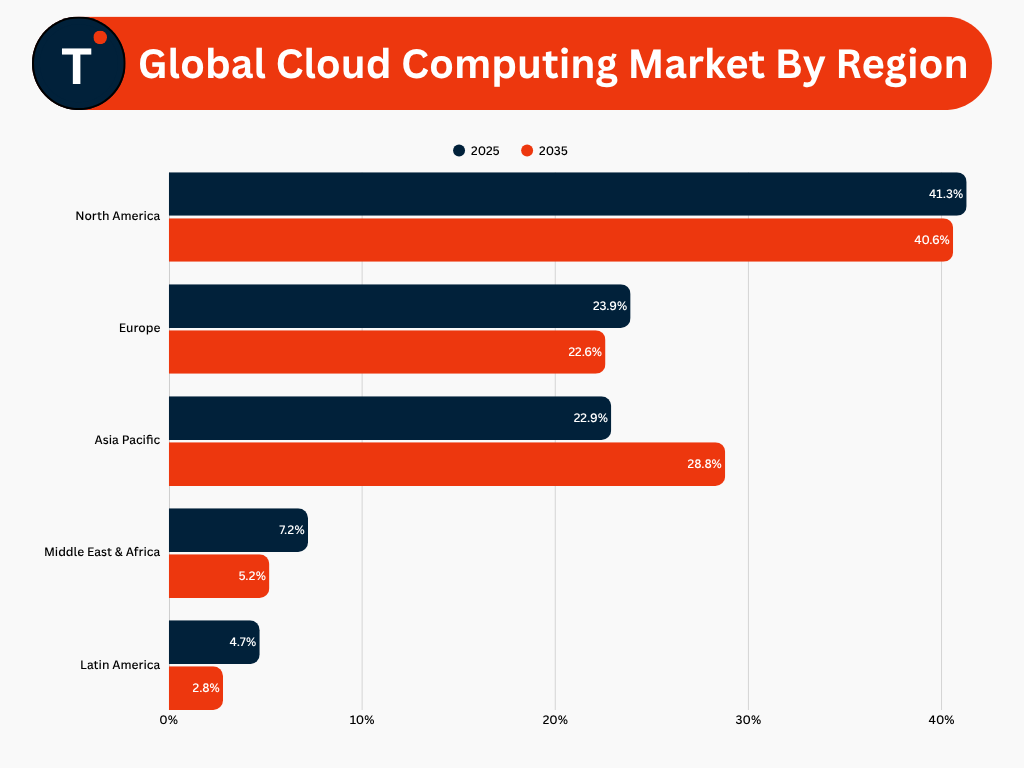
- North America emerged as the leading regional market, accounting for 41.3% of the global cloud computing market share in 2025.
- The North American cloud computing market was valued at US$ 361.90 billion in 2025 and is projected to reach US$ 2,392.64 billion by 2035, expanding at a CAGR of 20.8%.
- The United States represented the largest contributor to the North American market, capturing 89.1% of regional market revenue in 2025.
- The U.S. cloud computing market was valued at US$ 322.45 billion in 2025 and is anticipated to reach US$ 2,222.76 billion by 2035, registering a CAGR of 20.9%.
- Europe accounted for 23.9% of the global cloud computing market revenue in 2025, establishing itself as the second-largest regional market.
- The European cloud computing market was valued at US$ 209.14 billion in 2025 and is expected to grow to US$ 1,329.60 billion by 2035, reflecting a CAGR of 20.3%.
- Asia Pacific is projected to be the fastest-growing regional market, advancing at a CAGR of 24.0% during the forecast period.
- The Asia Pacific cloud computing market is forecast to increase from US$ 200.29 billion in 2025 to US$ 1,697.91 billion by 2035, driven by accelerating digital transformation initiatives and growing cloud adoption across emerging economies.
- The Middle East & Africa cloud computing market was valued at US$ 62.83 billion in 2025 and is expected to reach US$ 305.06 billion by 2035, expanding at a CAGR of 17.1%.
- The Latin America cloud computing market was valued at US$ 41.16 billion in 2025 and is projected to reach US$ 166.77 billion by 2035, registering a CAGR of 15.0% during the forecast period.
Deployment Models Overview
Public Cloud
- The public cloud segment dominated the global cloud computing market, accounting for 60.1% of total market revenue in 2025.
- The public cloud market was valued at US$ 526.35 billion in 2025 and is projected to reach US$ 3,572.48 billion by 2035, expanding at a CAGR of 21.1%.
- 90% of enterprises utilize multiple public cloud platforms, with organizations adopting an average of 3.9 public cloud services to support diverse business requirements.
- Cost optimization remains a key priority, with 68% of organizations planning to optimize existing cloud environments to improve operational efficiency and reduce expenditures.
- Public cloud adoption has reached a mature stage, with 63% of organizations reporting advanced cloud maturity levels, supported by sophisticated governance frameworks and implementation strategies.
Private Cloud
- The private cloud segment accounted for 23.1% of the global cloud computing market revenue in 2025.
- The private cloud market was valued at US$ 202.40 billion in 2025 and is anticipated to reach US$ 1,192.25 billion by 2035, registering a CAGR of 19.5%.
- 80% of enterprises maintain substantial private cloud environments to support critical workloads and data-intensive operations.
- Security and regulatory compliance remain the primary adoption drivers, with 82% of organizations identifying data protection as the key factor influencing private cloud investments.
Hybrid Cloud
- The hybrid cloud segment is projected to be the fastest-growing deployment model, advancing at a CAGR of 22.8% during the forecast period.
- The hybrid cloud market is expected to grow from US$ 146.57 billion in 2025 to US$ 1,127.24 billion by 2035.
- Organizations operate an average of 41% of workloads within public cloud environments and 39% within private cloud infrastructures, highlighting the increasing adoption of hybrid cloud strategies.
- Containerization has become a critical component of hybrid cloud deployments, with 89% of enterprises running containers in production environments.
- 90% of organizations utilize Kubernetes for container orchestration, supporting workload portability, scalability, and operational efficiency across hybrid environments.
- Financial Operations (FinOps) practices continue to gain momentum, with 51% of enterprises maintaining dedicated FinOps teams to optimize cloud spending and improve resource management across hybrid cloud infrastructures.
Quantifiable Benefits of Cloud Computing
- Organizations adopting cloud computing solutions achieve 25% to 45% reductions in total IT operational costs, demonstrating the significant financial benefits associated with cloud transformation initiatives.
- Large enterprises report annual cost savings ranging from US$ 12 million to US$ 15 million through cloud adoption, while small and medium-sized businesses achieve 30% to 40% reductions in operational costs during the first year of implementation.
- Automated resource optimization capabilities reduce infrastructure waste by 42%, enabling organizations to achieve 76% higher resource utilization rates compared to traditional on-premise environments.
- Organizations utilizing cloud-native technologies can accommodate 300% traffic surges without service disruptions, highlighting the scalability and resilience of modern cloud architectures.
- Kubernetes-based deployments deliver 99.99% availability, while automated scaling mechanisms respond to workload fluctuations within 2.5 seconds, ensuring consistent application performance.
- Enterprises leveraging serverless computing architectures report 47% reductions in operational overhead and 68% faster deployment cycles, improving agility and development efficiency.
- Organizations utilizing cloud services achieve 71% faster adoption of emerging technologies, with deployment timelines reduced from weeks to hours.
- Cloud-native development methodologies reduce time-to-market by 66% and improve software code quality by 43%, accelerating innovation and product delivery.
- Organizations implementing cloud-native collaboration tools experience 58% improvements in developer productivity and 73% enhancements in team collaboration efficiency.
- DevOps practices deployed within cloud environments reduce deployment failures by 62% and improve system recovery times by 81%, strengthening operational reliability and business continuity.
Key Drivers for Cloud Adoption in the Banking Sector
- 42% of banking organizations identify IT infrastructure simplification as the primary driver for adopting cloud solutions, reflecting the need for greater operational efficiency, scalability, and modernization.
- 20% of banks adopt cloud technologies to achieve cost reductions, enabling more efficient resource utilization and lower infrastructure management expenses.
- 17% of financial institutions view innovation acceleration as a key factor supporting cloud adoption, facilitating the development and deployment of new digital banking services.
- 15% of banking organizations implement cloud solutions to strengthen compliance with security and regulatory standards, supporting risk management and governance requirements.
- 4% of institutions cite access to a broader range of cloud-native banking solutions as a primary motivation for cloud adoption.
- 2% of banks identify customer-centricity initiatives as the main driver for cloud migration, leveraging cloud technologies to enhance customer experience and service delivery.
Prevalence of Key Cloud Security Measures Among Organizations
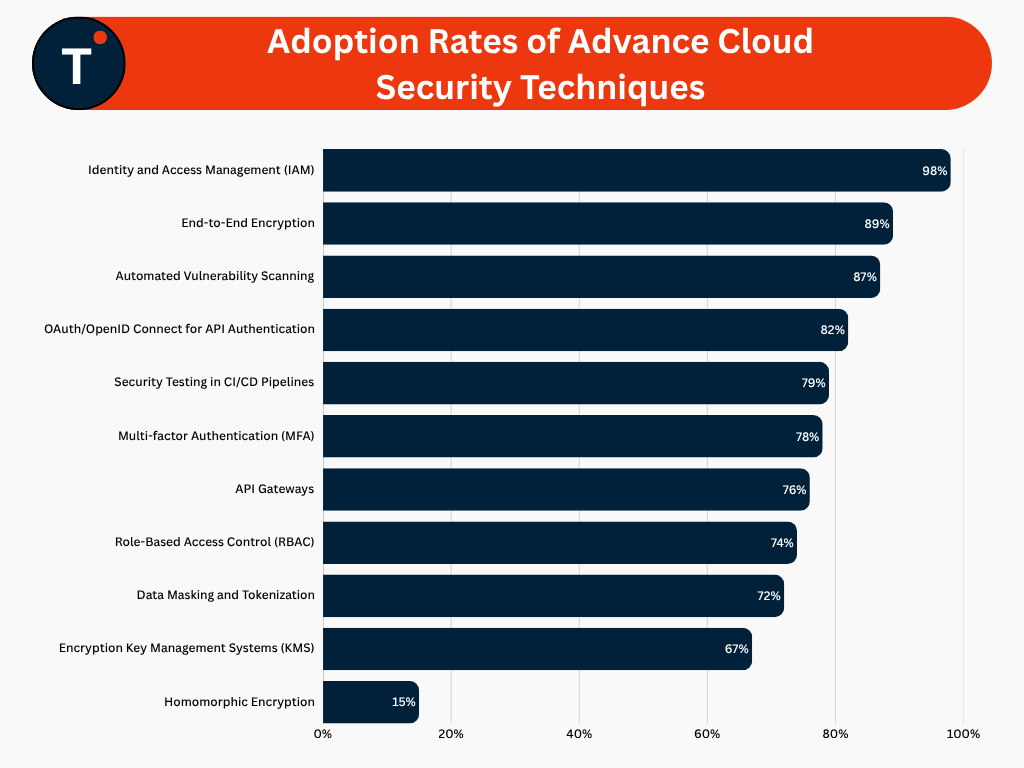
- 98% of organizations have implemented Identity and Access Management (IAM) solutions, making it the most widely adopted cloud security measure for controlling user access and protecting digital assets.
- 89% of enterprises utilize End-to-End Encryption to secure sensitive data throughout its lifecycle, ensuring confidentiality during storage and transmission.
- 87% of organizations employ Automated Vulnerability Scanning to continuously identify and remediate security weaknesses across cloud environments.
- 82% of enterprises have adopted OAuth/OpenID Connect-based API Authentication, strengthening identity verification and secure access to cloud applications and services.
- 79% of organizations integrate Security Testing within CI/CD Pipelines, enabling the early detection of security vulnerabilities during software development and deployment processes.
- 78% of enterprises have implemented Multi-Factor Authentication (MFA) to enhance account security and reduce the risk of unauthorized access.
- 76% of organizations utilize API Gateways to improve application security, traffic management, and API governance across cloud infrastructures.
- 74% of enterprises employ Role-Based Access Control (RBAC) frameworks to enforce least-privilege access policies and strengthen security governance.
- 72% of organizations have adopted Data Masking and Tokenization technologies to protect sensitive information and support regulatory compliance requirements.
- 67% of enterprises utilize Encryption Key Management Systems (KMS) to securely manage encryption keys and safeguard protected data assets.
- 15% of organizations have implemented Homomorphic Encryption, indicating that adoption of advanced encryption technologies remains at an early stage despite their growing relevance for privacy-preserving data processing.
Leading Cloud Service Providers
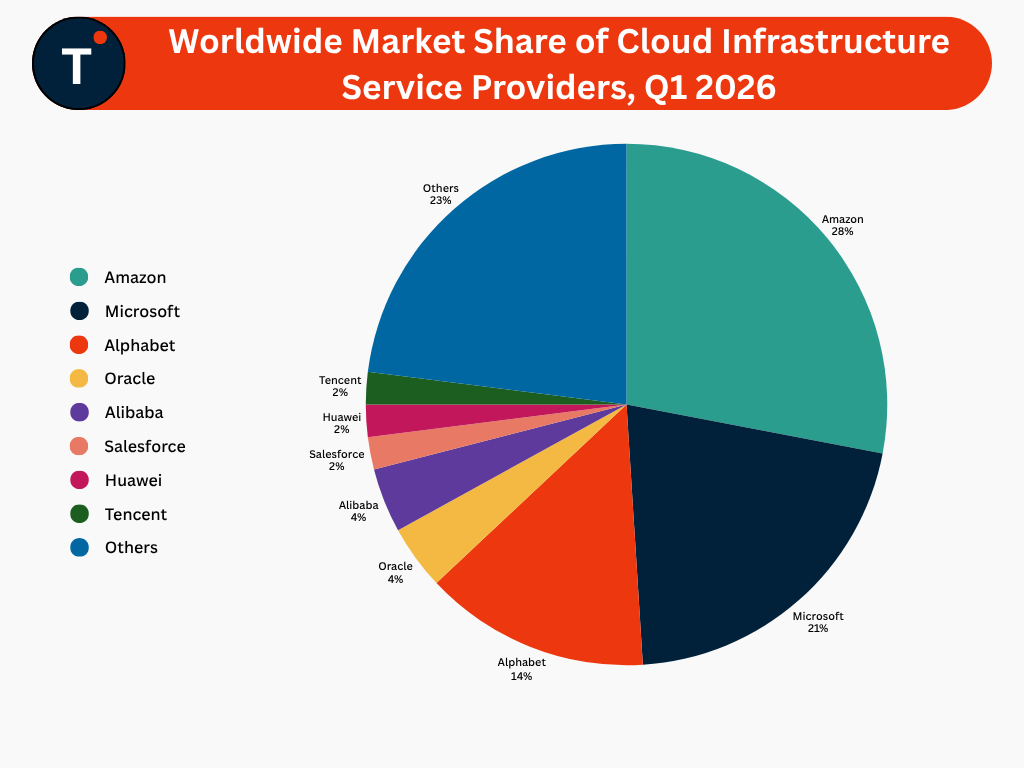
- Amazon Web Services (AWS) led the global cloud infrastructure services market with a 28% market share in Q1 2026, maintaining its position as the largest cloud service provider worldwide.
- Microsoft Azure accounted for 21% of the global market, strengthening its position through continued enterprise cloud adoption and expansion of its cloud-based solutions portfolio.
- Google Cloud (Alphabet) captured 14% market share, supported by growing demand for cloud infrastructure, artificial intelligence, and data analytics services.
- Oracle held 4% of the worldwide cloud infrastructure services market, benefiting from strong adoption among enterprise customers and database-intensive workloads.
- Alibaba Cloud represented 4% market share, reflecting its strong presence across Asia-Pacific and expanding global cloud operations.
- Salesforce accounted for 2% of the global market, supported by its cloud-based customer relationship management (CRM) and enterprise application offerings.
- Huawei Cloud captured 2% market share, driven by increasing adoption across enterprise, telecommunications, and public sector applications.
- Tencent Cloud held 2% of the global cloud infrastructure services market, leveraging its extensive digital ecosystem and cloud computing capabilities.
Current Challenges and Their Impact
- Security remains one of the most significant challenges in cloud environments, with organizations experiencing an average of 2,200 security incidents per month. Despite this, cloud-native security solutions successfully detect and prevent 99.97% of threats, while AI-driven security tools reduce false positives by 87%, improving threat detection accuracy and operational efficiency.
- Compliance management continues to grow in complexity, with organizations allocating 18% of their cloud budgets to compliance-related activities. Automated compliance solutions have reduced audit preparation time by 71% and enhanced continuous compliance monitoring by 84%, helping organizations strengthen governance frameworks.
- Organizations implementing GitOps practices report 92% fewer compliance violations, demonstrating the effectiveness of automation and policy-driven infrastructure management in maintaining regulatory compliance.
- Hybrid cloud integration remains a major operational challenge, with 67% of organizations encountering difficulties integrating workloads and applications across diverse cloud environments.
- The average enterprise manages 7.3 cloud platforms, increasing infrastructure complexity and creating additional integration and management challenges.
- Organizations adopting API-first integration strategies have reduced integration timelines by 58% and improved implementation success rates by 76%, enabling more seamless interoperability across cloud ecosystems.
- Performance optimization remains a key focus area, with 72% of cloud-native organizations adopting edge computing technologies to improve application responsiveness and workload efficiency.
- Edge computing deployments have reduced application latency by 81% for mission-critical workloads while improving data processing efficiency by 64%, enhancing overall system performance.
- Organizations implementing service mesh architectures report 93% improvements in observability and 47% reductions in troubleshooting time, enabling more effective monitoring, management, and optimization of distributed cloud applications.
Emerging Technologies and Innovation
- The integration of emerging technologies with cloud computing continues to accelerate, driving innovation and expanding the capabilities of cloud-based platforms across industries.
- Adoption of quantum computing services delivered through cloud environments is projected to increase by 186%, reflecting growing interest in advanced computing capabilities for complex problem-solving and data-intensive applications.
- The adoption of blockchain-based cloud solutions is expected to grow by 154%, driven by increasing demand for enhanced security, transparency, and decentralized data management.
- Organizations implementing industry-specific cloud solutions have achieved 37% faster time-to-market for new products and services, enabling greater business agility and competitive advantage.
- Industry-focused cloud platforms have also contributed to a 43% improvement in operational efficiency, supporting optimized workflows, enhanced productivity, and improved resource utilization.
- 84% of enterprises plan to increase investments in emerging cloud technologies over the next two years, highlighting strong confidence in the role of next-generation cloud innovations in supporting future business growth and digital transformation initiatives.
Emerging Cloud Technology Adoption and Growth Rates
| Technology Area | Adoption Rate | Investment Increase |
| Multi-cloud | 89% | 47% |
| Edge Computing | 82% | 35% |
| AI Integration | 76% | 41% |
| Green Computing | 87% | 28% |
Recent Developments
- In June 2026, Apple expanded its Private Cloud Compute (PCC) infrastructure beyond its proprietary data centers, supporting the next generation of Apple Intelligence and enhancing the scalability, security, and performance of its cloud-based AI services.
- In June 2026, Microsoft announced the early access preview of Azure Cobalt 200 Arm-based Virtual Machines (VMs) at Microsoft Build 2026. The new cloud-native infrastructure is designed for Linux-based and agentic AI workloads, delivering up to 50% higher generational performance compared with Azure Cobalt 100.
- In June 2026, NTT DATA expanded its strategic collaboration with Google Cloud to accelerate enterprise AI adoption from pilot projects to large-scale production deployments. As part of the initiative, NTT DATA plans to establish a Gemini Enterprise Practice with 5,000 certified experts and collaborate with Google Cloud to develop and deploy up to 500 AI agents across multiple industry use cases.
- In June 2026, Pinterest signed a US$4 billion cloud services agreement with Amazon Web Services (AWS), extending its cloud partnership through 2031. The agreement reinforces Pinterest’s long-term commitment to cloud-based infrastructure and AI-driven platform innovation.
- In May 2026, Blackstone and Google announced the formation of a joint venture to establish a new U.S.-based company focused on providing data center infrastructure and cloud-based AI computing services. The venture will offer access to Google Cloud’s Tensor Processing Units (TPUs) through a compute-as-a-service model, expanding enterprise access to advanced AI infrastructure.
- In April 2026, Amazon and Anthropic expanded their strategic partnership through a commitment from Anthropic to invest more than US$100 billion in AWS technologies over the next decade. The collaboration is expected to strengthen AI model development, cloud infrastructure utilization, and generative AI innovation.
- In March 2026, NVIDIA and Nebius Group N.V. announced a strategic partnership to develop and deploy next-generation hyperscale cloud infrastructure for artificial intelligence applications. As part of the agreement, NVIDIA committed US$2 billion in investment to support Nebius’s expansion and accelerate the development of AI-focused cloud computing capabilities.
Conclusion
- The global cloud computing market is witnessing robust growth, driven by increasing enterprise digital transformation initiatives, rising adoption of cloud-native technologies, and growing demand for scalable, cost-efficient IT infrastructure.
- Organizations across industries are leveraging cloud computing to improve operational efficiency, accelerate innovation, enhance collaboration, and optimize resource utilization, making cloud platforms a foundational component of modern business strategies.
- The continued expansion of public, private, and hybrid cloud deployments highlights the growing need for flexible and secure computing environments capable of supporting diverse workload requirements.
- Advancements in artificial intelligence, machine learning, edge computing, containerization, and automation are further strengthening the value proposition of cloud computing and expanding its range of enterprise applications.
Add TriCityLocalNews as a Preferred Source on Google for instant updates!