The electric forklift market is experiencing accelerated growth as industries shift toward cleaner and more efficient material handling solutions. Rising environmental concerns and the transition to electric-powered machinery are driving the replacement of internal combustion forklifts across logistics, warehousing, manufacturing, and retail sectors. Forklift batteries provide the required power for these vehicles and are primarily classified into lead-acid and lithium batteries.
Stricter global emissions standards and carbon neutrality goals are encouraging companies to invest in electric forklifts to reduce their environmental footprint. Electric forklifts produce zero on-site emissions, supporting indoor operations and compliance with clean air regulations. The expansion of e-commerce and large-scale distribution centers is also increasing demand for high-efficiency material handling systems, while the low noise levels and compact design of electric forklifts support automated and high-density warehouse environments.
Editor’s Choice
The US forklift battery sales totaled 324 thousand units in 2025 and are projected to reach 340 thousand units in 2026 and 550 thousand units by 2035.
Lead-acid batteries typically support 1,000–1,500 charge cycles, with a service life of three to five years.
Lithium-ion batteries offer 2,000–4,000+ charge cycles and can remain operational for five to ten years.
Battery-powered models account for 70% of new forklifts sold in the US.
Lead-acid battery systems generally deliver 70%–80% energy efficiency, while modern LiFePO4-based forklift batteries can exceed 95% efficiency.
The battery can represent up to 30% of an electric forklift’s total vehicle cost.
Advances in lead battery technology have increased battery life by 50% over the past 20 years.
Sulfuric acid represents 30%–50% of the electrolyte solution in a standard lead-acid forklift battery and can comprise 18%–22% of its total weight.
Lead-acid forklift batteries generally require 8–10 hours of charging followed by 6–8 hours of cooling, whereas lithium-ion batteries require 1–2 hours of charging without a cooling period.
Lithium-ion batteries can achieve a 30%–50% weight reduction compared with lead-acid batteries.
The average price of a lead-acid forklift battery was US$3,982.9 per unit in 2025, compared with US$7,981.6 per unit for a lithium-ion forklift battery.
General Statistics
China accounts for approximately 42% of global forklift battery production, making it the largest production market worldwide.
Tariffs imposed in 2025 on LiFePO4 batteries imported from China ranged from 70% to more than 170%.
In cold-storage and freezer environments, lead-acid battery capacity can decline by up to 35%. Lithium-ion batteries retain capacity more effectively under low-temperature conditions and support fast charging even inside freezer facilities.
Lead-acid batteries achieve a 99% recycling rate, compared with 15% for lithium-ion batteries. In the US, the established recycling system diverts more than 160 million lead-acid batteries from landfills annually.
A forklift battery can represent up to 30% of a new truck’s value and provide approximately 6,000 working hours.
Fast-charging technology can reduce operational downtime by as much as 10%, while warehouse downtime carries an average cost of US$10,000 per hour.
The California Air Resources Board (CARB) estimates that its proposed regulation could cumulatively reduce forklift-related emissions in California from 2026 to 2038 by approximately 18,700 tons of NOx, 2,100 tons of PM2.5, 5,000 tons of reactive organic gases, and 9.4 million metric tons of CO2.
Lead batteries remain a long-established power source for electric forklifts, with approximately 70,000 lead battery-powered lift trucks currently operating in California.
Forklift operating duration varies with power consumption, exceeding 8 hours at 3 kW, compared with approximately 6 hours at 4 kW and 5 hours at 5 kW.
How Many Forklift Battery Units Are Sold Globally?
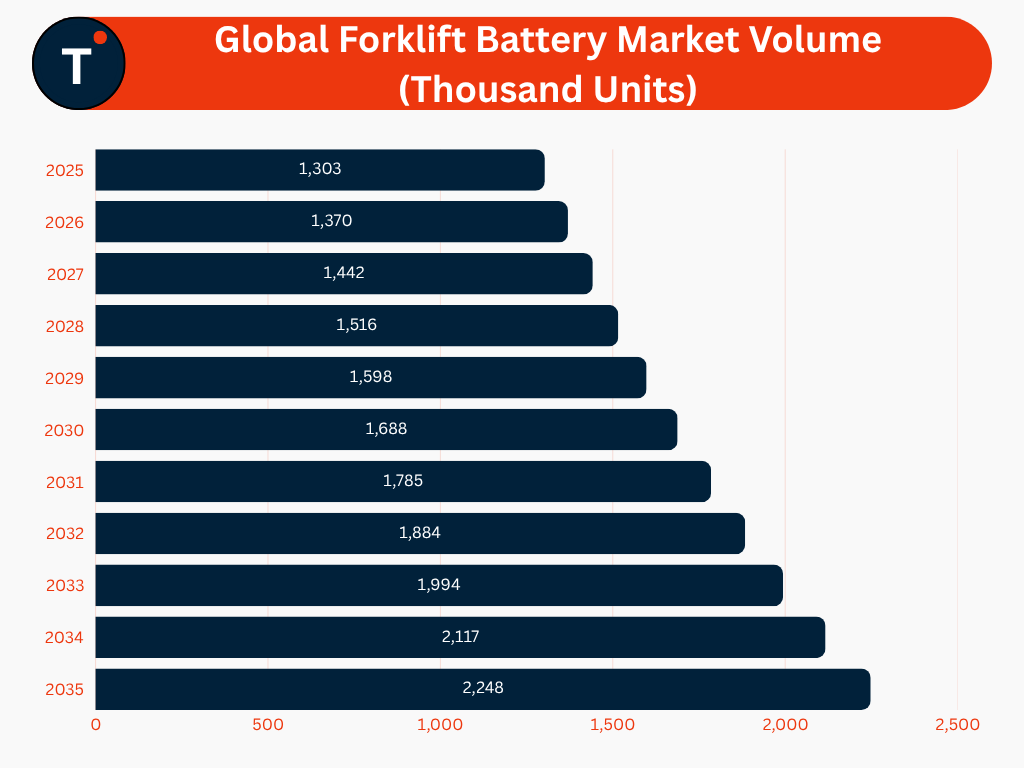
Global forklift battery sales reached 1,303 thousand units in 2025.
Worldwide sales of forklift batteries are projected to increase to 1,370 thousand units in 2026.
By 2035, global forklift battery sales are projected to reach 2,248 thousand units, registering a volume CAGR of 5.7% over the forecast period.
Global Forklift Battery Market Value (US$ Billion)
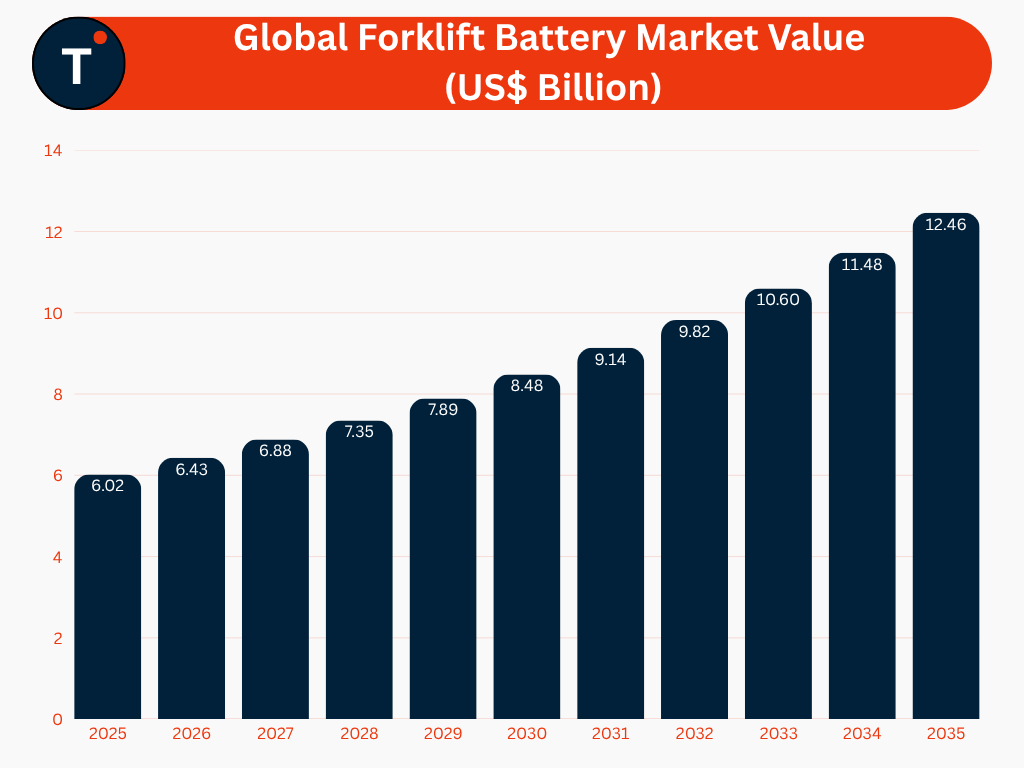
The global forklift battery market was valued at US$6.02 billion in 2025.
The forklift battery market value is projected to increase to US$6.43 billion in 2026.
The global forklift battery market is expected to register a CAGR of 7.6% between 2026 and 2035.
By 2035, the global forklift battery market is forecast to reach US$12.46 billion.
Forklift Battery Sales by Geography
The Asia Pacific forklift battery market recorded sales of 565 thousand units, valued at US$2.61 billion in 2025. By 2035, sales are projected to reach 1,037 thousand units, with the market value increasing to US$5.75 billion.
North America ranked as the second-largest regional market in 2025, with sales of 381 thousand units and a market value of US$1.76 billion. By 2035, the region is projected to reach 638 thousand units in sales and US$3.53 billion in market value.
The European forklift battery market recorded sales of 302 thousand units, corresponding to US$1.39 billion in 2025. Sales are estimated to reach 493 thousand units, while the market value is projected to increase to US$2.73 billion by 2035.
The US Forklift Battery Market Scenario
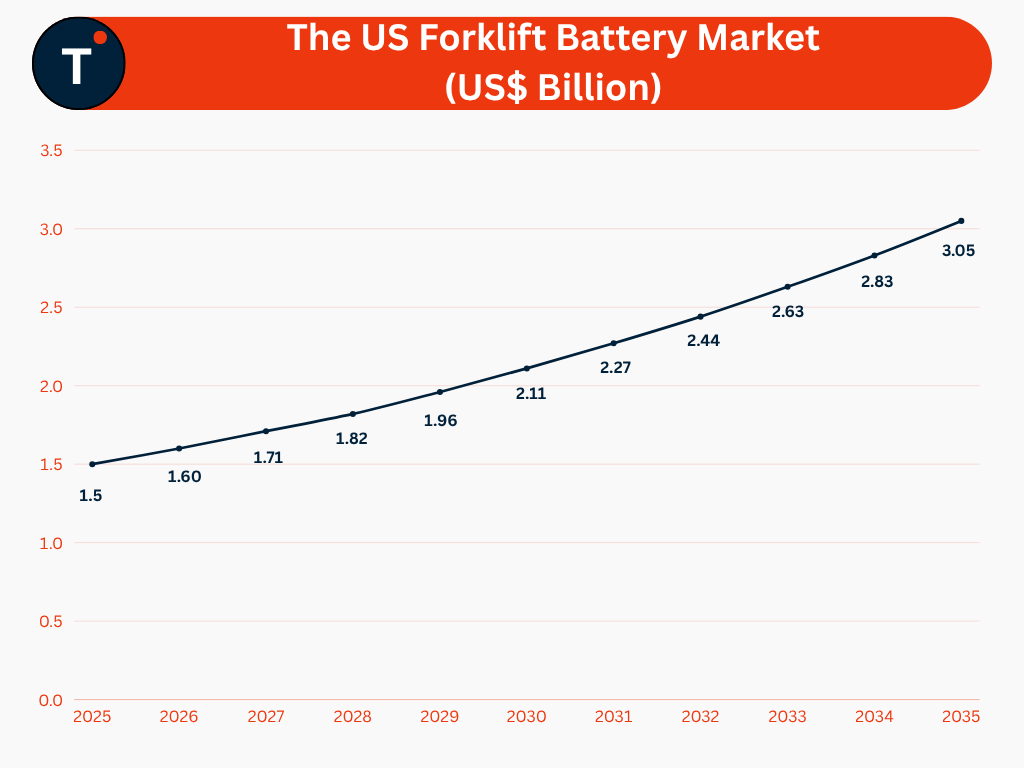
The US forklift battery market was valued at US$1.50 billion in 2025.
In 2026, the US forklift battery market is projected to reach US$1.60 billion.
From 2026 to 2035, the US forklift battery market is projected to grow at a CAGR of 7.5%, reaching US$3.05 billion by 2035.
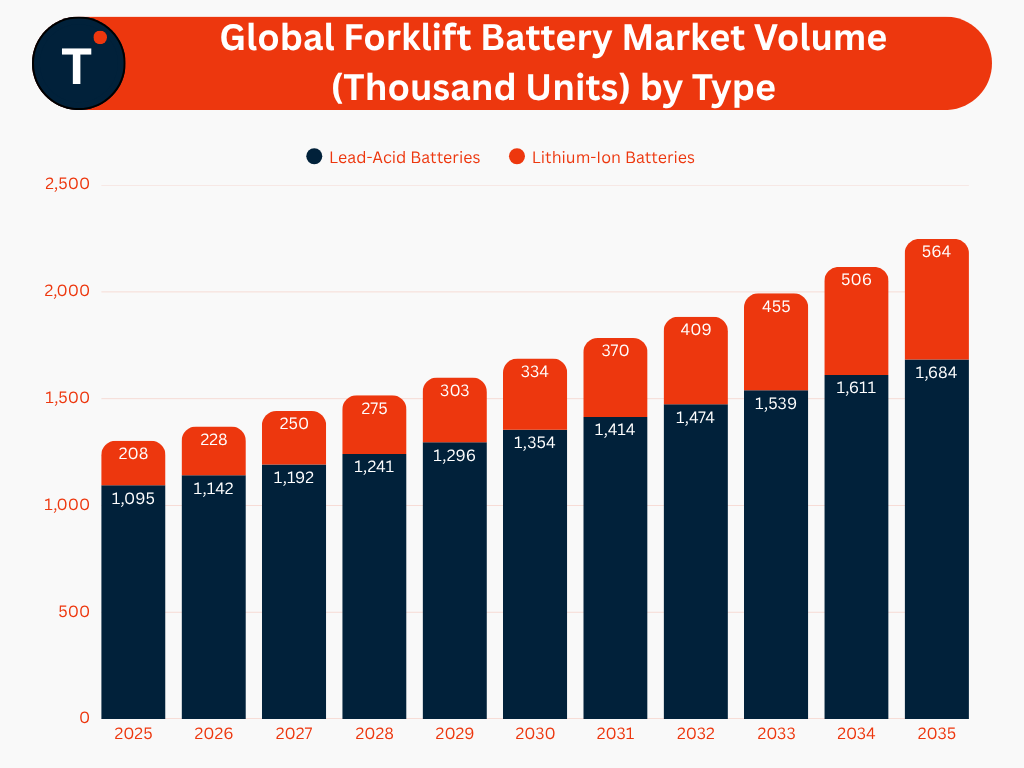
Global Forklift Battery Market Volume (Thousand Units) by Type
Lead-acid batteries accounted for 84% of the global forklift battery market volume in 2025.
Sales of lead-acid forklift batteries reached 1,095 thousand units in 2025 and are projected to increase to 1,684 thousand units by 2035.
Lithium-ion batteries accounted for 16% of the global forklift battery market volume in 2025.
Sales of lithium-ion forklift batteries are projected to increase from 208 thousand units in 2025 to 564 thousand units by 2035.
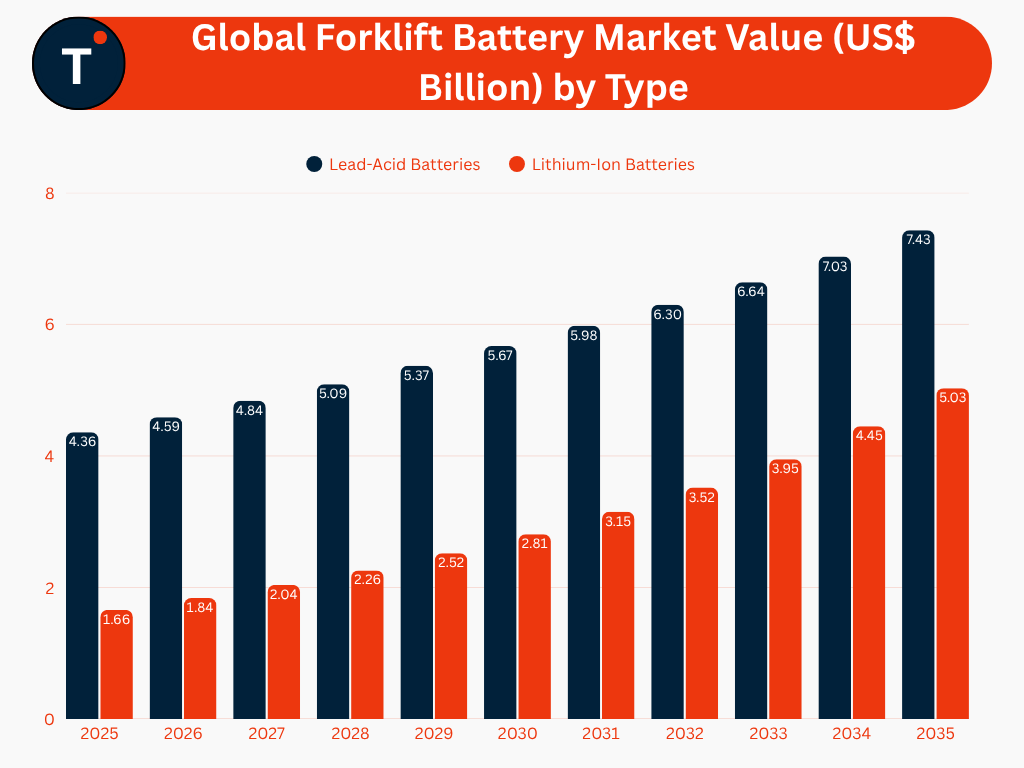
Global Forklift Battery Market Value (US$ Billion) by Type
Lead-acid batteries accounted for 72.4% of global forklift battery market revenue in 2025.
The global lead-acid forklift battery market was valued at US$4.36 billion in 2025 and is projected to reach US$7.43 billion by 2035, registering a CAGR of 5.5%.
Lithium-ion batteries are projected to account for 40.3% of global forklift battery market revenue by 2035.
The global lithium-ion forklift battery market is projected to increase from US$1.66 billion in 2025 to US$5.03 billion by 2035, registering a CAGR of 11.8%.
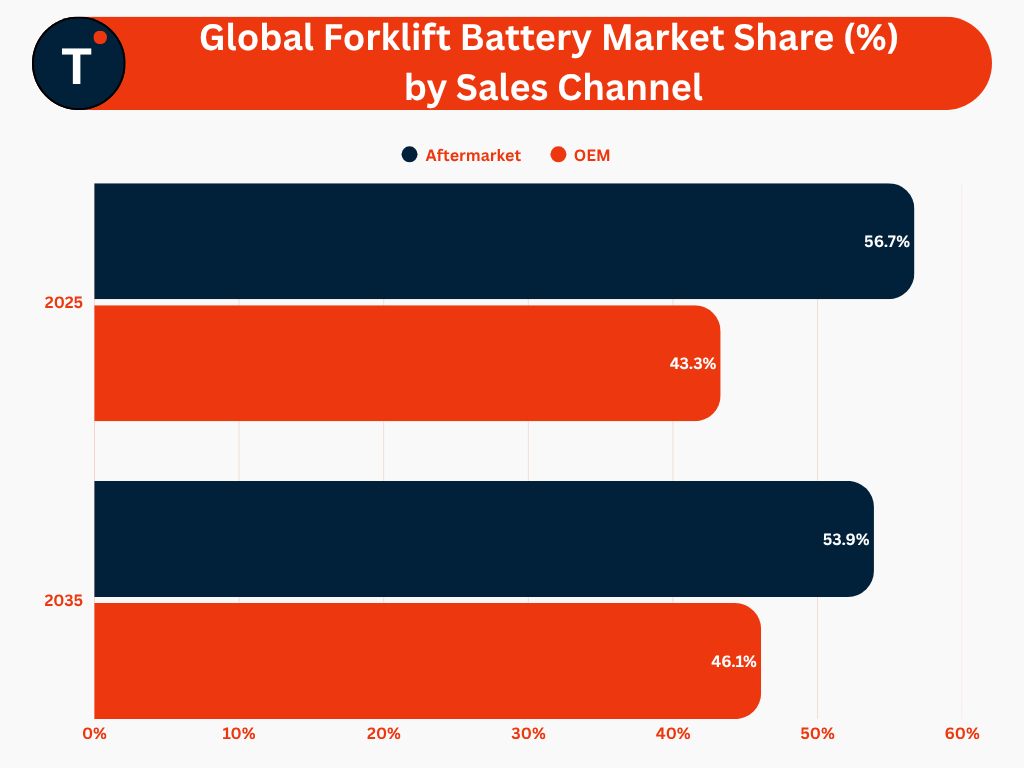
Global Forklift Battery Market Share by Sales Channel
Aftermarket sales represented 56.7% of the global forklift battery market in 2025, with sales valued at US$3.41 billion.
The aftermarket segment is projected to reach US$6.71 billion by 2035, reflecting a CAGR of 7.1% from 2025 to 2035.
OEM sales contributed 43.3% to the global forklift battery market in 2025, with the channel generating US$2.61 billion in sales.
OEM-channel sales are projected to increase to US$5.74 billion by 2035, corresponding to a CAGR of 8.3%.
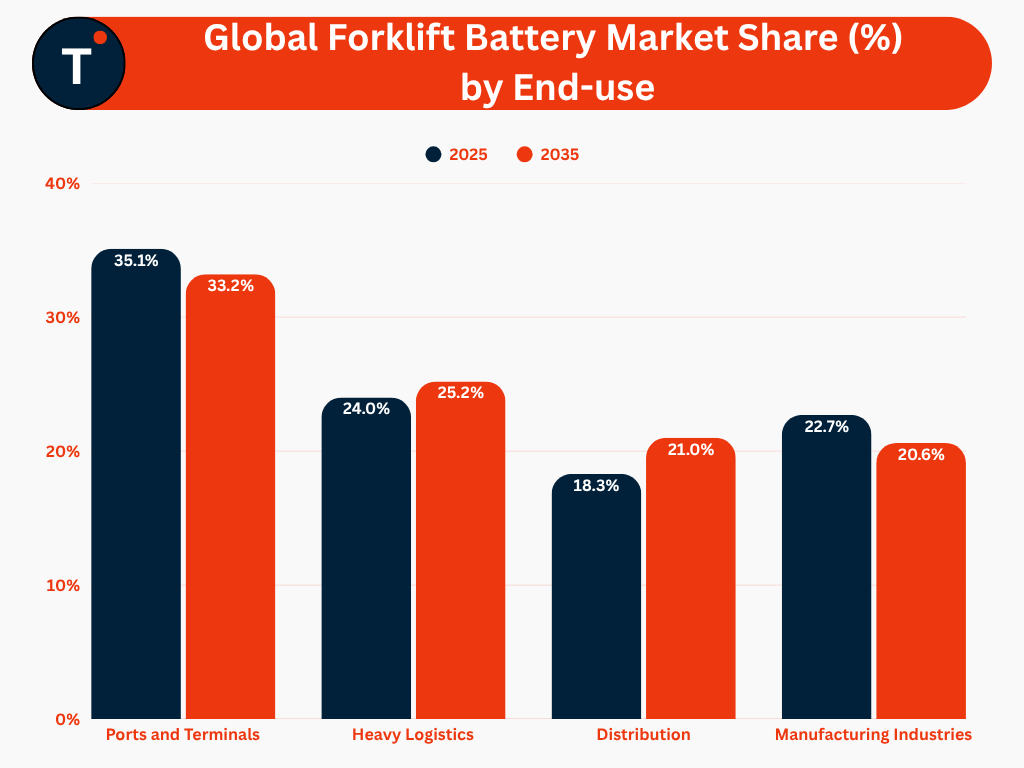
Global Forklift Battery Market Share by End-use
Ports and terminals accounted for 35.1% of the global forklift battery market in 2025, with forklift battery demand valued at US$2.11 billion. By 2035, forklift battery demand in ports and terminals is projected to reach US$4.13 billion, registering a CAGR of 7.0%.
The heavy logistics industry represented 24% of the global forklift battery market in 2025, with demand valued at US$1.44 billion. By 2035, forklift battery demand from heavy logistics is projected to reach US$3.14 billion, at a CAGR of 8.2%.
Distribution sector is projected to account for 21% of the global forklift battery market by 2035. Forklift battery demand in the distribution sector is expected to increase from US$1.10 billion in 2025 to US$2.61 billion by 2035, registering a CAGR of 9.1%.
Manufacturing Industries accounted for 22.7% of the global forklift battery market in 2025, with demand valued at US$1.37 billion. Forklift battery demand in manufacturing industries is projected to reach US$2.57 billion by 2035, growing at a CAGR of 6.5%.
How Much Does a Forklift Battery Weigh?
Lead-acid forklift batteries typically weigh between 1,000 and 3,500 lbs.
Lithium-ion forklift batteries generally weigh between 400 and 1,200 lbs.
Battery Type
Voltage
Capacity (Ah)
Approx. Weight
Lead-Acid
24V
400–600Ah
700–1,500 lbs
Lead-Acid
36V
600–900Ah
1,200–2,000 lbs
Lead-Acid
48V
600–1,000Ah
2,000–3,500 lbs
Lithium (LFP)
24V
200–400Ah
350–600 lbs
Lithium (LFP)
48V
200–700Ah
600–1,200 lbs
Forklift Battery Runtime by Battery Size and Forklift Type
Forklift Battery Specification
Typical Forklift Type
Typical Runtime per Charge
24V 200Ah
Electric Pallet Jack / Walkie Stacker
4–6 Hours
24V 300Ah
Ride-On Pallet Truck / Light Stacker
6–8 Hours
36V 350Ah
Reach Truck / Narrow Aisle Forklift
5–8 Hours
48V 300Ah
1.5–2 Ton Counterbalance Forklift
5–7 Hours
48V 525Ah
2.5–3 Ton Counterbalance Forklift
6–8 Hours
48V 630Ah
3–3.5 Ton Counterbalance Forklift
7–9 Hours
80V 420Ah
3–5 Ton Heavy-Duty Forklift
6–8 Hours
80V 560Ah
4–5 Ton Heavy-Duty Forklift
8–12 Hours
What Is the Cost of a Forklift Battery?
In 2025, the average price of a lead-acid forklift battery was US$3,982.9 per unit, while a lithium-ion forklift battery was priced at US$7,981.6 per unit.
In 2026, the average price of a lead-acid forklift battery is projected at US$4,022.1 per unit, compared with US$8,065.9 per unit for a lithium-ion forklift battery.
By 2035, the average price of a lead-acid forklift battery is projected to reach US$4,412.1 per unit, while the price of a lithium-ion forklift battery is expected to reach US$8,907.3 per unit.
Lead-Acid Batteries (US$/Unit)
Lithium-Ion Batteries (US$/Unit)
2025
3,982.9
7,981.6
2026
4,022.1
8,065.9
2027
4,062.5
8,152.9
2028
4,099.9
8,233.3
2029
4,142.3
8,324.8
2030
4,186.1
8,419.1
2031
4,230.8
8,515.5
2032
4,271.2
8,602.8
2033
4,315.5
8,698.4
2034
4,364.4
8,804.1
2035
4,412.1
8,907.3
Recent Industry Developments
In July 2026, EnerSys launched its next-generation NexSys iON lithium batteries, designed to support 24/7 heavy-duty forklift operations.
In July 2026, BSLBATT upgraded its forklift battery production facility into a fully automated smart factory, covering cell sorting, module assembly, pack integration, and final testing. The facility incorporates robotic assembly, laser welding, machine vision inspection, and digital production management, reducing delivery time by approximately 30% and supporting the company’s global expansion across forklift batteries, warehouse equipment, and industrial vehicles.
In July 2026, Stryten Energy LLC, C&D Technologies, Inc., and Trojan Battery Company announced a definitive agreement for Stryten Energy to acquire C&D Trojan. The transaction is intended to create a scaled platform for advancing global battery manufacturing and providing energy storage solutions across critical markets.
In June 2026, Yale Lift Truck Technologies introduced lithium-ion batteries and chargers specifically designed for Yale lift trucks, including the newly launched ERC-VG2 series. The purpose-built systems address compatibility concerns associated with third-party power solutions while providing a high-performance, maintenance-free, zero-emission power option.
In May 2026, Godrej Enterprises Group (GEG) introduced India’s first Multi-Ion battery technology for electric forklifts through its Material Handling Equipment (MHE) business. The technology is designed to provide 25% lower total cost of ownership, higher equipment uptime, and cleaner industrial operations, with a battery designed to last through the forklift’s full operational life.
In April 2026, Stryten Energy LLC launched the M-Series Li610 lithium-ion battery, expanding its motive power portfolio with a high-performance solution designed for demanding Class I forklift applications.
In February 2026, Bobcat Company introduced a new line of high-performance lithium-ion battery packs specifically engineered for Class I forklifts.
Conclusion
The forklift battery market is undergoing a broader transition toward efficient, reliable, and lower-emission power solutions as electric forklifts gain wider adoption across industrial and material-handling operations.
The continued use of lead-acid batteries, alongside the rapid development of lithium-ion and other advanced battery technologies, reflects an evolving technology landscape within the industry.
Increasing demand for faster charging, longer operating cycles, reduced maintenance, lower weight, and improved energy efficiency is shaping battery technology and product development.
Growing warehouse automation, e-commerce activity, cold-storage operations, and industrial expansion are supporting the need for dependable forklift power solutions across diverse operating environments.
Regulatory efforts to reduce emissions, combined with investments in cleaner material-handling equipment, are further influencing the transition toward advanced electric forklift battery technologies.
Ongoing product launches, manufacturing upgrades, and strategic developments by leading industry participants indicate continued innovation and investment across the global forklift battery industry.
Add TriCityLocalNews as a Preferred Source on Google for instant updates!
Jeff Goldman is a veteran technology journalist with over 15 years of experience covering the intersection of enterprise IT and digital innovation. He holds a B.A. in Computer Science, from Harvard University. Since 2010, Jeff has been a dedicated contributor to leading technology publications, breaking down complex industry shifts into actionable insights. His reporting primarily focuses on cybersecurity, enterprise networking, cloud storage, and emerging mobile technologies. Armed with a deep technical background, Jeff specializes in making highly specialized IT concepts accessible to both industry professionals and tech enthusiasts alike.
We use cookies to ensure that we give you the best experience on our website. If you continue to use this site we will assume that you are happy with it.