








A four-day workweek with unchanged pay can improve employee well-being without adversely affecting organizational productivity. Reduced working hours can strengthen talent attraction and retention, while lower employee turnover can reduce recruitment and replacement costs. Longer employee tenure also supports the accumulation of organizational knowledge and experience, making flexible four-day work arrangements a potential driver of workforce stability and business performance.
Editor’s Picks
- 81% of full-time workers favor a four-day workweek, with 89% of supporters willing to accept trade-offs to secure the arrangement.
- 77% of workers expect a four-day, 40-hour schedule to improve overall well-being.
- 59% of U.S. companies are open to evaluating a four-day workweek model, while 18% already offer it or are moving toward implementation.
- 56% of employees prefer a four-day, 40-hour schedule over the conventional five-day workweek.
- 93% of U.S. managers favor a four-day schedule for their teams, while 64% anticipate organizational adoption within the next few years.
- Only 8% of U.S. full-time employees currently follow a four-day work schedule, indicating a significant gap between preference and current adoption.
- Organizations in Japan recorded a 39.9% productivity increase following the transition to a four-day schedule.
- Companies participating in a UK four-day workweek pilot recorded a 35% increase in revenue.
- 90% of employees in a German four-day workweek initiative recorded improvements across well-being, life satisfaction, and work-life balance.
- Support for flexible schedules incorporating a four-day option reached 93% among Generation Z, 91% among millennials, and 87% among both Generation X and baby boomers.
- 92% of women favor flexible work options, compared with 87% of men.
- Among Generation Z and millennial workers, 48% would accept longer working hours for Fridays off, 35% would consider changing jobs, and 33% would exchange remote work for a four-day schedule.
Four-Day Workweek Models
- 4×10 model: A four-day schedule comprising 10 working hours per day maintains the conventional 40-hour workweek while providing employees with an additional day off.
- 32-hour model: A four-day schedule reduces weekly working hours to 32 hours, with employees retaining their existing salaries and benefits, placing greater emphasis on productivity and work efficiency.
General Statistics
- Four-day workweek trials have generated profit increases of up to 35% across participating organizations.
- Productivity gains of 20%–40% have been recorded among businesses adopting a four-day workweek model.
- The Thirty-Two Hour Workweek Act, introduced in the U.S. Congress in 2024, proposes reducing the overtime threshold from 40 to 32 hours over three years while maintaining worker pay.
- The share of U.S. employees with access to a four-day workweek increased from 14% in 2022 to 22% in 2024.
- Four-day workweek trials conducted by 4 Day Week Global generated a 42% reduction in employee resignations, a 36% increase in revenue, and a 64% decline in burnout.
- Women show a 5% higher preference for four-day workweeks than men, partly reflecting potential childcare cost savings.
- 58% of employees would choose a four-day workweek over a salary increase, highlighting the value placed on additional time off.
- A four-day workweek has the potential to reduce carbon emissions by up to 20%, primarily through lower commuting activity.
- Organizations implementing four-day schedules have recorded 57% lower employee turnover.
- 92% of companies participating in UK four-day workweek pilots have made the arrangement permanent.
- 46% of business leaders have maintained stable productivity under four-day schedules, while 34% have recorded slight productivity increases.
- 65% of Millennials and Generation X senior leaders are considering or have already implemented a four-day workweek, compared with 45% of Baby Boomer senior leaders.
- 63% of digital leaders operating four-day workweeks and 74% operating three-day workweeks rate their respective policies as highly successful.
- 66% of businesses using a four-day workweek have reduced operating costs.
- 66% of workers prefer spending the additional day off with friends, while 67% prefer spending it with family.
- The number of UK employees working under compressed working week contracts reached 748,000 in 2025, up from 509,000 in 2024.
- 30% of large U.S. companies are considering alternative schedules, including four-day and four-and-a-half-day workweeks, to enhance flexibility and work-life balance.
Countries with Major Trials (2015-2026)
| Country | Trial Period | Participants | Status (2026) |
| Iceland | 2015-2019 | 2,500 workers (~1% of workforce) | 86% of workforce now has reduced hours |
| United Kingdom | 2022 (6 months) | 61 companies, ~2,900 employees | 92% of companies continued; ongoing expansion |
| United States | 2023 (6 months) | 33 companies, ~900 employees | 97% planned to continue |
| Australia/NZ | 2022-2023 | Multiple company trials | Several permanent adoptions |
| Japan | 2019 (Microsoft), ongoing govt promotion | 2,300+ (Microsoft); limited broader adoption | Government encouragement, cultural barriers remain |
| Spain | 2021-2023 | Government-funded pilots | Mixed results; some permanent adoptions |
Hiring and Retention Impact
- 66% of employees consider a shorter workweek an attractive benefit when evaluating employment opportunities.
- Job applications at Atom Bank increased by 500% following the adoption of a four-day workweek, while Buffer recorded an 88% increase.
- 51% of employees would consider leaving their current job or changing industries for greater schedule flexibility that includes a four-day workweek option.
- Staff resignations declined by 57% during the UK four-day workweek pilot.
- 15% of employees participating in the UK trial placed sufficient value on the four-day schedule that no financial incentive would motivate a return to a traditional five-day workweek.
- 65% lower absenteeism has been recorded among organizations operating four-day workweeks.
- 83% of employers indicate that recruitment becomes easier following the adoption of a four-day workweek.
Impact on Company Profitability and Costs
- 23.1% lower energy and operational costs contribute to improved cost efficiency under a four-day workweek.
- Company turnover increases by an average of 15%, indicating potential improvements in overall business performance.
- 63% of businesses record improvements in staff retention following adoption of a four-day workweek.
- 78% of employees report higher happiness and lower stress levels, highlighting positive effects on workforce well-being.
Health and Work-Life Balance
- 78% of employees consider a shorter workweek beneficial for work-life balance.
- 76% associate a four-day workweek with improved mental health.
- 63% of HR managers view a four-day workweek as beneficial for work-life balance.
- 88% of employees consider a three-day weekend beneficial for family relationships.
- 85% of workers experienced reduced work-related fatigue under a four-day workweek.
- Employee sick days decline by 40% under a four-day workweek.
- 71% of businesses record lower levels of employee burnout following adoption of a four-day workweek.
Productivity and Performance Statistics
- 77% of workers associate a four-day workweek with higher productivity.
- 85% of businesses record productivity improvements following the adoption of a four-day workweek.
- 42% of employees benefit from fewer workplace distractions under a four-day schedule.
- Countries piloting four-day workweeks have recorded 8% average economic growth.
- 35% higher work-from-home productivity has been recorded under a four-day workweek.
- 77% of workers associate a four-day workweek with better overall health.
- More than 55% of companies achieve financial savings through four-day workweek arrangements.
- PeopleFinderFree recorded a 40% productivity increase following the implementation of a four-day workweek, alongside lower office-related expenses.
- Microsoft Japan recorded a 40% productivity increase during its four-day workweek trial.
- A UK four-day workweek pilot generated a 22% increase in productivity among participating employers.
- Four-day workweek trials in 2022 demonstrated that employees could complete regular workloads within 80% of conventional working hours.
- A London-based company recorded a 130% increase in revenue during its four-day workweek trial.
- Companies adopting four-day workweeks commonly record productivity gains of nearly 20%.
- Retail businesses recorded a 20% increase in sales volume during operating days under a four-day workweek model.
Environmental Benefits of a Four-Day Workweek
- A four-day workweek reduced average weekly commuting time in a UK trial from 3.5 hours to 3.15 hours, contributing to lower transportation-related emissions.
- Tyler Grange recorded a 21% reduction in car miles traveled following the adoption of a four-day workweek.
- Road transportation accounts for 14% of global greenhouse gas emissions, highlighting the potential environmental impact of reduced commuting.
- Microsoft Japan achieved a 23% reduction in electricity costs during its four-day workweek trial, indicating lower workplace energy consumption.
- Commercial buildings in the U.S. contribute 13% of total greenhouse gas emissions, creating scope for emissions reductions through lower workplace occupancy.
- A 10% reduction in working hours could lower carbon footprints by 8.6%, demonstrating the potential environmental benefits of shorter work schedules.
How AI Can Support the Four-Day Workweek
- 93% of senior leaders at organizations where AI is central to operations are considering or have already adopted a four-day workweek.
- 29% of organizations implementing a four-day workweek extensively use AI across their operations.
- Only 8% of organizations operating a traditional five-day workweek extensively use AI, highlighting a strong contrast in AI adoption across workweek models.
- The long-term productivity opportunity from AI is estimated at USD 4.4 trillion, highlighting its potential to support shorter working schedules.
- 61% of U.S. CEOs support the use of generative AI to automate routine tasks and reduce employee workload and stress.
- AI-driven productivity improvements can reach 25%, creating additional capacity for organizations transitioning toward shorter workweeks.
- 72% of executives expect AI to generate productivity improvements, reinforcing its potential role in enabling more efficient work models.
Average Working Hours by Country
| Country | Annual hours | Weekly avg | Statutory max (hrs/week) |
| Mexico | 2,226 | 42.8 | 48 |
| Colombia | 2,172 | 41.8 | 48 |
| Costa Rica | 2,149 | 41.3 | 48 |
| Chile | 2,026 | 39 | 45 |
| South Korea | 1,901 | 36.6 | 52 |
| Israel | 1,898 | 36.5 | 43 |
| United States | 1,811 | 34.8 | None (FLSA: OT after 40) |
| Turkey | 1,795 | 34.5 | 45 |
| Australia | 1,694 | 32.6 | 38 |
| Japan | 1,680 | 32.3 | 40 |
| Canada | 1,670 | 32.1 | Varies by province |
| New Zealand | 1,651 | 31.8 | None |
| United Kingdom | 1,532 | 29.5 | 48 (Working Time Regulations) |
| France | 1,511 | 29.1 | 35 |
| Spain | 1,494 | 28.7 | 40 |
| India | ~2,100 | ~40.4 | 48 |
| Philippines | ~2,000 | ~38.5 | 40 |
| Singapore | 1,897 | 36.5 | 44 |
| Netherlands | 1,417 | 27.3 | None (standard is 36-40) |
| Germany | 1,341 | 25.8 | 48 (standard 38-40) |
| Denmark | 1,380 | 26.5 | 37 (standard) |
| Norway | 1,425 | 27.4 | 40 |
How Employees Plan to Spend Their Additional Day Off
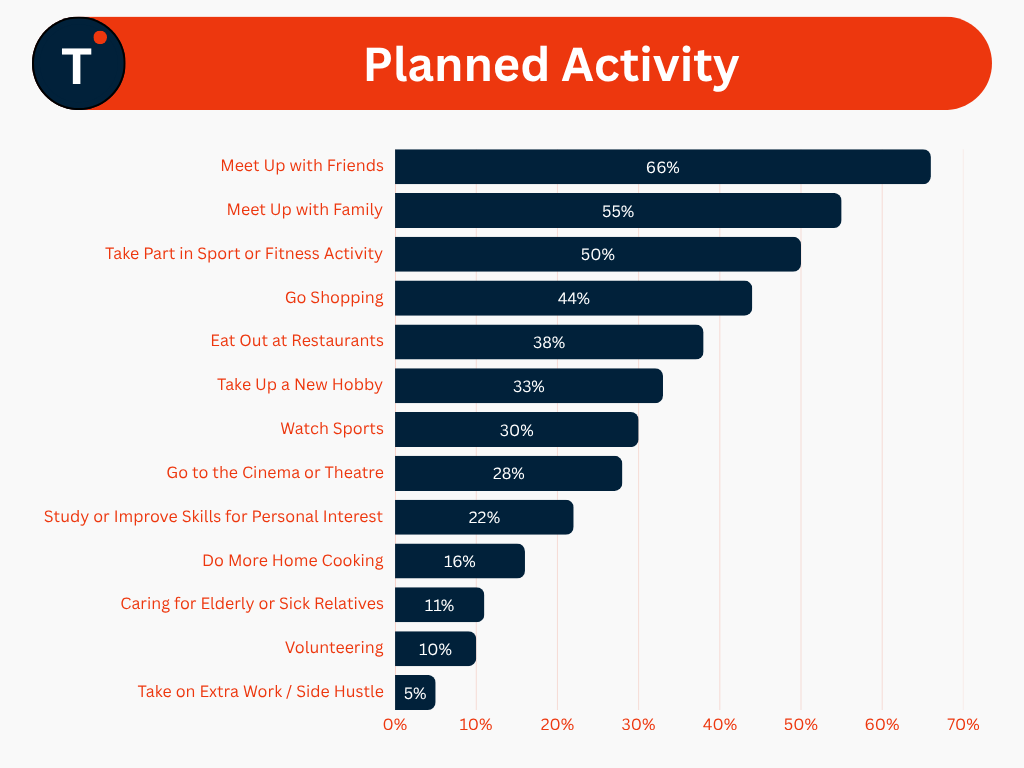
- 66% plan to meet up with friends, making it the most preferred activity.
- 55% plan to spend time with family.
- 50% plan to participate in sports or fitness activities.
- 44% plan to go shopping.
- 38% plan to eat out at restaurants.
- 33% plan to take up a new hobby.
- 30% plan to watch sports.
- 28% plan to go to the cinema or theatre.
- 22% plan to study or improve skills for personal interest.
- 16% plan to do more home cooking.
- 11% plan to care for elderly or sick relatives.
- 10% plan to engage in volunteering.
- 5% plan to take on extra work or a side hustle.
Adoption and Feasibility of the Four-Day Workweek
- Germany’s metal and electrical industries have provisions supporting the adoption of four-day workweek arrangements.
- 64% of business leaders expect the four-day workweek to become the standard within the next decade.
- 44% of HR professionals question the feasibility of implementing a four-day workweek within their respective industries.
- 46% of HR professionals consider employee schedule coordination a key implementation challenge.
- Only 45% of senior leaders aged 55–64 are considering or have already implemented a four-day workweek.
- 75% of businesses without a four-day workweek cite the need for continuous customer availability as the primary barrier to adoption.
- 28% of workers in Poland favor a four-day workweek.
- 54% of workers in Ireland and Germany prefer a shorter workweek over a higher salary, highlighting the growing value placed on additional time off.
Perceived Feasibility of the Four-Day Workweek Across UK Industries
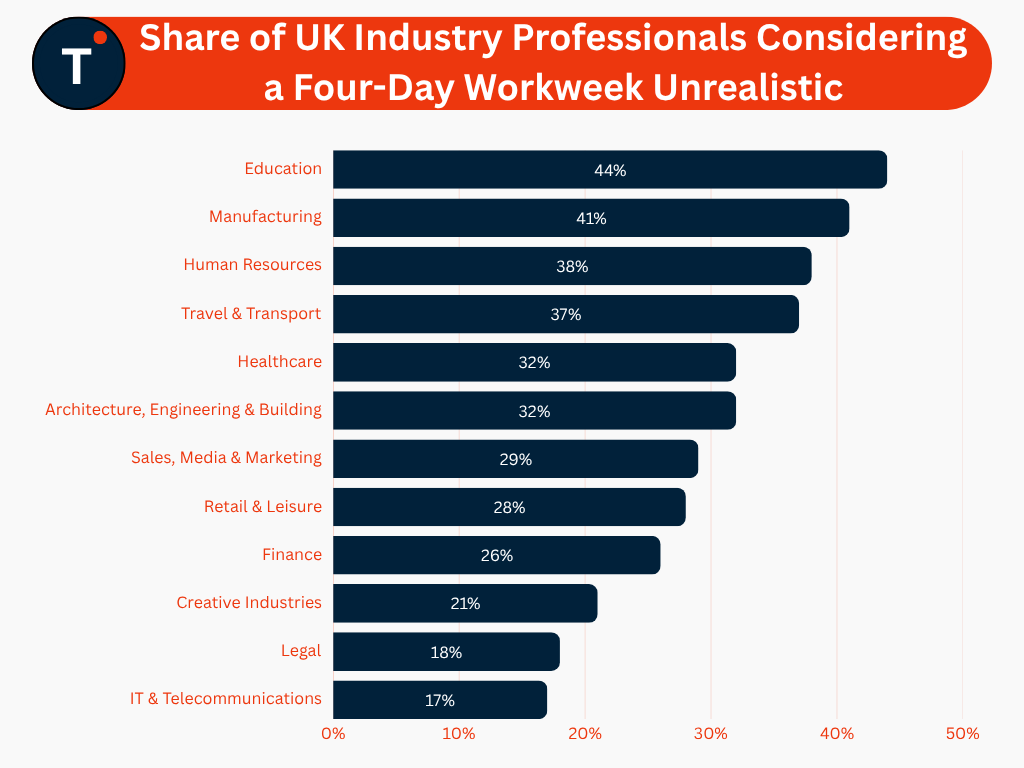
- 44% of professionals in the education sector consider a four-day workweek unrealistic, representing the highest share among the industries shown.
- 41% in manufacturing view the four-day workweek as unrealistic.
- 38% in human resources and 37% in travel and transport share similar concerns regarding feasibility.
- 32% in both healthcare and architecture, engineering, and building consider the model unrealistic.
- 29% in sales, media, and marketing hold this view, followed by 28% in retail and leisure.
- 26% of finance professionals consider a four-day workweek unrealistic.
- 21% in the creative industries and 18% in legal express concerns over feasibility.
- 17% in IT and telecommunications record the lowest share considering the four-day workweek unrealistic.
Challenges and Concerns Affecting Four-Day Workweek Adoption
- 62% of businesses view potential salary reductions as a key concern associated with implementing a four-day workweek.
- 40% of employees are concerned that shorter schedules could result in heavier workloads.
- Companies adopting a four-day workweek record a 19% decline in remote-work requests.
- 46% of employees are concerned that a four-day schedule could negatively affect sales performance.
- 75% of businesses without a four-day workweek cite the need for continuous customer availability as the primary barrier to adoption.
Conclusion
- The four-day workweek is gaining traction as a flexible work model, supported by strong employee interest and increasing organizational adoption.
- Evidence from workplace trials indicates potential benefits across productivity, profitability, employee retention, well-being, and operating costs.
- Higher pay, improved work-life balance, flexible scheduling, and additional time off remain key factors strengthening employee preference for shorter workweeks.
- AI adoption can further support the transition by automating routine tasks, improving productivity, and creating capacity for shorter working schedules.
- Environmental benefits, including reduced commuting and workplace energy consumption, add another potential advantage to the model.
Add TriCityLocalNews as a Preferred Source on Google for instant updates!