

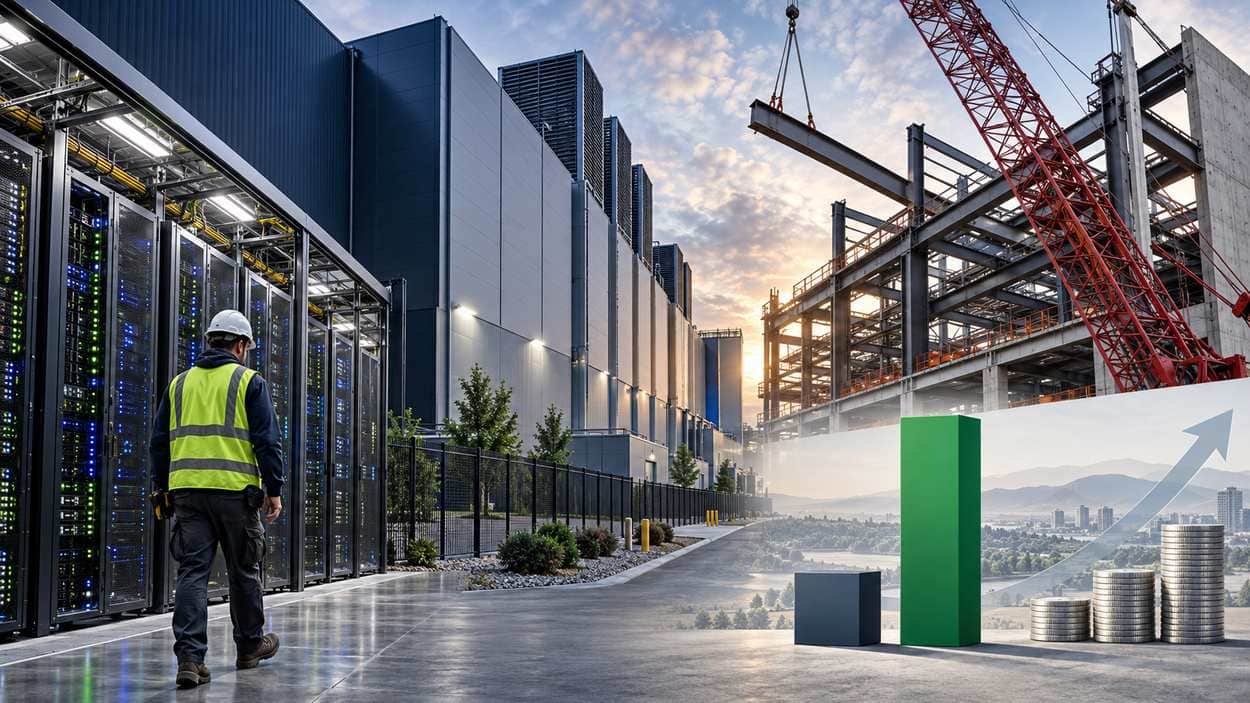


A typical 250,000-square-foot data center may have approximately 50 full-time workers, about half of which are contract workers, according to Virginia’s Joint Legislative Audit and Review Commission (JLARC). At the height of construction, approximately 1,500 workers are on site, data center representatives indicated.
Industry-wide, a PwC study for the Data Center Coalition says the US data center industry directly employed 1,005,080 people in 2024, and its total annual employment contribution reached 5.5 million jobs. The two figures measure different things: one building’s workforce, about half of it contract workers, and an industry total built with multipliers that spans everything up to the largest data centers in the US.
Key Takeaways
- Figures data center representatives gave JLARC put about 30 construction workers on site at peak for every full-time worker at a typical building.
- Employment in computing infrastructure providers, data processing, web hosting, and related services was 453,800 in September 2026 (preliminary), down from 489,200 in August 2023.
- Meta says its 1 gigawatt El Paso campus will support 300 operational jobs once complete.
- Brookings researchers estimate roughly 100-200 jobs at a typical treated county, depending on facility type.
- In PwC’s latest study, each direct job in the data center industry supports more than 4.5 jobs elsewhere; its earlier study said more than six.
- Good Jobs First says taxpayer costs routinely exceed $1 million per permanent job.
Editor’s Choice
- Direct industry jobs: 1,005,080 people directly employed by the US data center industry in 2024, per PwC for the Data Center Coalition.
- Total jobs supported: 5.5 million jobs, alongside $926.9 billion in GDP in 2024.
- Tax contributions: $204.4 billion to federal, state, and local governments.
- Peak construction at Richland Parish: 7,500+ skilled trade workers on-site at peak construction in Louisiana, per Meta.
- States not publishing losses in a timely way: 14 of the 37 states with sales and use tax exemptions for data centers.
- Projected hosting job growth: 19.5%, or 95,400 jobs, for computing infrastructure providers, data processing, web hosting, and related services.
How Many Jobs Do Data Centers Create
- Construction of an individual data center building usually takes about 12 to 18 months.
- The data center industry is estimated to contribute 74,000 jobs, $5.5 billion in labor income and $9.1 billion in GDP to Virginia’s economy annually, JLARC found.
- Most of those economic benefits derive from the construction phase rather than data centers’ ongoing operations.
- Critics, as summarized by Brookings researchers, note that large data center projects often promise only dozens to a few hundred permanent workers while the associated construction jobs are temporary.
- Estimates for a typical treated county range from roughly 100-200 jobs, depending on facility type.
- Capacity and spending totals for the same facilities sit in the wider data center capacity and capex figures.
| Count | What it measures | Figure | Source |
|---|---|---|---|
| Typical building staff | Full-time workers at a 250,000-square-foot data center, about half contract | approximately 50 | JLARC |
| Peak construction crew | Workers on site at the height of construction | approximately 1,500 | JLARC |
| Typical county gain | Jobs at a typical county receiving a first large data center | roughly 100-200 | Brookings |
| Federal industry count | All employees, NAICS 518, September 2026 (preliminary) | 453,800 | BLS |
| Industry direct jobs | People directly employed by the US data center industry, 2024 | 1,005,080 | PwC for the Data Center Coalition |
| Industry total jobs | Total annual employment contribution, 2024 | 5.5 million | PwC for the Data Center Coalition |
| Single campus pledge | Operational jobs at Meta’s El Paso campus once complete | 300 | Meta |
Source: JLARC, Brookings Institution, US Bureau of Labor Statistics, PwC for the Data Center Coalition, Meta, 2024 to 2026
About This Data
- Compiled from 23 sources: 5 federal and state statistics and audits, 7 company announcements, 10 industry, research and advocacy reports, and 1 news commentary.
- Sources date from July 2023 to October 2026.
- Government, company and independent research data came first; paid market-research reports were excluded.
- Figures are reviewed on a rolling basis and updated when sources publish new editions.

How many people work in a data center?
A typical 250,000-square-foot data center may have approximately 50 full-time workers, and approximately 1,500 workers are on site at the height of construction, JLARC reported. Industry-wide, PwC’s study for the Data Center Coalition counts 1,005,080 direct jobs in 2024 and a total employment contribution of 5.5 million jobs.
Data Center Industry Employment by Year
- BLS counted 453,800 employees in computing infrastructure providers, data processing, web hosting, and related services in September 2026, a preliminary figure, against 455,400 in August 2026.
- Employment is now about 7.2% below its August 2023 level of 489,200.
- The series stood at 308,300 in September 2016.
- Employment rose from 420,400 in September 2021 to 479,100 in September 2022.
- The figures are seasonally adjusted, and August and September 2026 are marked preliminary.
View the data
Worth noting: The BLS series covers computing infrastructure providers, data processing, web hosting, and related services, a category wider than data center staff alone. It has drifted lower while construction hiring climbed. Nonresidential construction employment increased by 16,100 positions in September 2026, according to Associated Builders and Contractors.
Recent Developments
- October 2, 2026: The construction industry added 11,000 jobs on net in September 2026, and industry employment is up 109,000 jobs, or 1.3%, year over year, ABC said. ABC Chief Economist Anirban Basu tied the gains to the data center boom supporting rapid hiring of certain specialty trade contractors.
- September 15, 2026: Roughly 1 in 6 ABC members is currently under contract to work on a data center, the highest proportion on record, and contractors with data center work reported 9.9 months of backlog against 8.3 months for those without.
- August 18, 2026: Amazon raised its Louisiana data center investment plan from $12 billion to $18 billion, with three planned campuses expected to create up to 750 full-time data center jobs and support 2,500 additional positions.
- August 10, 2026: Brookings researchers updated their data center employment brief to reflect new results as the research continues with an expanded sample.
- July 28, 2026: Meta said over 2,300 workers are already onsite at its El Paso campus, which expects to begin bringing capacity online in 2028.
- July 28, 2026: In Uptime Institute’s 2026 global survey, more than half of all respondents report difficulties finding qualified candidates for open positions, based on responses from more than 800 data center owners and operators.
Construction Jobs vs Permanent Jobs at Data Centers
- At the height of construction, approximately 1,500 workers are on site from various construction-related industries, about 30 for each full-time worker at a typical building.
- Georgia’s tax evaluation attributes 8,505 construction jobs and 1,641 operations jobs to the state’s tax exemption, about 5.2 construction jobs per operations job.
- Meta’s El Paso campus is supporting more than 4,000 construction jobs at peak and 300 operational jobs once complete.
- On its Richland Parish project page, Meta says each data center building requires thousands of skilled trade labor jobs to construct, while JLARC’s peak count describes a typical 250,000-square-foot building.
| Project or scope | Construction jobs or peak workers | Permanent or operations jobs | Source |
|---|---|---|---|
| Typical 250,000-square-foot building | approximately 1,500 | approximately 50 | JLARC |
| Meta Richland Parish, Louisiana | 7,500+ | 1,000 | Meta |
| Meta El Paso, Texas | more than 4,000 | 300 | Meta |
| Georgia, jobs attributed to the exemption (statewide) | 8,505 | 1,641 | Georgia Department of Audits and Accounts |
Source: JLARC, Meta, Georgia Department of Audits and Accounts, 2024 to 2026
Nonresidential Construction Hiring, September 2026
- Nonresidential specialty trade added the most jobs in September 2026, growing by 12,300 positions.
- The construction unemployment rate was 3.5% in September 2026.
- The residential segment has shed 1.0% of its employment base over the past year, Basu said.
View the data
Specialty trade hiring of this kind follows data center construction spending rather than the size of any operating staff.
Do data centers create permanent jobs?
A typical 250,000-square-foot data center may have approximately 50 full-time workers, about half of which are contract workers, JLARC reported. Georgia’s evaluation attributes 1,641 operations jobs to its exemption, against 8,505 construction jobs. Construction jobs end when a building is finished.
Data Center Jobs per Gigawatt and per Dollar Invested
- Meta’s El Paso campus will have 1 gigawatt of compute capacity and represents an investment of over $10 billion, so its operational jobs work out to fewer than 30 per $1 billion invested.
- The Richland Parish Data Center will deliver over two gigawatts of compute capacity, so its announced operational jobs work out to fewer than 500 per gigawatt. The data center energy consumption figures show what that much capacity draws from the grid.
- Amazon plans to invest at least $20 billion in Pennsylvania to expand its data center infrastructure, creating 1,250 new high-skilled jobs.
- Amazon’s $10 billion North Carolina plan works out to 50 new jobs per $1 billion.
- Amazon says its Warren County campus is estimated to create at least 200 new jobs at the Amazon data center campus.
- Amazon has invested over $156 billion in US data center infrastructure since 2011, supporting more than 37,000 jobs annually.
- Meta says the El Paso campus will play an essential role in bringing its AI technologies to life. The same per-gigawatt arithmetic applies to other AI data center campuses.
View the data
By the numbers: Meta’s El Paso campus pairs 1 gigawatt of compute capacity with 300 operational jobs. Amazon’s North Carolina plan puts $10 billion behind 500 new high-skilled jobs, about $20 million of planned investment per announced job. That ratio is why per-job subsidy math runs high.
Data Center Economic Impact: Industry Estimates
- The Data Center Coalition engaged independent consultant PwC to quantify the economic contributions of the US data center industry between 2023 and 2024. Because an industry group commissioned the work, its totals read as the industry’s own estimate.
- Total annual employment contribution reached 5.5 million jobs in 2024, a 17% increase on 2023.
- Total annual contribution to US GDP grew from $768 billion in 2023 to $927 billion in 2024, a 21% increase.
- Total fiscal support to federal, state, and local governments increased from $165 billion in 2023 to $204 billion in 2024, a 24% increase, and amounted to $369 billion over the two years.
- From 2017 to 2023, direct employment in the US data center industry grew by over 50%, compared to 10% growth in employment for the United States overall.
- Total annual employment contribution rose 60% from 2017 to 2023, in PwC’s earlier study.
View the data
Facility-level counts, such as the hyperscale data center figures, are a separate measure from these industry totals.
Why Industry and Critic Job Counts Differ
- PwC says the US data center industry directly employed 1,005,080 people in 2024, while the BLS count for computing infrastructure, data processing and web hosting was 481,300 in August 2024.
- Neither figure corrects the other: PwC applies its own definition of the data center industry, while BLS counts employees of one industry code.
- PwC’s earlier study put the industry’s 2023 contribution to US GDP at $727 billion; the latest puts 2023 at $768 billion.
- Brookings researchers say a naive comparison of treated and control counties, as some industry-sponsored reports have done, would overstate the impact on jobs, because data center counties were growing faster before the facilities arrived.
- An independent researcher writing in Cardinal News notes that to claim Virginia’s sales tax exemption a data center must invest $150 million and create 50 jobs at 150% of the local average wage, with lower thresholds in distressed localities. Fifty is also the per-building figure several data center representatives gave JLARC.
| Measure | PwC earlier study (2017 to 2023) | PwC latest study (2023 to 2024) |
|---|---|---|
| 2023 contribution to US GDP | $727 billion | $768 billion |
| 2023 fiscal support to governments | $162.7 billion | $165 billion |
| Jobs supported elsewhere per direct job | more than six | more than 4.5 |
Source: PwC for the Data Center Coalition, 2025 and 2026 studies
Key finding: Brookings researchers assembled a dataset of approximately 1,500 US data center facilities along with 52 announced-but-canceled projects, and compare labor markets with built facilities to labor markets with announced-but-canceled facilities. That design separates what a data center adds from growth a county was already on track for.
Local Employment Effects of Data Centers
- Labor markets that receive their first large data center see employment rise in the data processing sector by 56% over the first decade of operations.
- Telecommunications, a key sector in data center operations, jumps 43%, while wages were unchanged and home prices rose a modest 2% to 5%.
- At a typical treated county, these estimates imply roughly 100-200 jobs, depending on facility type.
- The estimates link facilities to county-level employment and wage data from the Bureau of Labor Statistics for 2003-2024.
- The telecommunications ecosystem effects are concentrated in hyperscale investment, while colocation facilities generate construction activity and modest operational employment.
- Location decisions for hyperscale facilities are driven by power availability, land, and fiber infrastructure, not by tax breaks.
- In hyperscale counties, incentives represent about 2% of total construction investment, against 62% in colocation counties.
Do data centers bring jobs to local communities?
Yes, with caveats. Labor markets that receive their first large data center see data processing employment rise 56% over the first decade, and the estimates imply roughly 100-200 jobs at a typical treated county, Brookings researchers found. Wages were unchanged, and home prices rose a modest 2% to 5%.
Data Center Tax Breaks: Cost per Job
- An earlier 2016 report profiled 11 subsidized data centers and found total support averaging $1.95 million per job, Good Jobs First says.
- Subsidized companies have invested upwards of $5.4 billion in Illinois server farms, and state and local governments have spent roughly $1.4 million per new data center job.
- Of Illinois’s grants, $91.5 million has gone to Microsoft for three data centers in the Chicago suburbs.
- Data center companies routinely stack subsidies, collecting sales tax exemptions, property tax abatements, and income tax credits simultaneously.
- Georgia’s evaluation determined that 30% of data centers in Georgia could be attributed to the tax exemption, so 70% would exist in its absence. That attribution share drives every per-job figure for Georgia’s data center tax exemption.
| Case | Subsidy | Jobs | Cost per job | Source |
|---|---|---|---|---|
| Columbus, Ohio property tax abatement (2021) | $54.3 million | 20 | $2.7 million | Good Jobs First |
| Illinois data center program (since mid-2019) | $468 million | 339 | roughly $1.4 million | Good Jobs First |
| Georgia sales and use tax exemption (FY 2025) | $474.2 million forgone | 8,505 construction, 1,641 operations | $42,646 | Georgia Department of Audits and Accounts |
Source: Good Jobs First (2023), Georgia Department of Audits and Accounts (2025)
Why it matters: Good Jobs First says all of these subsidies favor capital investment, not job creation, such that taxpayer costs routinely exceed $1 million per permanent job. For a county weighing an abatement, the operating headcount is the job count that lasts.
How much do data center tax breaks cost per job?
Good Jobs First reports that state and local governments have collectively spent roughly $1.4 million per new data center job in Illinois, and a 2021 Columbus abatement equaled $2.7 million for each of the center’s 20 jobs. Georgia’s evaluation uses a different method and reports a far lower figure.
State Revenue Lost to Data Center Tax Exemptions
- 14 of the 37 states with sales and use tax exemptions for data centers do not publish their official revenue losses in a timely way, Good Jobs First found.
- An earlier Good Jobs First count, from April 2025, found that of the 32 states with tax incentives to data centers, 12 fail to disclose even aggregate revenue losses.
- At least 10 states already lose more than $100 million per year in tax revenue to data centers.
- Texas revised its FY 2025 cost projection from $130 million to $1 billion in the space of just 23 months, and now projects $1.3 billion for FY 2026. That revision shows how quickly Texas data center incentives outran early estimates.
- Brookings researchers cite an estimated $1.6 billion cost for Virginia’s data-center sales-tax exemption in fiscal year 2025. The higher figure in the table below adds local government losses, and the Virginia data center tax exemption figures set out each estimate.
- In just two years, more than 83% of Indiana’s data center sales and use tax exemption went to Amazon.com.
- Wisconsin’s Legislative Fiscal Bureau projected that if four data center projects are built as planned, the state will lose $1.5 billion during construction and $269 million annually going forward.
| State | Figure | Period | What it is |
|---|---|---|---|
| Georgia | $2.5 billion | FY 2026 | Cost projection, raised 664% in January 2026 |
| Virginia | $1.94 billion | FY 2025 | State and local cost of the sales and use tax break |
| Ohio | $1.6 billion | 2025 | State loss, excluding local sales tax shares |
| Texas | $1.3 billion | FY 2026 | Projected loss |
| Indiana | $655 million | As of 2025 | Reported loss to the sales and use tax exemption |
| Oregon | $616 million | 2016 to 2025 | Property tax abatements for Amazon, Apple, Alphabet and Meta data centers |
Source: Good Jobs First, June 2026
The rows cover different years, taxes and bases, so they are never added together. Yearly detail on the Ohio data center tax break shows how fast one state’s figure moved.
Data Center Job Growth Outlook
- BLS projects employment in computing infrastructure providers, data processing, web hosting, and related services to grow 19.5%, or 95,400 jobs, from 2023 to 2033.
- Software publishers are projected to grow 20.4%.
- The hosting industry’s projected rate is about 4.6 times the rate projected for total wage and salary employment.
- The monthly BLS series has moved the other way since August 2023, so the projection and the recent count do not yet line up.
View the data
Data Center Occupations and Wages
- In 2025, the industry code employed 24,940 computer support specialists, BLS industry data show.
- Amazon says opportunities at its Warren County campus include data center engineers, network specialists, operations managers, and security specialists.
- Meta says construction trades on its Louisiana project include steel workers, pipefitters, electricians, carpenters and fiber technicians.
- JLARC found that data center jobs tend to be high paying.
View the data
- Average hourly earnings of all employees in the industry code were $60.78 in August 2026, a preliminary figure, up from $59.88 in May 2026.
View the data
What jobs are there in a data center?
Operations jobs center on electrical, mechanical and IT work. Meta says once operational, the Richland Parish data center will support 1,000 operational jobs: electricians, HVAC specialists, server and network techs and engineers. BLS counts 14,540 computer systems analysts and 2,630 computer programmers in the same industry code.
Conclusion
A typical 250,000-square-foot data center may have approximately 50 full-time workers, about half of which are contract workers, while PwC’s study for the Data Center Coalition credits the industry with 5.5 million jobs in total. The first is one building’s workforce, contractors included; the second adds jobs elsewhere through a multiplier that changed between editions.
For a county weighing an incentive, the lasting figure is the operating headcount. The next readings to watch are the monthly BLS series and the cost figures states have yet to publish.